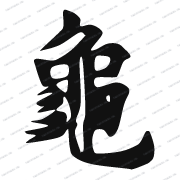
龟 (guī) — Tortoise
Single-character Chinese tattoo · verified meaning · symbolic & traditional-friendly
Browse all 龟 glyphs ↗Meaning & Nuance
龟 (guī) is the Chinese character for tortoise/turtle. Far from the Western “slow” joke, in Chinese culture the tortoise is one of the Four Celestial Animals and a revered symbol of longevity, stability, and endurance — it bears the weight of the world in myth. 龟 also sounds like 贵 (guì, “precious”). Note the simplified 龟 differs greatly from traditional 龜. It is distinct from 鳖 (biē, soft-shell turtle).
Pronunciation & Form
Pinyin: guī — a first-tone (high, level) syllable, held steady and bright. The simplified character is a condensed form; traditional 龜 is far more elaborate.
Common Words & Phrases
Why Get 龟 as a Tattoo
龟 is a quiet emblem of endurance and a long, stable life — the creature that outlasts everything. As a tattoo it suits someone who values persistence over speed, reading clearly as “tortoise” to Chinese readers. It is a meaningful counterpoint to flashier animal tattoos: a wish to endure. Pair it with 鹤 (crane) or 山 (mountain) for a longevity-and-stability theme.
Tattoo Style & Placement
Best fits: traditional, fine-line, or symbolic styles. 龟 is compact, working well as a small-to-medium piece on the forearm, wrist, or ankle. A shell pattern or wave accent suits it. Font note: a clean outline keeps its rounded form; keep it at least ~3–4 cm tall so the strokes stay legible.
Authenticity & Cultural Note
Always confirm the character with a native speaker or linguist before inking. The simplified 龟 and traditional 龜 look very different, and 龟 is distinct from 鳖 (soft-shell turtle). handmade.ink meanings are checked by native Chinese linguists so your ink says exactly what you intend.
Frequently Asked Questions
What does the Chinese character 龟 mean?
How do you pronounce 龟?
Is 龟 a good tattoo for longevity?
What is the difference between simplified 龟 and traditional 龜?
What words use the character 龟?