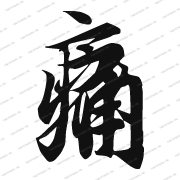
痛 (tòng) — Pain
Single-character Chinese tattoo · verified meaning · raw & cathartic
Browse all 痛 glyphs ↗Meaning & Nuance
痛 (tòng) means “pain,” both physical and emotional, and “to ache deeply.” It carries the 疒 (sickness / illness) radical and pairs with 苦 in 痛苦 (suffering). Emotionally it reaches toward 痛心 (heartbroken) and 悲痛 (grief). It is more acute than 苦 (kǔ, hardship) and more bodily than 伤 (shāng, wound); 痛 is the felt sting. People sometimes choose it to honor surviving pain.
Pronunciation & Form
Pinyin: tòng — a fourth tone, a falling pitch that drops sharply, like a wince or a sharp intake. The tone matches the word's sting.
Common Words & Phrases
Why Get 痛 as a Tattoo
痛 is an unflinching tattoo about pain survived—grief, loss, illness, or addiction recovery. It is honest rather than decorative, and that rawness is exactly its power. The character is strong and clear, holding up at any size, and reads unambiguously as “pain” to Chinese readers. People wear 痛 to acknowledge what they lived through and came out the other side of. It is a bold, cathartic statement.
Tattoo Style & Placement
Best fits: bold line, blackwork, or heavy script. 痛 has the 疒 illness radical on the left, so it reads best at medium-to-large size. Placements: forearm, upper arm, rib, or back. A solid 痛 over the heart or on the forearm makes a personal mark; pair with 苦 themes if telling a fuller story. Keep the left radical distinct so the character isn't misread.
Authenticity & Cultural Note
Always confirm the character with a native speaker or linguist before inking. 痛 (tòng, pain), 疼 (téng, ache), and 苦 (kǔ, suffering) are close in meaning; handmade.ink verifies 痛 as the acute “pain” character so your tattoo says exactly that.
Frequently Asked Questions
What does the Chinese character 痛 mean?
How do you pronounce 痛?
Is 痛 a good tattoo about surviving pain?
What words use the character 痛?
How is 痛 different from 苦?
Does 痛 have a positive side?