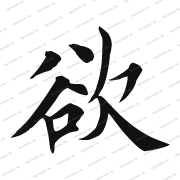
欲 (yù) — Desire
Single-character Chinese tattoo · verified meaning · bold & expressive friendly
Browse all 欲 glyphs ↗Meaning & Nuance
欲 (yù) means “desire” — craving, longing, and want in its many forms. In Chinese thought it sits close to the Buddhist idea of craving as a source of suffering, yet in everyday speech it simply names the wants that move us: hunger, appetite, ambition. It differs from 愿 (yuàn, a wish or vow), which carries a hopeful, almost pious tone, whereas 欲 is raw wanting.
Pronunciation & Form
Pinyin: yù — a fourth-tone (sharp, falling) syllable. The tone drops decisively, like a quick downward stroke, giving the word a firm, closing feel.
Common Words & Phrases
Why Get 欲 as a Tattoo
欲 captures the honest truth that wanting is what makes us alive — a bold, slightly dangerous single character for someone who owns their appetites. As a tattoo it reads as confidence rather than caution, a statement that desire is not something to hide. It is compact and visually striking, so it stays legible even at a small size, and it pairs naturally with other statement characters like 爱 (love) or 梦 (dream). People choose 欲 to mark a turning point of self-acceptance or a reclaiming of ambition.
Tattoo Style & Placement
Best fits: bold script, brush calligraphy, or a solid blackwork block. 欲 has a grounded base that anchors well on flat areas. Placements: forearm, upper arm, rib, shoulder blade, or calf. A vertical 欲 on the forearm in a strong brush style makes a confident, editorial piece. Size warning: keep the character at least ~4 mm tall per stroke group so it stays readable as skin ages.
Authenticity & Cultural Note
Always confirm the character with a native speaker or linguist before inking. 欲 can read as craving or lust depending on context, so pairing and placement matter — a verified 欲 from handmade.ink is checked by native Chinese linguists so your ink says exactly what you intend.
Frequently Asked Questions
What does the Chinese character 欲 mean?
How do you pronounce 欲?
Is 欲 a good tattoo meaning?
What words use the character 欲?
What is the difference between 欲 and 愿?