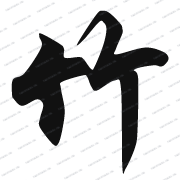
竹 (zhú) — Bamboo
Single-character Chinese tattoo · verified meaning · fine-line & minimalist friendly
Browse all 竹 glyphs ↗Meaning & Nuance
竹 (zhú) means “bamboo” — resilience, humility, and integrity. In Chinese culture bamboo bends but does not break, and it is one of the “four gentlemen” (四君子) of scholar painting alongside plum, orchid, and chrysanthemum. As a tattoo it reads as flexible strength. It is its own radical (the bamboo top 竹字头). Not to be confused with 木 (mù, tree) or 林 (lín, forest).
Pronunciation & Form
Pinyin: zhú — a second tone (rising) syllable, gliding upward. 竹 is its own radical, drawn as two pairs of leaves on top (the bamboo-head shape).
Common Words & Phrases
Why Get 竹 as a Tattoo
竹 represents resilience and humility — a refined single-character tattoo for those who value integrity. Its clean, segmented form stays legible small. People choose 竹 to mark bending without breaking, scholarly calm, or a bond with nature. It reads clearly as “bamboo” and carries quiet, respected meaning.
Tattoo Style & Placement
Best fits: fine-line, brush, or minimalist with node accents. 竹 works as a small vertical mark. Placements: forearm, rib, calf, or upper arm. Pairs with 梅, 兰 (orchid), or 山. Keep the two leaf-pairs balanced.
Authenticity & Cultural Note
Always confirm the character with a native speaker or linguist before inking. 竹 (zhú, bamboo) belongs to the “four gentlemen” plants and can be confused with 木 (tree) or 林 (forest); verify the exact glyph. handmade.ink meanings are checked by native Chinese linguists.
Frequently Asked Questions
What does the Chinese character 竹 mean?
How do you pronounce 竹?
Is 竹 a good tattoo for resilience?
What words use the character 竹?
What are the “four gentlemen” in Chinese art?
What is the structure of 竹?