
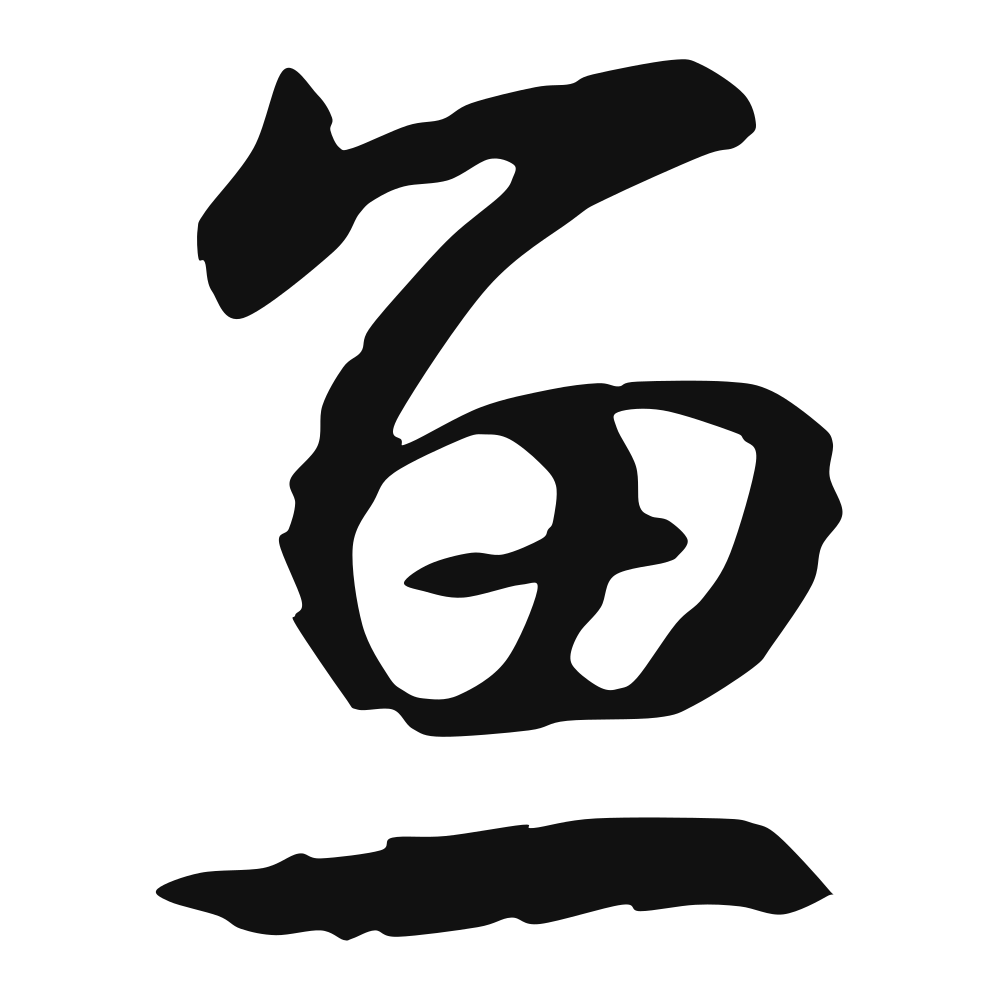
鱼
surname Yu; fish (CL:條|条[tiao2],尾[wei3])
Closest English meanings
fish·finfish·pisces
The Calligrapher — Wáng Xīzhī 王羲之
The 'Sage of Calligraphy'; his running script has set the standard for 1,700 years.
Eastern Jin calligrapher (303–361), master of running script/cursive script/regular script — the Sage of Calligraphy; his Orchid Pavilion Preface is the most celebrated work in the tradition, and nearly every later master traces lineage to his hand. Eastern Jin dynasty
Cultural Story
鱼 is a clean pictograph of a fish—head, eye, body, and forked tail drawn in bone and bronze. The 《説文解字》 calls it 水虫也, "a water creature," the ancestor of every fish word that follows.
Common words & phrases
- 钓鱼 fishing · angle · go fishing
- 金鱼 goldfish
- 鱼汤 fish soup
- 鱼肉 fish meat · flesh of fish
- 鲜鱼 fresh fish
- 鱼竿 fishing rod · fishing pole
Read the story behind the character
鱼 is fish, everywhere: children 钓鱼 with a 鱼竿, keep 金鱼 in bowls, and eat 鱼汤 and 鱼肉. Markets sell 鲜鱼 by the slab. From aquariums to feasts, the character swims through daily life, diet, and the weekend angler's quiet hobby.
Why this character belongs on skin
In Chinese, the word for fish sounds like the word for surplus — and so a room full of 鱼 paintings means a house that will never want for more. But the deeper image is older: a fish moving through water with no thought of moving, free because it has found its element. To ink this character is to wish yourself abundance, yes, but also to wish yourself that easier swimming — the life where you stop struggling against the current and discover the current was always carrying you. Zhuangzi's fish forgot the hook because it forgot the fear. Carry 鱼 and you carry a small, slippery luck, the kind that multiplies. Let there be more than enough. Let it flow. Let yourself be the creature who belongs entirely to the water.
Own this character
Purchase delivers the original SVG of this glyph, brushed by Wáng Xīzhī 王羲之, ready to place on skin, paper, or screen.