
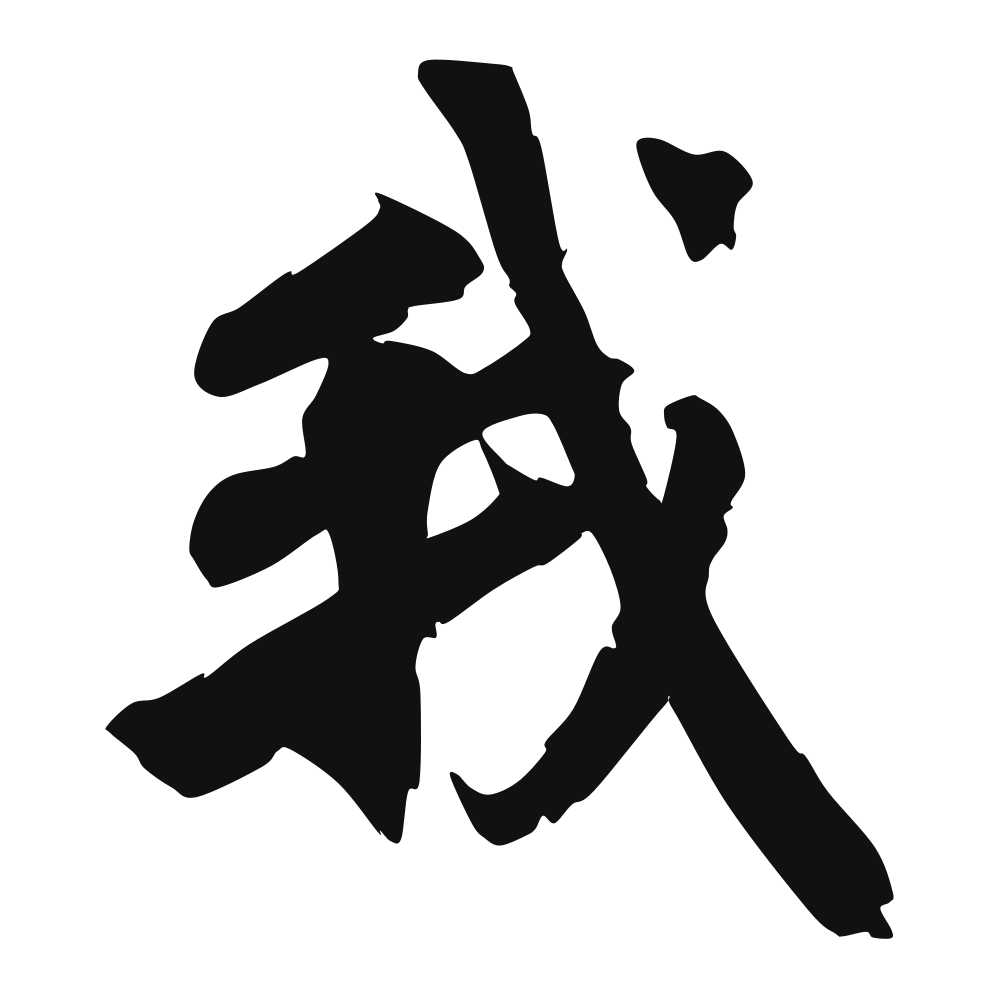
The Calligrapher — Chéng Miǎo 程邈
Qin official credited with systematizing clerical script (lishu), a pivotal step in Chinese writing.
Qin-Han calligrapher (生卒年不详(秦)), master of clerical script — known for 隶书(相传整理八分). Qin–Han era
Etymology & Meaning · 字义溯源
2 · The Character: 我 Wǒ (3rd tone). The Shuowen: 「我,施身自谓也。或说我,顷顿也。从戈从𠄒」 — the word one uses of oneself; an alternate reading is 'to tilt / fall'. Oracle-bone forms show 我 as a toothed long-handled weapon — the self was once a weapon held. Classical: 《易经·观卦》 「观我生」 (observe my life); 《孟子·尽心上》 「万物皆备于我」 (all things are complete in me); 《庄子》 「今者吾丧我」 (now I have lost the small self). Grading: 我 is the plain first-person 'I / self' and stands alone as selfhood (自我). Disclose the weapon origin (a Chinese reader won't see it, but it's honest colour) and that classical Chinese distinguished 吾 (subject) from 我 (object/emphatic). A clean standalone for 'self'.
Cultural Story
我 began as a weapon. On bronze inscriptions it is a halberd-like implement of state, a tool of force before it was a person. Somewhere in the early Zhou it slid from the thing held to the hand that holds it, and the first person was born from a blade. The self, etymologically, once cut.
Where a Western reader can stand: Where a Western reader can stand: 我 is the plain 'I' — the Latin ego, the Cartesian cogito — and its oracle form was a serrated halberd whose name was lent to the first person, so the pronoun carries a ghost of self-assertion. The 孟子's 萬物皆備於我 is the peak claim. Honest caveat: a 我 tattoo reads literally as 'ME' — powerful and iconic, but a Chinese reader sees a bare pronoun, not a virtue; pair it (真我, 無我) or own the ego-register on purpose. Cheng Miao's clerical hand gives it the authority of public record rather than private feeling — but disclose that his invention of clerical script is legend, with excavated slips showing it already in use and no authentic work surviving.
Common words & phrases
- 我们 we · us
- 自我 self · ego
- 我国 our country
- 忘我 selfless · forget self
- 我行我素 one's own way
Read the story behind the character
我 is the unavoidable word: 我们 the team, 自我 the brand of self-help, 忘我 the athlete's praise. 我国 is what the newsreader says, 我行我素 the slogan of the unbothered. It does the singular and the plural, the humble and the defiant, in the same two strokes.
Why this character belongs on skin
There is a moment, the first time you say it without flinching — "I." Not the name they gave you at birth, not the role they assigned, not the quiet translation of someone else's desire. Just 我, a character built like a hand closing around a weapon, a self that knows how to defend itself. You spent years translating yourself for rooms that never learned your language. But the day you stop — the day "I" becomes a sentence all its own — something in your chest unlocks. This is the first character any of us learns, and the last one they want us to keep. Ink it where your hand can find it. Let it be the small, defiant grammar of a life that finally belongs to you, claimed and unrepentant.
Own this character
Purchase delivers the original SVG of this glyph, brushed by Chéng Miǎo 程邈, ready to place on skin, paper, or screen.