
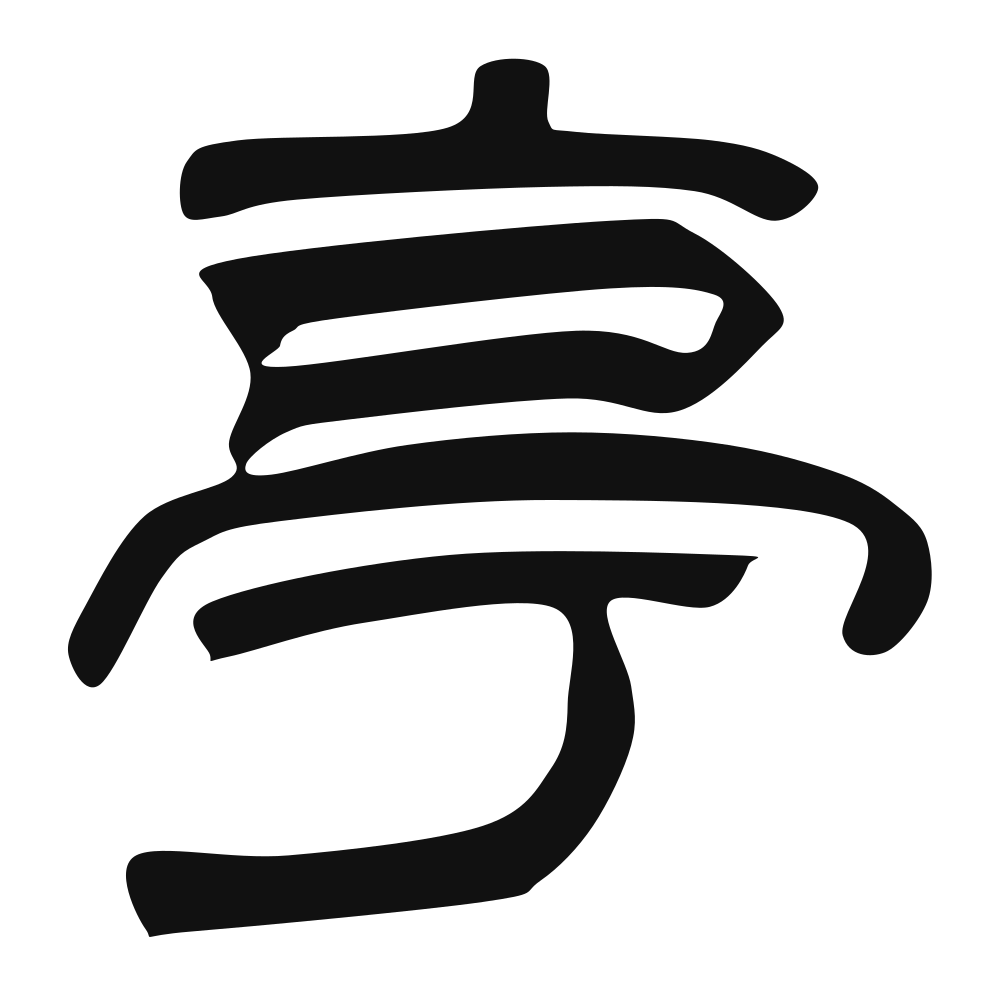
亭
亭 (tíng) — pavilion, kiosk. Roof 亠 + 丁: a wayside shelter. Classical life: 亭台楼阁 — pavilions and terraces; 亭 is the pause in a garden. Grammar: free morpheme — also: pavilion; booth; kiosk; erect
Closest English meanings
pavilion·kiosk·booth·shelter·stand
The Calligrapher — Wēng Fānggāng 翁方纲
Qing scholar-calligrapher of precise regular script.
Qing calligrapher (), master of regular script — known for 肌理说. Qing dynasty
Etymology & Meaning · 字义溯源
2 · The Character: 亭 亭 (tíng, 2nd tone) is, in Xu Shen, the place of settled rest: 民所安定也 — 'where the people find peace and stability.' The form (亭) rises from 高 (high) with 丁 (sound). It is the roadside pavilion, the watch-post, the halt. The classics give it stillness and uprightness: the Shiming '亭,停也。道路所舍,人停集也' (a亭 is a stop, a roadside lodging where travellers gather); the Daodejing '亭之毒之' (it perfects and nourishes); the Shiji (封禅书) '黃帝封泰山,禪亭亭' (the mount of 亭亭); Sun Chuo's '羲和亭午' (the sun at its noon halt). As a free morpheme 亭 means 'pavilion, upright, to halt,' positive in 亭亭玉立, 长亭. Honest disclosure: 亭 is a pretty, balanced character (the pavilion) and reads well on skin; pair it with 午 (亭午 = noon) or leave it as the standalone 'pavilion of rest.' In Japanese it is tei. The Wuxing attribution is confident: 亭 is Fire (火), the noon sun at its halt.
Cultural Story
亭 was the roadside post where travelers rested and the magistrate's sub-station where minor suits were heard, a roof on pillars, open to the breeze. The 說文 reads it as to stop, to lodge. 蘭亭 is where Wang Xizhi wrote his famous preface by the water. 亭亭 is the girl standing straight as a pillar. The character is the pause built into the landscape.
Where a Western reader can stand: Weng Fanggang was a Qing scholar-epigrapher and regular-script master, a leader of the Epigraphic (Stele) School who joined rigorous textual scholarship with precise, classical regular script in the Ouyang Xun–Yan Zhenqing lineage. 亭 is the pavilion of settled rest; in his epigraphic regular it reads like a carved inscription — a quiet, learned monument to halting and breathing. For the client it is the scholar's pavilion: composed, disciplined, timeless, the sort of char you hang in a study rather than flash on a stage.
Energy Reading
Earth (土)
Comparative symbology, not fortune-telling.
Common words & phrases
- 亭子 pavilion · kiosk · pavilion building
- 凉亭 pavilion · summerhouse · gazebo
- 亭台 pavilions and terraces · pavilions · pavilions and terraces
- 亭亭 upright · graceful (of a girl) · slim and elegant
- 报亭 newsstand · kiosk · news kiosk
- 邮亭 postal kiosk · mail kiosk · post pavilion
Read the story behind the character
亭子 and 凉亭 are the park shelter and the garden photo; 亭台 the classical vignette on a postcard. 亭亭 is the compliment for a slim bride. 报亭 is the vanishing newsstand; 邮亭 the postal kiosk now rarely staffed. The character names any small roof on legs, the pavilion, the booth, the stand. It is the architecture of the pause, the place to stop, sheltered, before the road continues.
Why this character belongs on skin
Halfway up the mountain there is a place to stop, a roof with no walls, open to the rain and the view alike. This is the pavilion where the traveller sets down his load, and the poem is finished in the resting. The Daoist builds nothing to enclose—only a frame for the wind, a bench for the sunset you did not know you needed. To pause is its own discipline; we rush past the very things meant to save us. A pavilion on the skin is a promise to stop, to let the day arrive without hurrying it onward. It is the tattoo of one who has learned the holiness of the interval—between tasks, between lovers, between the breath going out and the breath coming in. Let it mark you as a shelter others can find, a person who stands still long enough to be a rest for someone tired. Wear it where the shoulder meets the neck, the place a weary head might lean.
Own this character
Purchase delivers the original SVG of this glyph, brushed by Wēng Fānggāng 翁方纲, ready to place on skin, paper, or screen.