
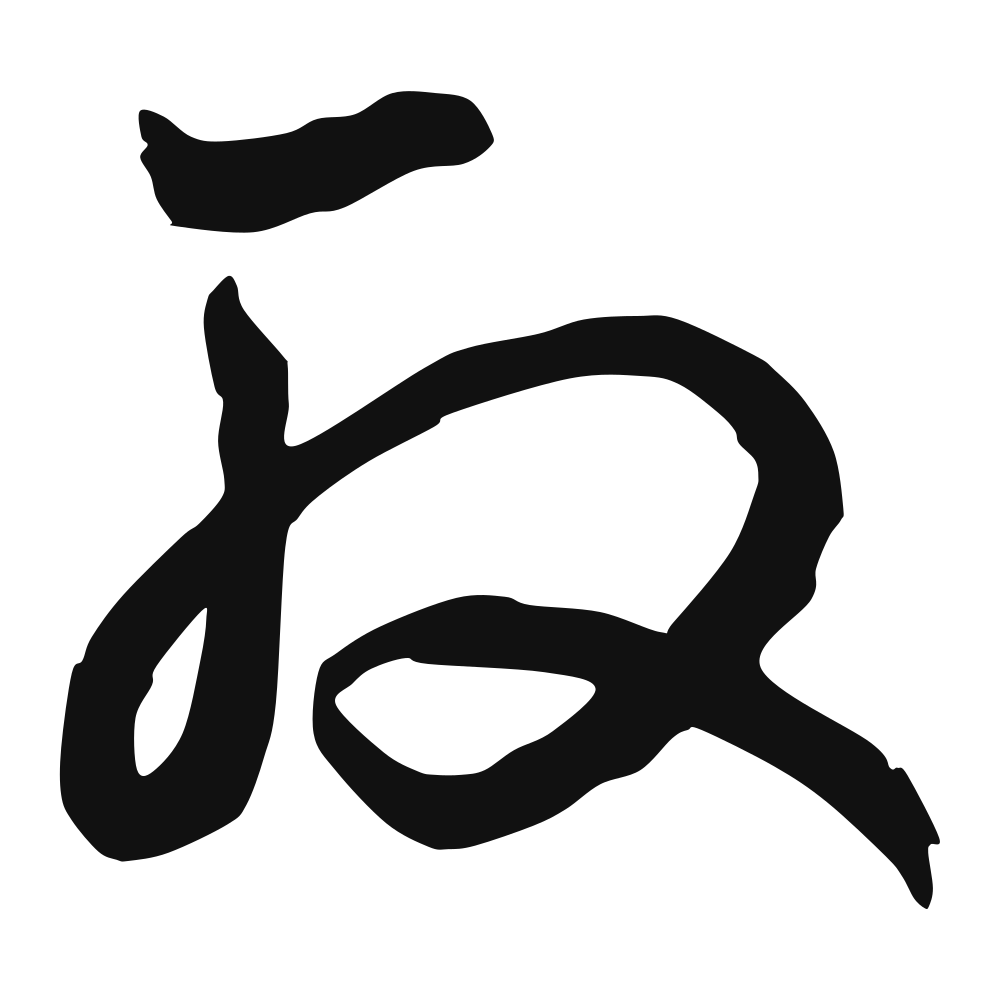
取
to take; to get; to choose; to fetch
Closest English meanings
take·get·fetch·choose
The Calligrapher — Xiānyú Shū 鲜于枢
Yuan master of fluent running and cursive script.
Yuan calligrapher (1246–1302), master of running script/cursive script — known for 《石鼓歌》. Yuan dynasty
Etymology & Meaning · 字义溯源
2 · The Character: 取 Qǔ (3rd tone). The Shuowen is stark: 「取,捕取也。从又从耳。《周禮》:『獲者取左耳。』」 — 'to seize,' a hand (又) and an ear: in antiquity a warrior cut off an enemy's left ear as a tally of the kill. The Rites confirm 「獲者取左耳」, and 取 later softened to 'take / choose' — 取道 (take the road), 取材 (select material), and 娶 (marry, 'take a wife'). So 取 is 'to obtain,' but its root is martial and grim. As a tattoo it can mean 'to take / win,' yet alone it risks reading as grabby or as the war-tally. If used, pair it with a noble object — 取義 (take righteousness, 捨生取義) — so the taking is principled. Element tables assign Metal (金).
Cultural Story
取 showed a hand seizing an ear -- in war, the trophy of a slain foe, proof of the kill. From that came "to take". The related 娶, to take a wife, kept the same root. The Zhou bronze inscriptions record 取邑, the taking of a town. The word began as a hand on an enemy's ear and widened to every act of taking.
Where a Western reader can stand: Xianyu Shu (1246–1302) was a northern Yuan official whose robust running-cursive made him the close friend and chief rival of Zhao Mengfu, leading the revival of the elegant Jin–Tang tradition. His 取 comes in vigorous, well-balanced cursive — fluent but never fussy. As a tattoo, 取 means 'to take / obtain,' but its root is grim: in antiquity a warrior cut off an enemy's left ear as a kill-tally (周礼 '獲者取左耳'). Alone it can read as 'grabby' or as that war trophy. Xianyu's confident hand actually helps — yet the honest move is to pair it: 取义 ('take righteousness,' from 捨生取義, 'give your life for what is right') turns the grabbing into a stand. Element Metal (金).
Common words & phrases
- 取得 obtain · gain · achieve · get
- 取消 cancel · call off · abolish
- 采取 adopt · take · employ
- 争取 strive for · fight for · win
- 提取 extract · withdraw · take out
- 获取 obtain · acquire · gain
Read the story behind the character
A flight is 取消 by the storm; the bank 提取 the cash from the machine. A committee 采取 the safer plan; a student 争取 a place she doubts she will win. The company 取得 the license; a reader 获取 the file behind the paywall. The word runs through the day's acquisitions and revocations -- what is taken, what is won, what is withdrawn, what is undone.
Why this character belongs on skin
In the old script, qǔ is a hand closing on an ear—the ear of a fallen enemy, taken as proof of a life ended and a self made larger by the taking. To qǔ is to seize, to fetch, to obtain what was not yours until your hand decided otherwise. The monk qǔ the scriptures across a continent of snow; the lover qǔ a name and makes it marriage. We are timid about taking, taught to wait—but qǔ is the verb of the alive, the one who reaches and receives. Ink it where you take hold—the hand, the hip—a mark that you are done waiting to be given. You went and got. The ear you bring home is your own, transformed. Take. It was always there to be taken.
Own this character
Purchase delivers the original SVG of this glyph, brushed by Xiānyú Shū 鲜于枢, ready to place on skin, paper, or screen.