
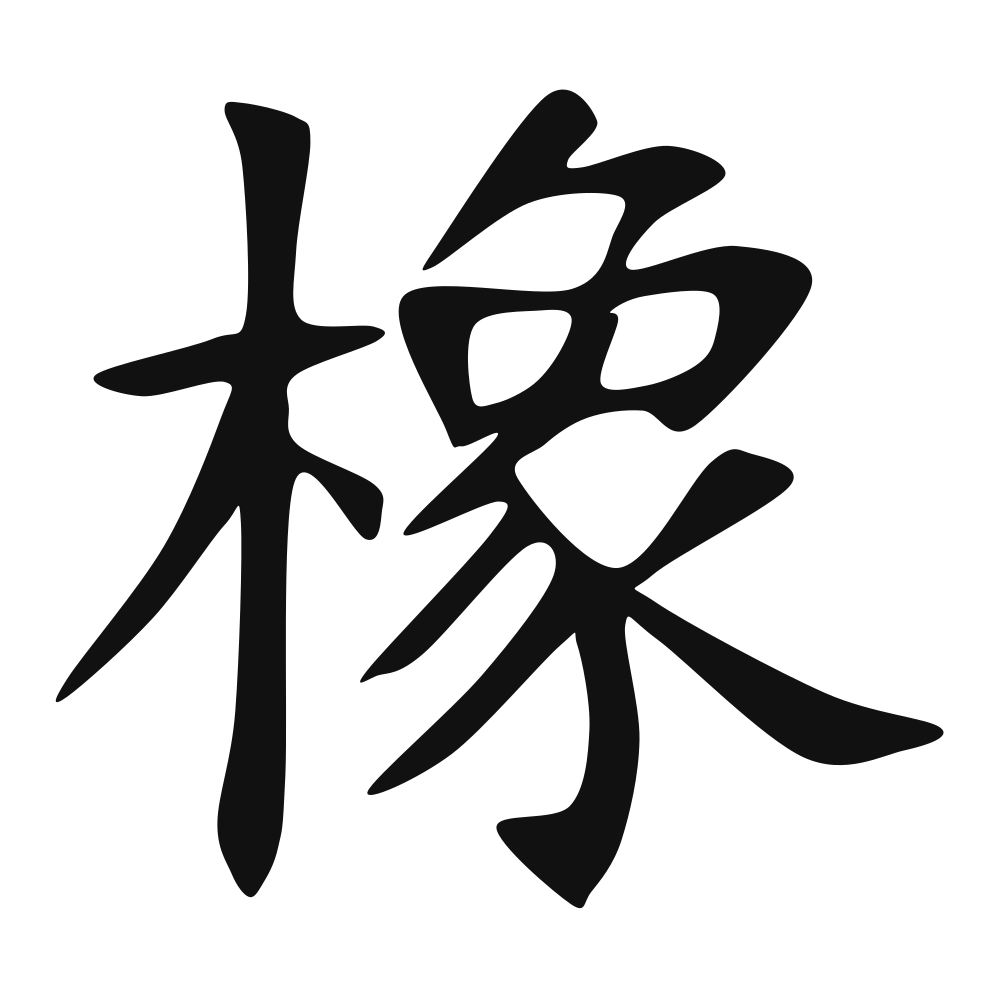
橡
oak; Quercus serrata
Closest English meanings
oak·rubber tree
The Calligrapher — Yà Qī 亚栖
Tang monk calligrapher of cursive script, heir to Zhang Xu's manner.
Tang calligrapher (), master of cursive script — known for 禅僧书家. Tang dynasty
Cultural Story
橡 covered the oak and the rubber tree, two very different plants sharing one name through their useful, springy wood and sap. The Shuowen links it to the oak bearing acorns, food for pigs in old villages, while later trade brought the rubber tree whose latex built an industry. The character thus bridges forest and factory, the acorn and the tyre.
Common words & phrases
- 橡皮 rubber · eraser
- 橡胶 rubber
- 橡树 oak tree
- 橡木 oak (wood)
Read the story behind the character
Modern life runs on 橡: a student rubs out a mistake with a 橡皮 eraser, factories process 橡胶 rubber for tyres and shoes, and a gardener plants an 橡树 oak tree for shade while a carpenter builds with 橡木 oak wood floors. From the pencil case to the car wheel to the living-room planks, 橡 quietly supports childhood, transport, and home in forms most people never stop to name.
Why this character belongs on skin
The tree radical and its own echo: the oak. In the West it is the king of trees — Druid groves, ship keels, Zeus's thunder-oak at Dodona where prophecy rustled in the leaves. The acorn's whole ambition folded into something you can hide in a closed fist; the old proverb makes the acorn a promise the oak eventually keeps. Oaks live five hundred years, grow slowly, refuse to be hurried, and their wood, once hardened, built the navies that mapped the world. There is a moral patience in it that any tradition would endorse: depth before height, roots before banners. Ink it on the shoulder, where the body carries loads, or the calf that stands. It is for the one who plants things they may not sit under — or who is, themselves, the slow answer to someone's old small hope.
Own this character
Purchase delivers the original SVG of this glyph, brushed by Yà Qī 亚栖, ready to place on skin, paper, or screen.