
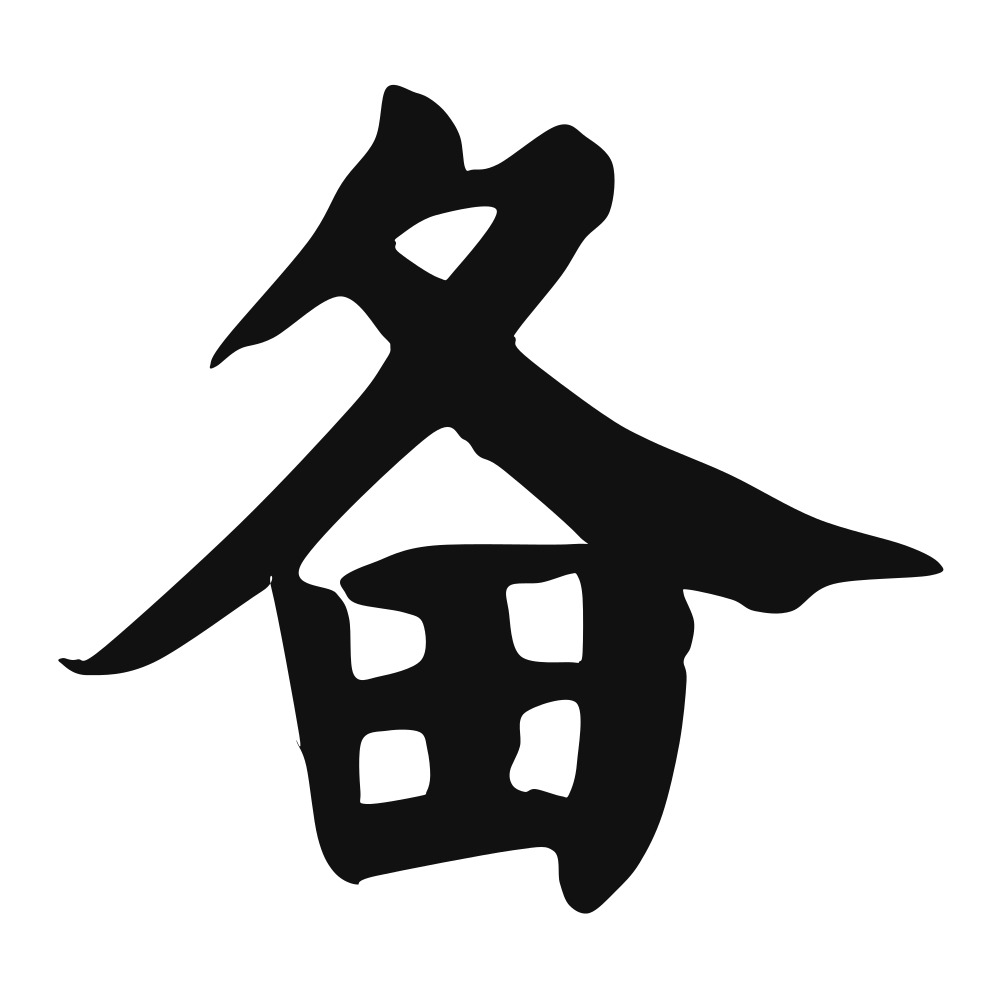
備
(bound form) to prepare; to equip; (literary) fully; completely
Closest English meanings
prepare·equip·ready
The Calligrapher — Yán Zhēnqīng 颜真卿
Tang master of robust regular script; co-creator of the enduring 'Yan style'.
Tang calligrapher (709–784), master of regular script/running script — the Tang moral paragon whose upright, muscular regular script became the model of Chinese integrity in writing. Tang dynasty
Etymology & Meaning · 字义溯源
### Soundbèi — bèi (4th tone). Free-standing morpheme ### Original meaningBèi (4th tone). The Shuowen Jiezi defines it as 「慎也。从人𤰈聲」 (平祕切) — 'careful' — and that is the reading worth keeping hold of, because 段玉裁 notes that the modern sense has swallowed the old one: 「僃行而𤰈廢矣…尟知其古訓慎者」 — few now remember that it once meant carefulness. The oracle-bone graph is said to picture arrows standing in a quiver, the readiness you lay down before you need it; so 'prepared' and 'careful' meet in one image. Classical Chinese leans on it heavily and always in the plain sense of having what will be needed: 《書·說命》 「惟事事,乃其有備,有備無患」; 《左傳·襄公十一年》 「居安思危,思則有備,有備無患」; 《墨子·七患》 「備者,國之重也」; 《易·繫辭》 「易之為書也,廣大悉備」 — the Changes as a book is broad and complete in everything. Its loveliest definition comes from ritual: 《禮記·祭統》 「福者,備也。備者,百順之名也,無所不順者之謂備」 — blessing is completeness; completeness is the name for a hundred obediences, and nothing going against you is what completeness means. Modern usage is plainer and unromantic: 準備 to prepare, 設備 equipment, 軍備 armaments, 齊備 complete. ### The structure (形聲 · 从人𤰈聲 — person (人) + 𤰈 phonetic (𤰈 itself meant 'complete; implements'); the oracle-bone form is usually read as arrows standing in a quiver, which is why Shuowen's 'careful' and the later 'prepared/complete' belong to one picture)①亻rénpersonthe care is a person's care, not an event's②𤰈bèiimplements; completethe phonetic, already carrying 'equipped'③箭箙jiànfúarrows in a quiverthe oracle-bone picture often proposed for this graph④準備zhǔnbèito preparewhere it lives now: the plainest possible word for getting ready ### In use todayItemReading / meaningNoteReadingbèi (4th tone)single readingCore senseprepared; complete; carefulShuowen's root sense is 慎 'careful'Grammarbound morpheme in modern use準備 prepare, 裝備 equipment, 完備 completeTattoo fityes-standalone — plain but soundreads as readiness rather than as a wish for luck ### Closest words in English — and what each misses - Lucky — 吉/幸 hold luck; 備 is what you hold instead of relying on luck - Blessing — 福 holds blessing — though 《禮記》 defines 福 as 備, which is a definition, not an identity - Rich / abundant — 富/裕 hold wealth; 備 is sufficiency for a purpose, not surplus - Wisdom / insight — 智 holds wisdom; 備 is foresight in the plain, administrative sense of stocks and storesAn honest note on grammar. Free-ish classical word; in modern Mandarin mostly a bound morpheme (準備, 設備, 完備, 防備) though still legible and completable alone as 'ready, prepared'Where a Western reader can stand: 備 (bèi) means prepared, ready beforehand, complete. Xu Shen's diction
Cultural Story
The "Zuo Zhuan" counsels, "in peace think of danger; thinking brings 备, and 备 brings freedom from harm" — 有备无患. The word 備 was the store laid by against the unseen: grain, armor, a plan. To be 備 was to have met the future halfway, so that what came could not take you bare-handed.
Where a Western reader can stand: 備 (bèi) means prepared, ready beforehand, complete. Xu Shen defines it simply as 'careful', and the oldest form is usually read as arrows standing ready in a quiver — provision laid down before it is wanted. Its great line is 『there is preparation, therefore no trouble』 (《書·說命》, repeated in 《左傳》), and the Book of Rites even defines blessedness as completeness. No mysticism, no fortune-telling — just the claim that met trouble is trouble already thought about.
Common words & phrases
- 準備 prepare
- 設備 equipment · facilities
- 配備 equip · outfit
- 預備 prepare · reserve
- 備用 spare · backup
Read the story behind the character
A school runs 準備 drills for the fire; the lab checks its 設備 before the run. A camp 配備 the tent, and a family keeps a 預備 bulb in the drawer. The phone backs files to 備用 storage. The word still means laying things by — a drill, a spare, a plan — the quiet insurance against the day something breaks.
Own this character
Purchase delivers the original SVG of this glyph, brushed by Yán Zhēnqīng 颜真卿, ready to place on skin, paper, or screen.