
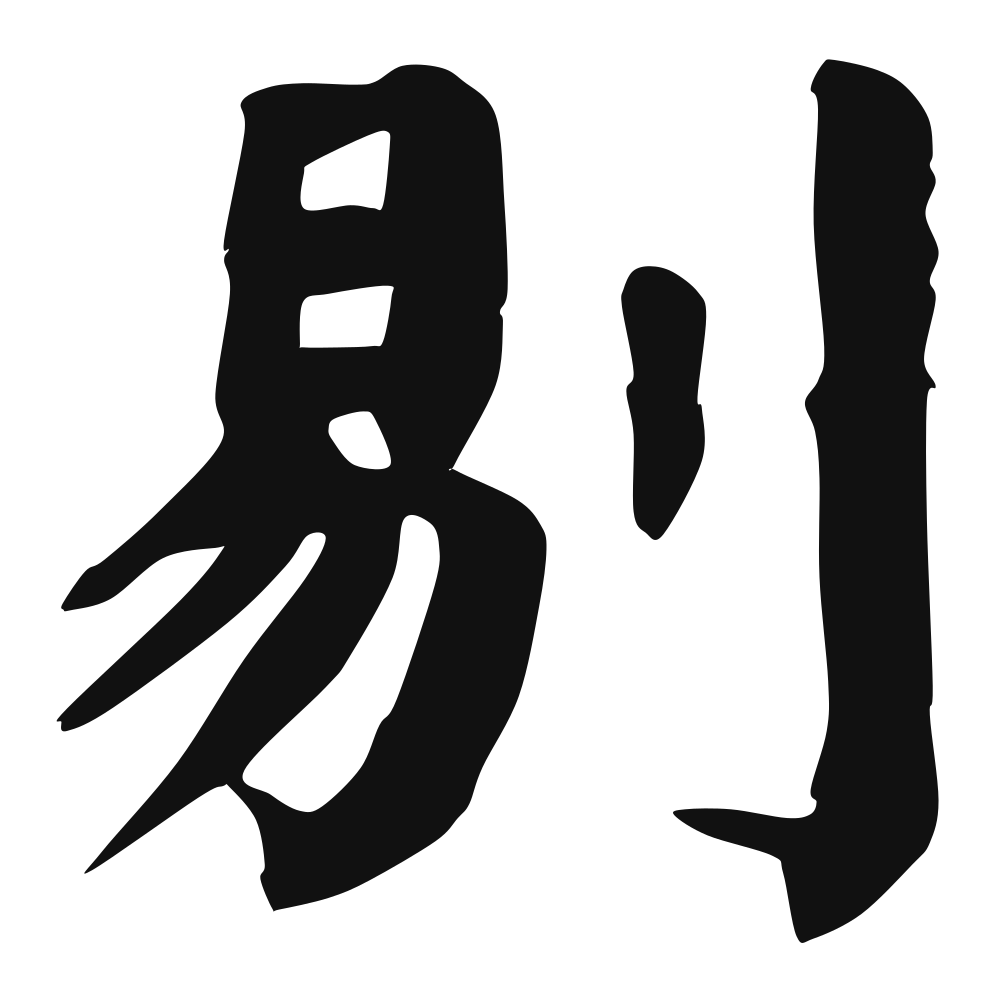
剔
to scrape the meat from bones; to pick (teeth etc); to weed out
Closest English meanings
pick out·scrape·eliminate
The Calligrapher — Yán Zhēnqīng 颜真卿
Tang master of robust regular script; co-creator of the enduring 'Yan style'.
Tang calligrapher (709–784), master of regular script/running script — the Tang moral paragon whose upright, muscular regular script became the model of Chinese integrity in writing. Tang dynasty
Etymology & Meaning · 字义溯源
### Soundtī — tī (1st tone); tì when used for 剃 (to shave). Often a bound morpheme — needs a partner word ### Original meaningTī (1st tone). The Shuowen Jiezi is blunt: 「剔,解骨也。从刀易聲」 — 'to take the bones apart', a knife for meaning and 易 for sound. (The Kangxi quotations transmit the gloss more briefly as 「解也」, and 《玉篇》 repeats 「解骨也」.) 《通俗文》 draws the line: 「去骨曰剔」 — removing the bone is called 剔. From that butcher's sense came the whole family: to pick, to scrape out, to weed out (剔除), to trim a lamp-wick (张祜《赠内人》「斜拔玉钗灯影畔,剔开红焰救飞蛾」 — she pulls a hairpin out of her hair and frees the moth from the flame), and, by extension, to carve until light passes through (玲珑剔透, 晶莹剔透 — exquisitely worked, translucent). It also borrows for 剃, to shave: 司马迁《报任少卿书》「其次剔毛发,婴金铁受辱」 counts it among the humiliations. Honest disclosure: the core of this character is scraping and picking — several naming tables grade it 凶 and unsuitable for a name. ### The structure (形聲 · 从刀,易聲 — knife (刀) for the meaning, 易 (yì) for the sound; Shuowen: 解骨也)①刀dāoknifethe radical; every sense starts from a blade②易yìto change / (here) phoneticthe sound-bearer, and by folk reading the idea of separating③骨gǔbonewhat the knife works along: 解骨也④剔透tītòuworked until translucentthe only romantic register, and it needs the compound ### In use todayItemReading / meaningNoteReadingtī (1st tone); tì for 剃the tì reading is a borrowingCore senseto pick out / scrape / removeroot sense: 解骨, taking flesh off boneGrammarverb剔除 to weed out, 剔牙 to pick teeth, 剔透 translucentTattoo fitcaution — rough standalone, lovely in 剔透several naming tables grade it 凶 ### Closest words in English — and what each misses - Clean / cleanse — 淨/清 hold cleanness; 剔 is removal by picking, and the thing removed may be good or bad - Carve — 雕/刻 hold carving; 剔 is carving only in the borrowed sense of 剔透 - Refine / purify — 煉/純 hold refining; 剔 is a physical act on a surface or a bone - Sharp — 利/銳 hold sharpness; 剔 names the small precise act, not the edgeAn honest note on grammar. Verb (剔除 to weed out, 剔牙 to pick one's teeth, 剔透 translucent); read tì it writes 剃 (to shave); not a name character, not a surnameWhere a Western reader can stand: 剔 (tī) means 'to pick out, to scrape, to work along the bone'. Xu Shen's definition is 解骨也 — taking flesh off bone — and the everyday word built on it, 剔除, means 'to weed out'. Its one genuinely beautiful register is the compound 剔透 (as in 玲珑剔透): carved so fine that light goes through. Alone on skin it will read as 'pick out / remove', and several naming tables grade it unsuitable for a name. If the t
Cultural Story
(The craft of 剔红, carved cinnabar lacquer, layers a tree's sap and cuts it back to a red relief; the Yuan and Ming courts prized a fine 剔透 bowl above jade. The character 剔 is the pick that lifts what should not be there. It names the carver's patience and the clear stone he chases.
Where a Western reader can stand: 剔 (tī) means 'to pick out, to scrape' — Xu Shen's definition is 解骨也, taking flesh off bone. Its one beautiful register is the compound 剔透 (as in 玲瓏剔透): carved so fine that light passes through. Alone on skin it reads as 'weed out', and several naming tables grade it unsuitable for a name. If the translucency is what you are after, tattoo 剔透 as a pair, not 剔 by itself.
Common words & phrases
- 剔除 eliminate · remove
- 挑剔 picky · fault-finding
- 剔牙 pick teeth
- 剔透 exquisite · clear
Read the story behind the character
(He 剔牙 with a pick after the meal. The buyer is 挑剔 about the seam. The chef 剔除 the bones before plating. The 剔透 jade glows under the lamp. The word names the pick, the fault-finder, and the clear thing held to the light. He 剔牙 after the meal, the buyer is 挑剔 about the seam, and the 剔透 jade glows under the lamp.
Why this character belongs on skin
Love sometimes looks like a knife. 剔 is to pick out, to scrape clean, the blade radical 刀 lifted to remove what does not belong — the fish bone from the flesh, the false from the true, the person who was costing you your life. 挑剔 is to be exacting; 剔除 is to cut away. The Buddhists speak of shedding attachment like old skin, and the work is never gentle. To carry 剔 is to honor the surgery you survived, the moment you finally lifted the blade to your own story. We romanticize holding on; this mark is for the courage of letting go. It is the tattoo of the one who pruned the garden and watched it bloom. Some hurts are only removed by hand. Ink it where you can touch it, a quiet vow to keep your life clean, to keep cutting what wounds you, because mercy for yourself sometimes wears the face of a knife.
Own this character
Purchase delivers the original SVG of this glyph, brushed by Yán Zhēnqīng 颜真卿, ready to place on skin, paper, or screen.