
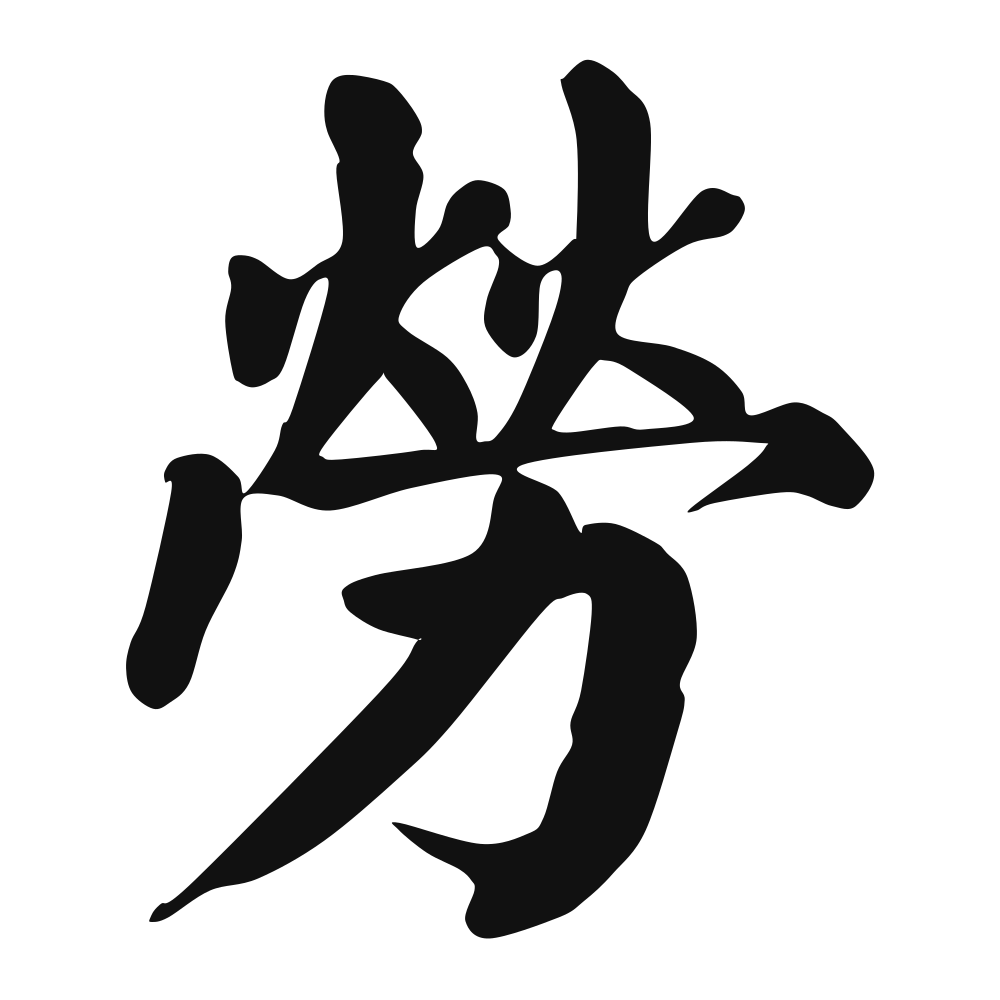
勞
surname Lao; (bound form) to toil; labor; (bound form) laborer; (bound form) meritorious deed; (bound form) fatigue; to put sb to the trouble (of doing sth); (bound form) to express appreciation for sb's efforts (Taiwan pr. [lao4])
Closest English meanings
labor·work·toil
The Calligrapher — Yán Zhēnqīng 颜真卿
Tang master of robust regular script; co-creator of the enduring 'Yan style'.
Tang calligrapher (709–784), master of regular script/running script — the Tang moral paragon whose upright, muscular regular script became the model of Chinese integrity in writing. Tang dynasty
Etymology & Meaning · 字义溯源
### Soundláo — láo (2nd tone); lào (4th tone) when it means to reward toil (慰劳). Free-standing morpheme ### Original meaningLáo (2nd tone); read lào (4th tone) when it means 'to慰劳, to reward toil'. The Shuowen Jiezi defines it as 「勞,劇也。从力,熒省。用力者勞」 — 'severe; from 力 (effort), with 熒 abbreviated as the phonetic; the one who spends effort is 勞'. Note what Xu Shen does not say: the popular modern analysis reads the seal form as 焱 (flame) over 冖 (a roof) over 力 (effort) — working by lamplight at night — and that picture is a century of classroom tradition but not the Shuowen analysis, which is a phono-semantic compound. 《尔雅·释诂》 gives the plain gloss 「勞,勤也」. The classical uses carry both the cost and the honour: 《易·兑卦》「悦以先民,民忘其劳」 — lead the people with what gladdens them and they forget their toil; 《孟子·滕文公上》「或劳心,或劳力;劳心者治人,劳力者治于人」; 《礼·儒行》「先勞而後祿」 — the work comes before the pay. 《易·谦》九三 has the best line in the canon: 「勞謙,君子有終,吉」 — toiling and humble, the superior man has a good end. Honest disclosure: 勞 is the character of the cost, not of the reward; some naming tables grade it 凶. ### The structure (形聲 · 从力,熒省 — effort (力) with 熒 abbreviated as phonetic; Shuowen: 劇也,用力者勞. (The popular 'flame over roof over effort' reading is later teaching, not the Shuowen analysis.))①力lìstrength, effortthe radical, and the whole point: 用力者勞②熒yíngglimmering lamplightabbreviated as the phonetic (熒省)③劇jùsevere, hardShuowen's defining word — toil is graded as severity④謙qiānmodestythe pairing the Yijing blesses: 勞謙,君子有終,吉 ### In use todayItemReading / meaningNoteReadingláo (2nd); lào (4th) = to reward toiltwo readings, two jobsCore sensetoil, labour, wearinessthe cost side, not the reward sideGrammarnoun and verb; also a surname勞動 labour, 疲勞 fatigue, 慰勞 to comfort workers, 功勞 meritTattoo fitcaution — reads as burdengraded 凶 by some naming tables ### Closest words in English — and what each misses - Work — 工/作 hold work as activity; 勞 is work felt as cost and weariness - Achievement / merit — 功/成 hold the result; 勞 is the expenditure that precedes it - Tired — 疲/倦 hold fatigue; 勞 is the toiling itself, which may or may not tire - Dedication — 勤 (the word 尔雅 uses for 勞) holds diligence; 勞 is the heavier, harder wordAn honest note on grammar. Free noun and verb (勞動, 勞苦, 疲勞, 慰勞); also a surname (漢有琅邪勞丙); the lào reading is the verb 'to reward labour'Where a Western reader can stand: 勞 (láo) means 'toil' — Xu Shen defines it as 劇也, severe, and explains it as 从力, from effort: 用力者勞, the one who spends effort is the one who toils. The popular story that the character shows someone working
Cultural Story
The Records of the Grand Historian grants founders 汗馬之劳 — the toil of the sweating warhorse — for campaigns won from the saddle. The word 慰劳 fed and honored such men. 劳動 in the Han meant corvee on the roads; the graph sets fire beneath growth, the field under the sun's pressure.
Where a Western reader can stand: 勞 (láo) means 'toil' — Xu Shen defines it as 劇也, severe, the spending of strength. The popular picture of someone working by lamplight is classroom teaching, not the Shuowen's analysis. As a tattoo it is honest but heavy: this is the character for the cost, while 功 and 成 are the characters for the reward. The line that redeems it is the Yijing's 勞謙,君子有終,吉 — toiling and humble, a good end.
Common words & phrases
- 勞動 labor · work
- 疲勞 fatigue · tiredness
- 功勞 merit · credit
- 慰勞 comfort · honor
- 勞累 tired · weary
Read the story behind the character
Taiwan's labor day still writes 劳動節; 疲劳 ends a nurse's chart after a night on call. A foreman logs a worker's 功劳 in the monthly meeting, and a friend texts 慰劳 with a photo of dinner bought for the tired. The traditional form now chiefly marks newspapers and shop signs across the strait.
Own this character
Purchase delivers the original SVG of this glyph, brushed by Yán Zhēnqīng 颜真卿, ready to place on skin, paper, or screen.