
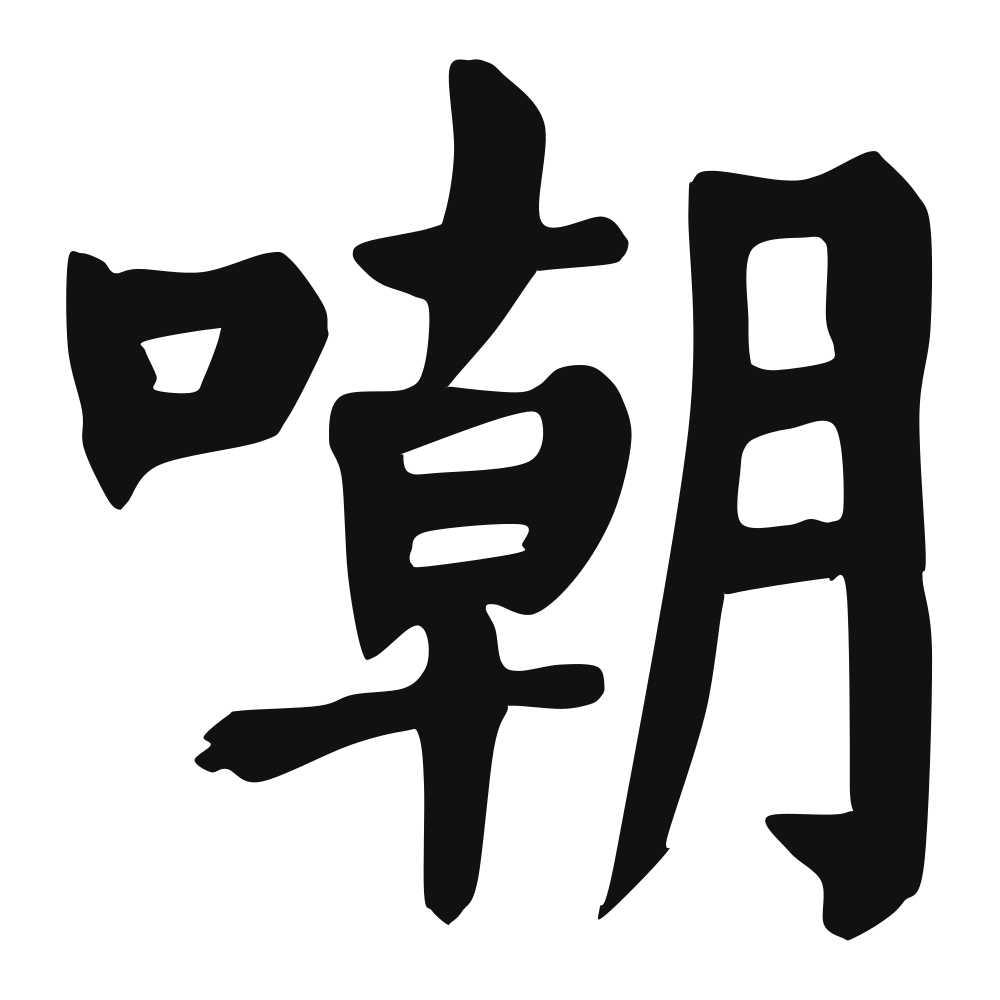
嘲
to ridicule; to mock
Closest English meanings
ridicule·sneer·mock
The Calligrapher — Yán Zhēnqīng 颜真卿
Tang master of robust regular script; co-creator of the enduring 'Yan style'.
Tang calligrapher (709–784), master of regular script/running script — the Tang moral paragon whose upright, muscular regular script became the model of Chinese integrity in writing. Tang dynasty
Cultural Story
The Shuowen reads 嘲 as 謔, mocking jest, a character of the mouth with a biting edge. The Wei-Jin gentlemen of the Shishuo Xinyu traded clever 嘲 to display wit, and Tang poets turned 嘲 on pompous officials and absurd fashions. Where 嗤 is a private sneer, 嘲 is spoken aloud for the circle to enjoy — a public teasing that could amuse or wound. The Classics warn that 嘲 easily slides from play into cruelty, the laugh that flatters the laugher at another's cost.
Common words & phrases
- 嘲笑 mock · ridicule · laugh at
- 嘲讽 sneer · taunt
- 嘲弄 ridicule · make fun of
- 冷嘲 cynicism · sarcasm
Read the story behind the character
Classmates 嘲笑 (mock, ridicule) a peer's accent; a columnist 嘲諷 (sneers, taunts) a politician's promise. Netizens 嘲弄 (ridicule, make fun of) a failed product, and a jaded critic answers with 冷嘲 (cynicism, sarcasm). 嘲 is the modern language of mockery — in the schoolyard, the comment section, and the late-night monologue — the sharp laugh that targets pretense, weakness, or folly, sometimes playful, often unkind.
Why this character belongs on skin
The mouth radical doubled—laughter beside speech—and between them, the ancient word for the sea's tide: chao, the water that rises, falls, and rises again at the shore. So mockery in this language is literally the tide of mouths, voices washing over someone in waves. The ancients knew satire as a serious art; the court jester was the one man who could tell the emperor the truth, mocking what flattery had made invisible. Mockery cuts, yes—but it also humbles the mighty, prunes the pompous, and can turn even on the self, which is where it becomes wisdom. The person who can laugh at their own disaster has climbed above it; the one who cannot be laughed at has built a prison and moved in. Every tradition keeps this door. Don Quixote is mocked on every page and somehow grows nobler under it. This character is ink for the thick-skinned and the honest—for someone who can take the tide of laughter and stand in it. Wear it and say what the wise fool says: mock away. The tide comes in, the tide goes out. I am still standing here, laughing too.
Own this character
Purchase delivers the original SVG of this glyph, brushed by Yán Zhēnqīng 颜真卿, ready to place on skin, paper, or screen.