
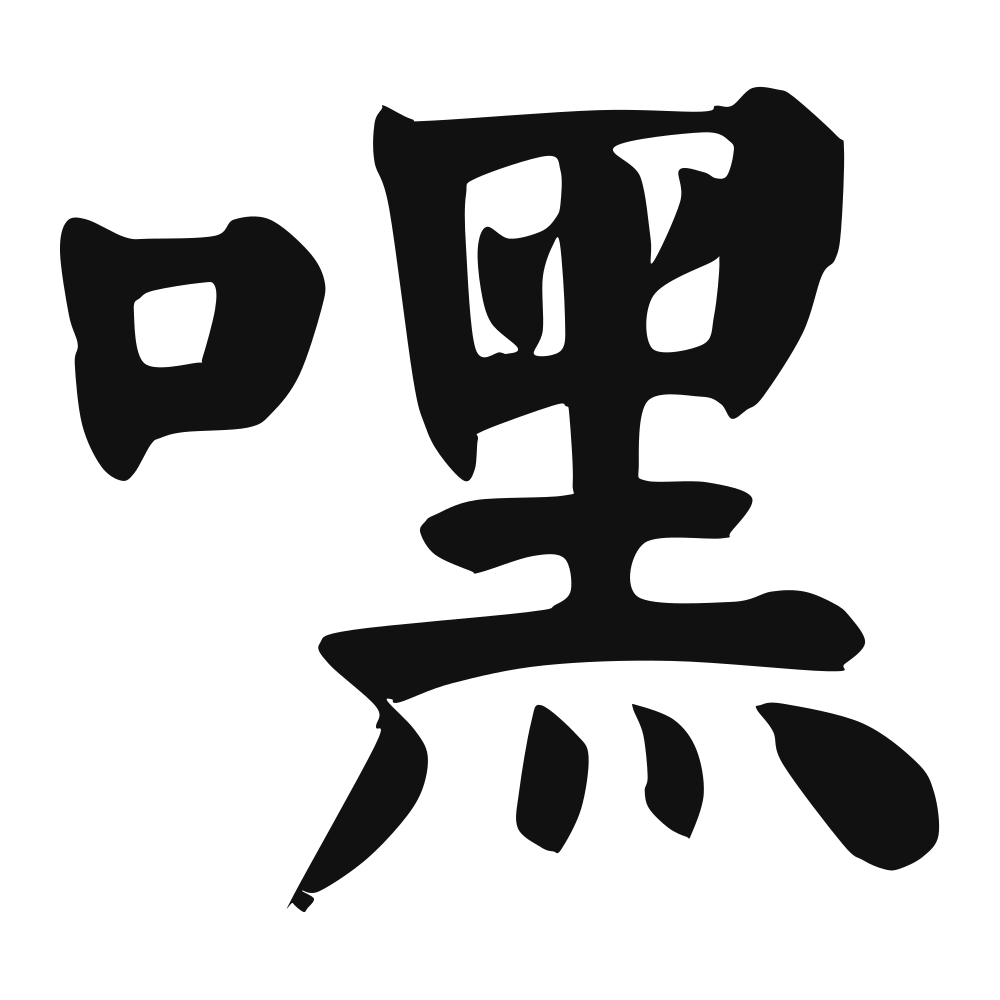
The Calligrapher — Yán Zhēnqīng 颜真卿
Tang master of robust regular script; co-creator of the enduring 'Yan style'.
Tang calligrapher (709–784), master of regular script/running script — the Tang moral paragon whose upright, muscular regular script became the model of Chinese integrity in writing. Tang dynasty
Cultural Story
嘿 is a late, sound-driven character of the mouth radical. In older writing it could stand for 默, silence — 嘿然 meant to fall speechless — a meaning the Classics touched only lightly. As spoken Chinese developed, 嘿 became the casual call 'hey,' the attention-getter tossed across a room, and 嘿嘿 the giggle of someone up to mild mischief. Though young in the script, it does the oldest job of the mouth radical: catch a feeling — surprise, silence, or a smirk — in a single breath.
Common words & phrases
- 嘿嘿 hee-hee · giggle
- 嘿然 silent · speechless
- 嘿呀 hey · expression of surprise
Read the story behind the character
A friend pokes you and says 嘿 (hey) to get your attention; a prankster lets out 嘿嘿 (hee-hee, giggle) before the joke lands. Caught off guard, someone goes 嘿然 (silent, speechless), and a kid yelps 嘿呀 (hey! expression of surprise) when he drops his ice cream. 嘿 is the modern sound of casual call and playful giggle — the quick 'hey,' the speechless stare, and the little laugh that punctuates everyday surprise.
Why this character belongs on skin
One syllable, mouth open, half a laugh and half a nudge: 嘿 is the word you throw across a street to someone you know too well for formalities. It is the elbow of language—a sound before grammar, announcing nothing except presence, and joy at presence, and come here. Say it and watch the face it lands on: the eyebrows lift, the mouth answers before the mind votes. It is the oldest kind of word, probably—grunts that survived every civilization because they carry exactly one thing, undiluted: recognition. A dog knows it. A child at a playground knows it. Two old soldiers across a station platform, forty years on—one syllable does the work a paragraph can't. There is 嘿咻 too, the sound of labor, of effort in rhythm—breathe and push, breathe and push—so the syllable lives at both the meeting and the carrying. To wear 嘿 is a small act of rebellion against distance: the vow to stay the kind of person who gets called to across streets, who calls back, for whom one sound is enough to say I see you, I'm glad, come here.
Own this character
Purchase delivers the original SVG of this glyph, brushed by Yán Zhēnqīng 颜真卿, ready to place on skin, paper, or screen.