
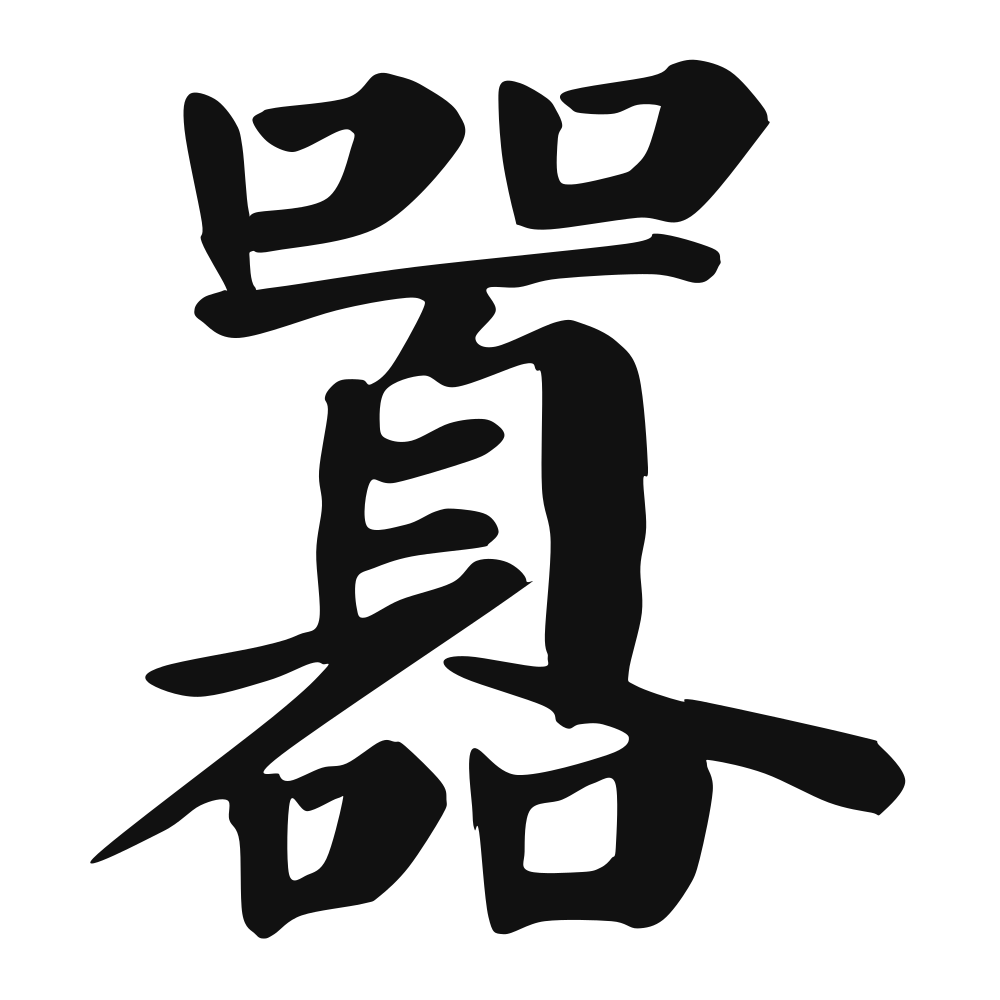
The Calligrapher — Yán Zhēnqīng 颜真卿
Tang master of robust regular script; co-creator of the enduring 'Yan style'.
Tang calligrapher (709–784), master of regular script/running script — the Tang moral paragon whose upright, muscular regular script became the model of Chinese integrity in writing. Tang dynasty
Etymology & Meaning · 字义溯源
### Soundxiāo — xiāo (1st tone); also áo. Often a bound morpheme — needs a partner word ### Original meaningXiāo (1st tone); the traditional form is 囂, and there is a second reading, áo. The Shuowen Jiezi gives a picture, not a definition: 「囂,聲也,气出頭上。从㗊从頁。頁,首也」 — sound, with the breath coming out above the head; built from 㗊 (four mouths, 'many mouths') and 頁 (a head). The Book of Songs uses it plainly: 《小雅·車攻》 「選徒囂囂」, 毛傳 囂囂,聲也 — the chosen crowds and their din; 《小雅·十月之交》 「讒口囂囂」 — the many mouths of slander. 《左傳·成公十六年》 gives China its idiom for a rising fuss: 「甚囂,且塵上矣」 (hence 甚囂塵上); 《左傳·昭三年》 「湫隘囂塵」 — cramped, low-lying, noisy and dusty. But the same graph has a contrary classical reading, and it is a good one: 《孟子》 「人知之亦囂囂,人不知亦囂囂」, glossed 囂囂,自得無欲之貌 — whether people know you or not, you stay self-possessed and free of desire. 《詩·大雅·板》 「聽我囂囂」 shows the stubborn side of that: I offer you counsel and you will not hear it. Kangxi counts 囂 at 21 strokes (口部+18); the simplified 嚣 is 18. Naming tables assign Wood (木), while several name-sites rate the character 凶. ### The structure (會意 · 从㗊从頁 — four mouths (㗊, 'many mouths') beneath a head (頁); the Shuowen adds 气出頭上, the breath coming out above it)①㗊jímany mouthsfour mouths at once — the crowd, the slander, the din②頁xiéheadthe head above the mouths; the Shuowen says the breath comes out over it③囂囂xiāoxiāoa din / self-possessedthe reduplicated form carries both the noise and the Mencius calm④甚囂塵上shèn xiāo chén shàngthe clamour rises and the dust fliesthe Zuo Zhuan phrase that became the idiom ### In use todayItemReading / meaningNoteReadingxiāo (1st tone); also áoáo is used for the ancient place-name and in 詩·大雅·板Core senseclamour; arrogance嚣张 · 喧嚣 · 叫嚣 · 甚嚣尘上Grammaradjective / verb, usually reduplicated 囂囂the Mencius calm-reading also needs 囂囂Tattoo fitcaution — modern sense is negative; 囂 is 21 strokesfor the Mencius idea use 囂囂, or 泰 tài / 安 ān ### Closest words in English — and what each misses - Loud — 響/鬧 hold loudness and rowdiness; 囂 adds the crowd of mouths and, in modern use, the bullying edge - Arrogant — 傲 (ào) holds pride directly; 嚣张 is swagger plus aggression, and 傲 lacks the noise - Free / Independent — 自得 holds the Mencius sense; a lone 囂 does not carry it without 囂囂 and without the reader knowing the passage - Rebel — 反/逆 hold rebellion; 囂 is noise, not opposition — though 叫嚣 comes closeAn honest note on grammar. Adjective and verb, mostly in the reduplicated form 囂囂; 嚣张 (arrogant and aggressive) and 喧嚣 (noisy) are the living modern compoundsWhere a Western reader can stand: 囂 (xiāo) is drawn a
Cultural Story
The Shi Ji describes the 嚣张 air of the fallen Shang capital, where the last king's revels never stopped. Later the word dignified political noise: the "嚣然而起" of factions in the Tang court. In the military treatise San Lue, a commander is warned against an army that grows too 嚣 before battle, for clamor often masks disorder.
Where a Western reader can stand: 囂 (xiāo) is drawn as four mouths under a head, and in modern Chinese it is mostly unpleasant — 嚣张 (arrogant), 喧嚣 (noisy), 甚嚣尘上 (a fuss growing louder). There is one real classical counter-reading: Mencius says a man should be 囂囂 whether the world knows him or not — self-possessed, wanting nothing. That is the reason anyone considers this character, but be clear it is a quotation needing the doubled form, not the everyday face of the word.
Common words & phrases
- 喧嚣 noisy · clamorous
- 叫嚣 clamor · rattle
- 嚣张 arrogant · aggressive
- 嚣然 clamorous
Read the story behind the character
Roadside vendors 叫嚣 prices at the tourist market, each louder than the last. A sports bar erupts in 喧嚣 when the home team scores. Online, a pundit's 嚣张 take gets clipped and shared within minutes — the more aggressive the phrasing, the faster it travels the feed.
Why this character belongs on skin
Four mouths around a head: that is the ancient picture inside 嚣, the din of a marketplace, the noise that surrounds a person on every side. The sages treated clamor as the natural weather of the world—Laozi never argued with the crowd, he simply left the gate. But notice the geometry: the mouths ring the head; the noise is outside, the quiet is at the center, and the center is you. Buddhists found enlightenment not in mountains but in the middle of markets, because silence that survives noise is the only silence worth having. You live inside this character every day—the feeds, the opinions, the clatter of other people's certainty. There is a subtle sensuality in claiming your own stillness amid it, like a dark, calm room in a house of shouting. Ink this small and hidden, at the inner wrist or behind the ear, where only closeness finds it: a private emblem of the quiet no crowd has ever breached.
Own this character
Purchase delivers the original SVG of this glyph, brushed by Yán Zhēnqīng 颜真卿, ready to place on skin, paper, or screen.