
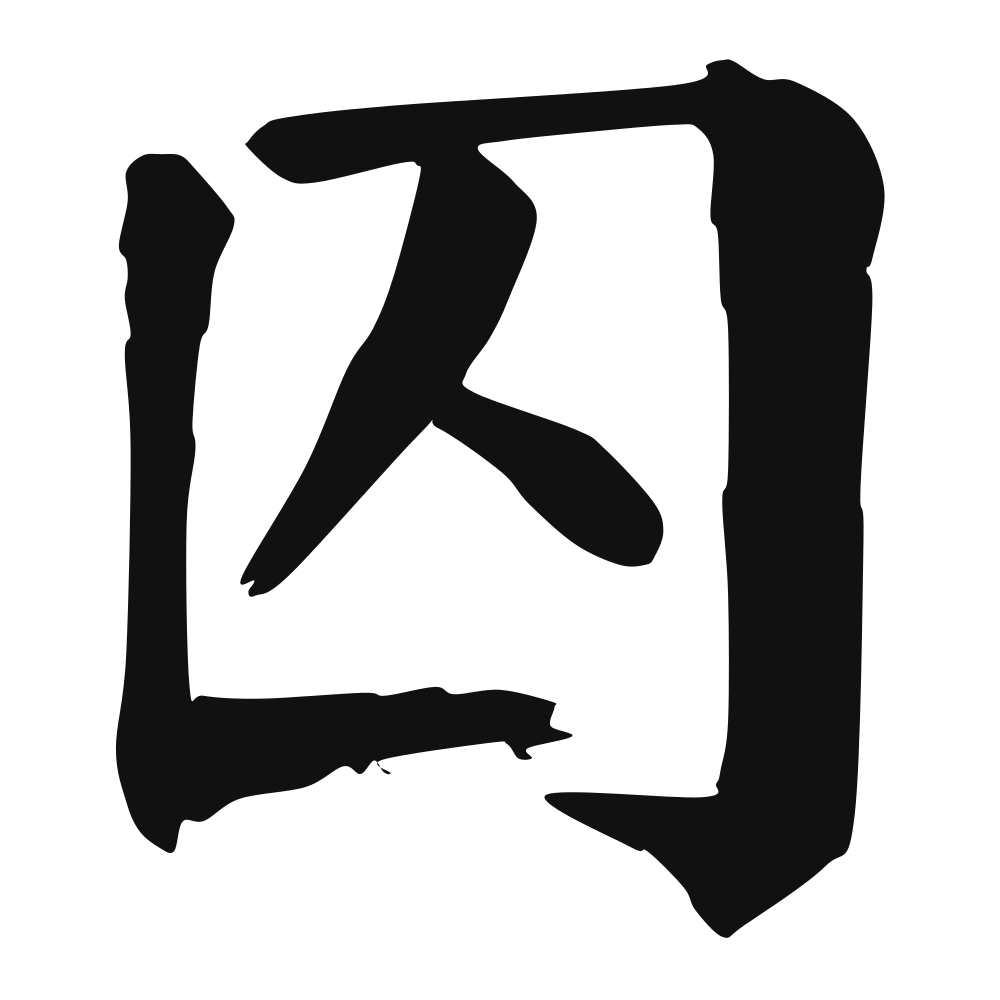
The Calligrapher — Yán Zhēnqīng 颜真卿
Tang master of robust regular script; co-creator of the enduring 'Yan style'.
Tang calligrapher (709–784), master of regular script/running script — the Tang moral paragon whose upright, muscular regular script became the model of Chinese integrity in writing. Tang dynasty
Cultural Story
The Shang king imprisoned the future King Wen of Zhou at Youli, where tradition says he composed the hexagrams of the Yijing while a 囚. Tang law codified 囚 categories by crime and season. In the Records of the Grand Historian, 死囚 awaiting amnesty on the winter solstice mark the empire's mercies and its terrors alike.
Common words & phrases
- 囚犯 prisoner · convict
- 囚禁 imprison · jail
- 死囚 condemned prisoner
- 囚笼 cage · prison
Read the story behind the character
:A defense lawyer visits a 囚 in the county holding cell before the bail hearing. On the true-crime podcast the host narrates how the 囚 spent ten years behind bars. At the border a smuggler is kept in a 囚笼 cot until his papers clear — the metal frame rattles when he shifts.
Why this character belongs on skin
A man inside a wall is still a man. We draw the line and then live inside it. 囚 is the prisoner — the person enclosed, the character a square with a human held at its center, boxed in by circumstance, by law, by his own mind. It is the oldest image of confinement, and the oldest image of the self that cannot leave itself. To wear 囚 is to tell the truth about the cage: that we have all been caught, that freedom is often just the shape of the box we stop fighting. But look again — the man is drawn inside the frame, not erased by it. The mark is a quiet solidarity with every captive heart, and a question inked into your skin: what confines you, and who, exactly, is holding the wall?
Own this character
Purchase delivers the original SVG of this glyph, brushed by Yán Zhēnqīng 颜真卿, ready to place on skin, paper, or screen.