
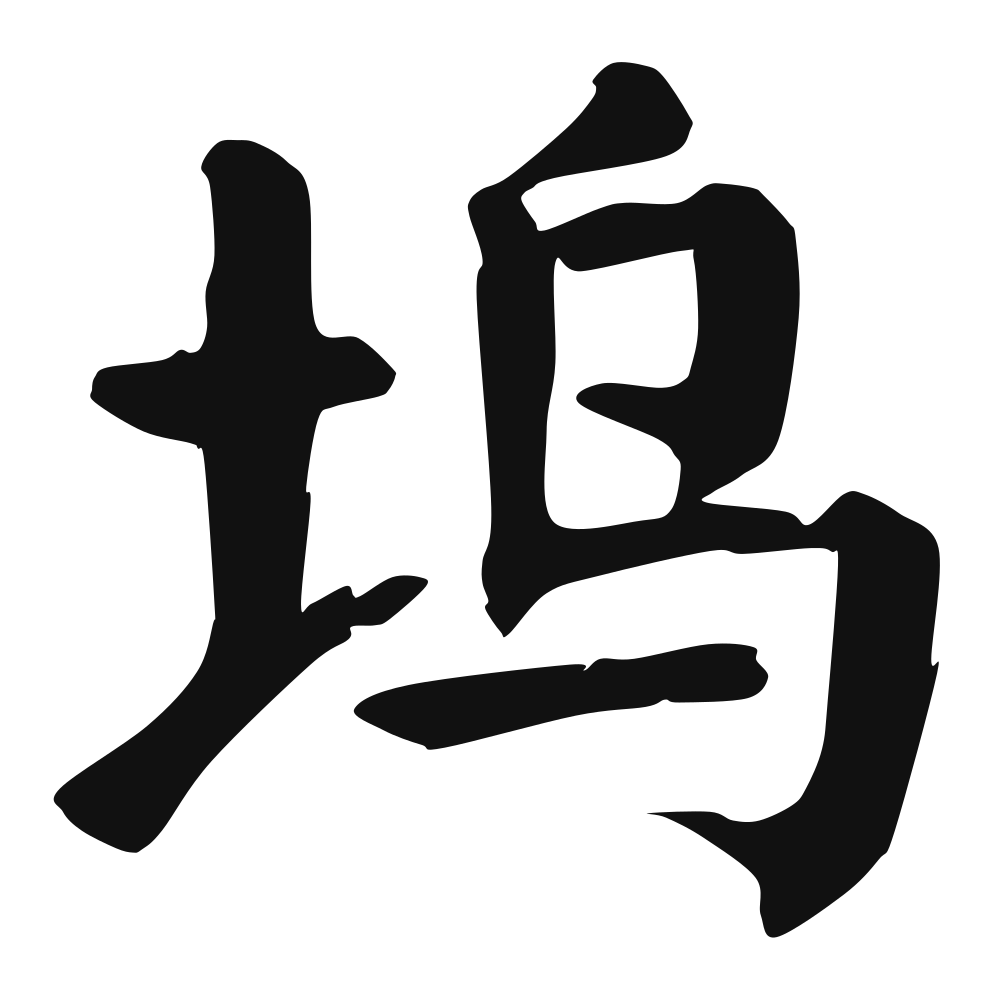
坞
(bound form) low area within a surrounding barrier; (literary) small castle; fort
Closest English meanings
dock·depression·cottage
The Calligrapher — Yán Zhēnqīng 颜真卿
Tang master of robust regular script; co-creator of the enduring 'Yan style'.
Tang calligrapher (709–784), master of regular script/running script — the Tang moral paragon whose upright, muscular regular script became the model of Chinese integrity in writing. Tang dynasty
Etymology & Meaning · 字义溯源
### Soundwù — wù (4th tone). Free-standing morpheme ### Original meaningWù (4th tone); the traditional form is 塢, and the Shuowen entry is filed under the older 隖: 「小障也。一曰庳城也。从𨸏烏聲。安古切」 — a small defensive screen, or, in the second gloss, a low walled fort. Duan Yucai adds the 埤蒼 「小障曰隖」 and 服虔《通俗文》 「營居為隖」 — a camp to live in. Kangxi, under 塢 (13 strokes, 土部+10; simplified 坞 is 7), gives the military history: 《後漢·安帝紀》 元初元年「遣兵屯河內衝要,皆作塢壁」; 《後漢·董卓傳》 「築塢于郿,號萬歲塢」 — the fortress Dong Zhuo built at Mei and named the Myriad-Year Mound, which is where the sense of a private, hoarding stronghold comes from. Then the word softens into landscape. 王維's villa at 輞川 had a 辛夷塢 (Magnolia Hollow); 杜甫 writes 「前有毒蛇後猛虎,谿行盡日無村塢」 — snakes ahead, tigers behind, a whole day up the creek with no village to shelter in; 《紅樓夢》 has 「方離柳塢,乍出花房」. And in 集韻 烏故切音污 it simply means 野聚 — a hamlet. Naming tables assign Earth (土). ### The structure (形聲 · 从𨸏(阜),烏聲 — mound (阜) plus 烏 (wū, 'crow') as phonetic; the later form 塢 swaps the mound radical for 土 (earth))①𨸏 / 阜fùmound / earth wallthe Shuowen radical — raised earth, the thing that screens②烏wūcrowthe phonetic; it also gives 塢 its dark, enclosed feel③塢wùsmall fort / hollowthe later earth-radical form that carried both the fort and the landscape senses④萬歲塢wàn suì wùthe Myriad-Year MoundDong Zhuo's fortress at Mei — the reason the word can smell of hoarding ### In use todayItemReading / meaningNoteReadingwù (4th tone)集韻 also records 烏故切, 音污, glossed 野聚 'a hamlet'Core sensea walled refuge; a sheltered hollow山坞 · 花坞 · 船坞 · 坞壁Grammarnoun, free in compoundsthe landscape sense wants a partner (山坞, 花坞)Tattoo fitcaution — fort, hollow and dry dock all possiblepair it as 山坞 or 花坞 to fix the gentle reading ### Closest words in English — and what each misses - Home — 家 (jiā) is home; 塢 is a defensive enclosure or a landform, not a household - Valley — 谷 (gǔ) is a valley; 塢 is the small enclosed hollow, or the wall built in it - Harbour — 港 (gǎng) is a harbour; 船坞 is specifically the dry dock where a ship is repaired - Castle / Fortress — 城/堡 hold city-wall and fortress; 塢 is the small, low, makeshift version — 庳城An honest note on grammar. Noun, free in compounds — 山坞 a mountain hollow, 花坞 a sheltered flower-garden, 船坞 a dry dock, 坞壁 a fortified village wallWhere a Western reader can stand: 塢 (wù) is a hollow with high sides, and a wall built to make one. The Shuowen defines it as a small defensive screen or a low fort; the Han histories use it for the walled camps thrown up at strategic passes and for Dong Zhuo's hoarding 萬歲塢. Later it softens: 山坞 is a
Cultural Story
:The Odes hide the lover in the 山坞, a hollow safe from the wind. The Tang built 坞 as fortified farmsteads against bandits; 村坞 dotted the borderlands. The character is a cottage tucked in the fold of hills — shelter, and a small enclosed world apart from the road.
Where a Western reader can stand: 塢 (wù) is a hollow with high sides, and a wall built to make one. The Shuowen defines it as a small defensive screen; the Han histories use it for walled camps and Dong Zhuo's hoarding 萬歲塢. Later it softens: 山坞 a mountain hollow, 花坞 a sheltered garden, 辛夷坞 Wang Wei's Magnolia Hollow. Nothing is unlucky, but it has three faces. If you love the sheltered-hollow feeling, ink it as 山坞 or 花坞 so that reading wins.
Common words & phrases
- 船坞 dock · shipyard
- 山坞 mountain hollow
- 好莱坞 Hollywood
- 村坞 village cottage
Read the story behind the character
The 船坞 lifts the fishing boat for repair. The 山坞 keeps the orchard warm. The 好莱坞 sign crowns the hillside. The old 村坞 is now a guesthouse. A yacht waits in the 坞 for the tide, its hull out of the water and the gulls settled on the rail.
Why this character belongs on skin
Every fleet needs a place to stop being a fleet. Wu is the dock, the boatyard, the fortified village tucked behind earthworks — a hollow in the land made safe, where hulls are patched and warriors eat with their boots off. The character combines earth and shelter, a walled basin against the weather. Ancient warlords built wu-bu, stockaded strongholds, when the empire cracked; merchants built them where rivers slowed. The meaning underneath is tenderness disguised as logistics: a place where something vulnerable can be worked on. You have one, even if no one named it — the kitchen at midnight, the friend's porch, the studio where the mess is allowed. Daoism prizes the empty hollow: usefulness comes from what is not there, Laozi says, the way a bowl's emptiness is what holds the soup. Ink wu where your pulse is easiest to find. It marks your harbor — the basin where you are repaired, and from which you launch again.
Own this character
Purchase delivers the original SVG of this glyph, brushed by Yán Zhēnqīng 颜真卿, ready to place on skin, paper, or screen.