
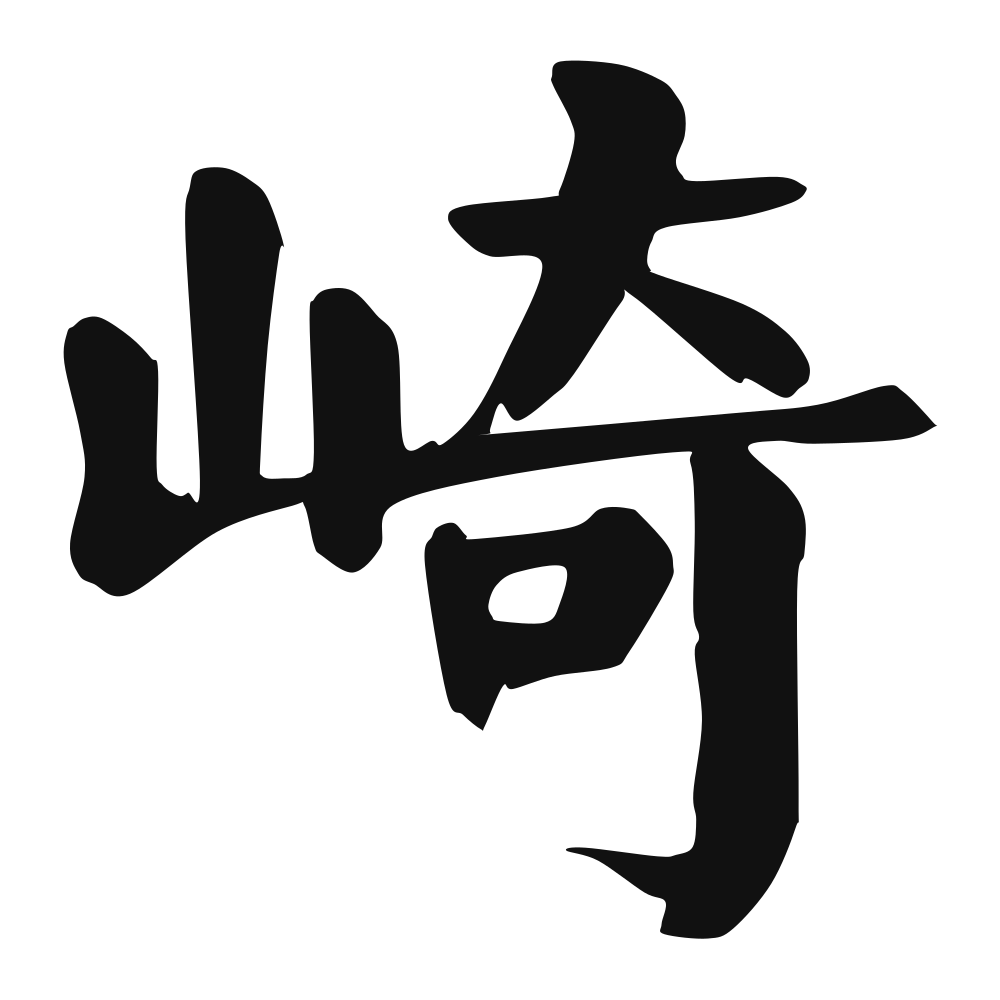
The Calligrapher — Yán Zhēnqīng 颜真卿
Tang master of robust regular script; co-creator of the enduring 'Yan style'.
Tang calligrapher (709–784), master of regular script/running script — the Tang moral paragon whose upright, muscular regular script became the model of Chinese integrity in writing. Tang dynasty
Cultural Story
Qi means uneven, broken ground, and lives almost entirely in qi qu (rugged, bumpy) with its partner qu. The Shuo Wen gives it as a dangerous path. Old road books warn of qi on the western passes, and essays use the pair for a life that will not run straight. Qi yin (lofty and steep) adds height to the roughness of the way.
Common words & phrases
- 崎岖 rugged · bumpy · uneven
- 崎崟 lofty and steep
Read the story behind the character
Your commute is qi qu (rugged, uneven) where the old lane floods, and a founder calls his startup road pure qi qu. A travel clip shows a qi yin (lofty and steep) switchback carved into the cliff, and a cyclist complains the cobbled old town is murder on thin tires. You text the path is qi when a friend asks why you're late again.
Why this character belongs on skin
The rough path is the only one that leads anywhere worth arriving. 崎 names the mountain that refuses to be smooth, the road cut angry through stone, the country of the difficult. The ancients walked it and called it fate; the Daoist calls it the way itself, for nothing true arrives by the level road. Love is 崎—the uneven country where the footing fails and you learn the other person by the stumble. A life smoothed of all resistance is a life smoothed of all meaning; the polished stone gives no purchase. Warriors are forged on the rugged pass, not the parade ground. Wear this ink where you have been wounded and kept going, and let the uneven character confess the truth you already know: the scars are the map, and the map is the only proof you were ever really moving.
Own this character
Purchase delivers the original SVG of this glyph, brushed by Yán Zhēnqīng 颜真卿, ready to place on skin, paper, or screen.