
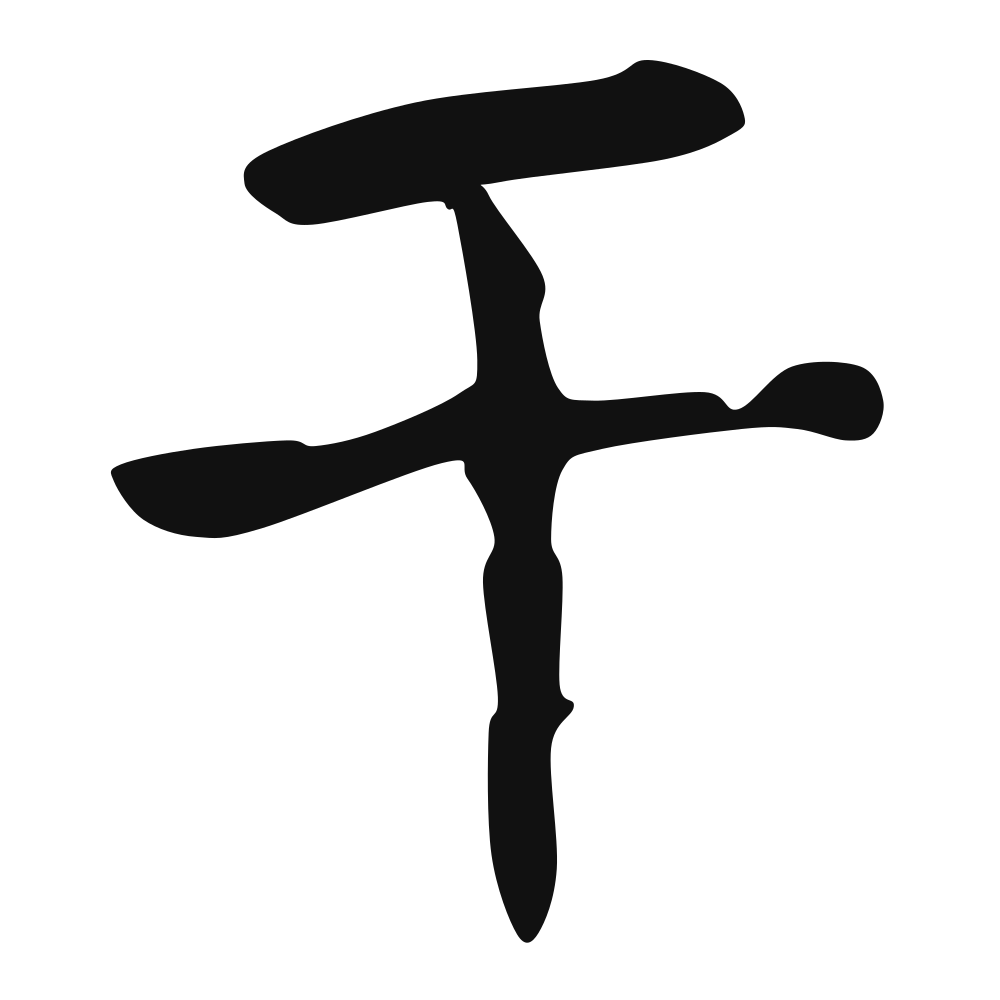
干
surname Gan; dry; dried food; empty; hollow; taken in to nominal kinship; adoptive; foster; futile; in vain; (dialect) rude; blunt; (dialect) to cold-shoulder; (bound form) to have to do with; to concern oneself with; one of the ten heavenly stems 天干[tian1 gan1]; (archaic) shield; tree trunk; main part of sth; to manage; to work; to do; capable; cadre; to kill (slang); to fuck (vulgar); (coll.) pissed off; annoyed
Closest English meanings
dry·to do·trunk
The Calligrapher — Yán Zhēnqīng 颜真卿
Tang master of robust regular script; co-creator of the enduring 'Yan style'.
Tang calligrapher (709–784), master of regular script/running script — the Tang moral paragon whose upright, muscular regular script became the model of Chinese integrity in writing. Tang dynasty
Etymology & Meaning · 字义溯源
2 · The Character: 干 Gān (1st tone), also gàn (4th). Shuowen Jiezi (卷三) glosses 干 as 犯也 — 'to encroach, to offend' — and explains the graph as 从反入,从一, an inverted 入 pushing up against a line. From that shaft-like form grew three classical senses. First, a shield: 《詩·周南·兔罝》 sings 赳赳武夫,公侯干城 — 'the stalwart warrior, shield and city-wall of his lord' — and 《書·大禹謨》 has 舞干羽于兩階. Second, a riverbank: 《詩·魏風·伐檀》 gives 坎坎伐檀兮,寘之河之干兮, and 《易·漸》 初六 reads 鴻漸于干. Third, 'to seek': 《論語·為政》 records 子張學干祿. Kangxi counts three strokes. Honest disclosure: simplified 干 absorbed both 乾 (dry) and 幹 (trunk, to do), and in Mainland internet slang 干 functions as a crude sexual verb — a literate Chinese reader may see that first. It is also the 天干 of the sexagenary cycle. Never sell 干 as a bare power word; pair it (干城, 骨干) so the shield sense governs.
Cultural Story
干 is a knot of three old words: a shield (干戈, weapons), 'dry' (the simplified 乾), and 'trunk or to do' (幹). The Odes speak of 干戈, shields and spears, for war, while 乾 means the clear, dry heaven. Reforms merged them all under 干. So one syllable now holds the soldier's shield, the parched air, and the work of hands - a small monument to how Chinese writing compresses history.
Common words & phrases
- 干净 clean
- 干部 cadre
- 干活 to work
- 干燥 dry
- 能干 capable
Read the story behind the character
You wipe the table 干净, clean, and a 干部, a cadre, runs the village office. After school you 干活, do the work, in the field, and the weather is 干燥, dry, in autumn. Everyone wants a 能干, capable, colleague. From cleaning to cadres to capability, 干 packs a soldier's shield, dry weather, and hard labour into the busiest little character of daily speech.
Why this character belongs on skin
干 is a tree stripped to its trunk — and from that single upright line came a whole vocabulary of doing. To do, to act, to be the spine of something. The character also meant a shield, the board a soldier raised, and there too is the shape: a vertical stand against what comes. To carry 干 is to claim the dignity of the doer over the talker, the person whose life is measured in what got handled, not what got said. We are drowning in intention; this mark is the opposite, the dry trunk that does not weep or explain. It is for the one who stepped up when the room went quiet. There is a plainness to 干 that feels almost sacred — no flourish, just the vertical fact of standing in the way of harm or in service of the work. Ink it like a shield you wear on the inside, the part of you that simply says: I'll handle it.
Own this character
Purchase delivers the original SVG of this glyph, brushed by Yán Zhēnqīng 颜真卿, ready to place on skin, paper, or screen.