
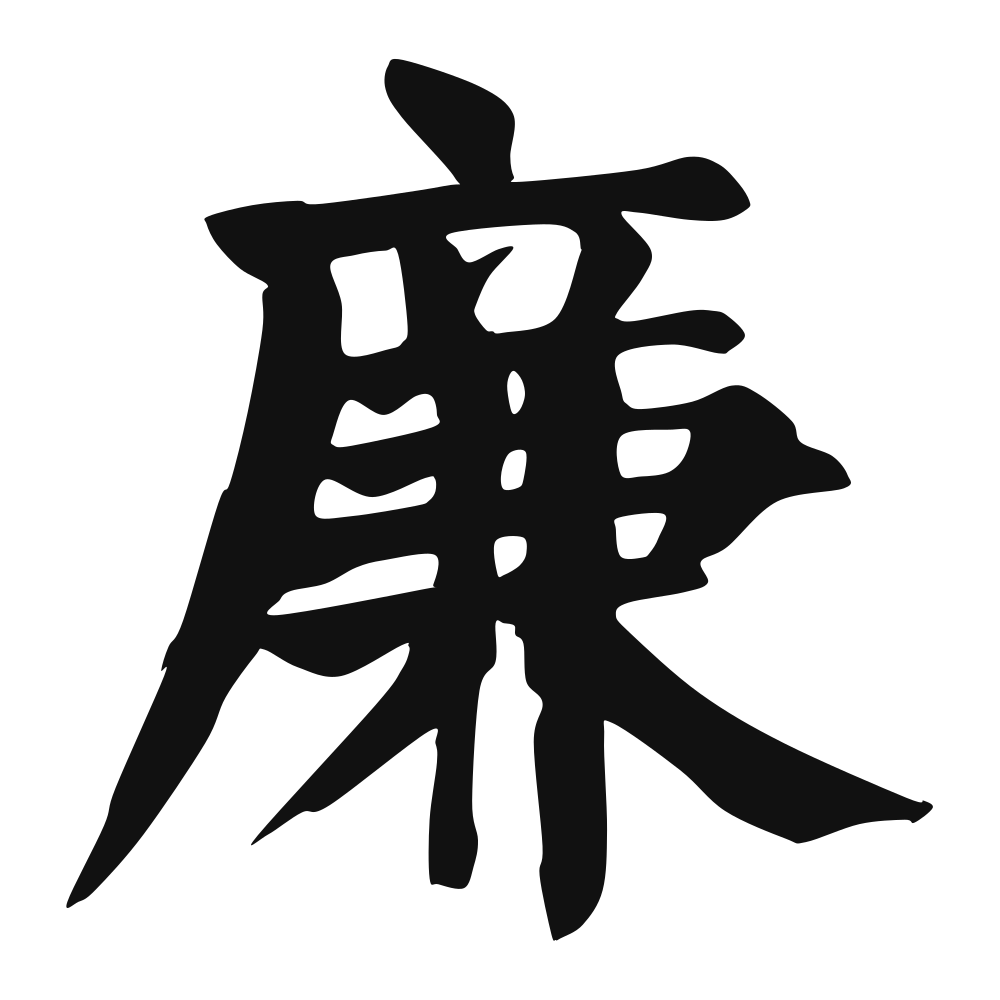
廉
廉 (lián) — honest, incorruptible, frugal. Roof 广 + 兼 (unite): gathering under one roof with restraint. Classical life: 廉洁 — clean and honest, the core of official virtue. Grammar: free morpheme — also: surname Lian; incorruptible; honest; inexpensive; to investigate (old); side wall of a traditional Chinese house (old)
Closest English meanings
honest·incorruptible·cheap·upright
The Calligrapher — Yán Zhēnqīng 颜真卿
Tang master of robust regular script; co-creator of the enduring 'Yan style'.
Tang calligrapher (709–784), master of regular script/running script — the Tang moral paragon whose upright, muscular regular script became the model of Chinese integrity in writing. Tang dynasty
Cultural Story
廉 is the bare corner of a wall, the clean edge with nothing piled against it — and so, honesty. 魏徵 spoke truth to 唐太宗 without flinching, the model of 廉臣, and 廉恥, the sense of shame, was the hinge 管仲 said held a state together. The word is upright because the corner is empty.
Energy Reading
Wood (木)
Comparative symbology, not fortune-telling.
Common words & phrases
- 廉洁 honest · clean · incorruptible · upright
- 清廉 upright · honest · clean · uncorrupted
- 廉价 cheap · low-priced · inexpensive
- 廉政 clean government · honest administration · honest governance
- 低廉 low · cheap · inexpensive
- 廉耻 sense of honor · shame · propriety
Read the story behind the character
廉政 is the slogan on the anti-corruption billboard, 廉价 the tag that moves the shirt online, 廉洁 the line a officials' obituary cannot skip. The empty corner is now a campaign and a discount alike — the edge still means unburdened, whether by bribes or by price.
Why this character belongs on skin
廉 is integrity with an edge — literally. Its oldest sense was the steep side of a thing, the clean angle of a wall or a blade that will not curve; from that geometry the word became the supreme virtue of the honest official. 廉洁, incorruptible; 廉吏, the magistrate who left office with the same cloak he arrived in. The histories revere such men — the minister who refused the jade worth fifteen cities, the judge who would not take the bribe even from the emperor's mother — because everyone in the palace understood how rare the straight edge was. Confucius ranked it near the root of worthiness: a person who cannot be bought has a floor beneath every other virtue. The character does not promise wealth; it promises that no one will ever own the corner of you that bends. To wear 廉 is to keep that edge — unbribed by money, flattery, or fear.
Own this character
Purchase delivers the original SVG of this glyph, brushed by Yán Zhēnqīng 颜真卿, ready to place on skin, paper, or screen.