
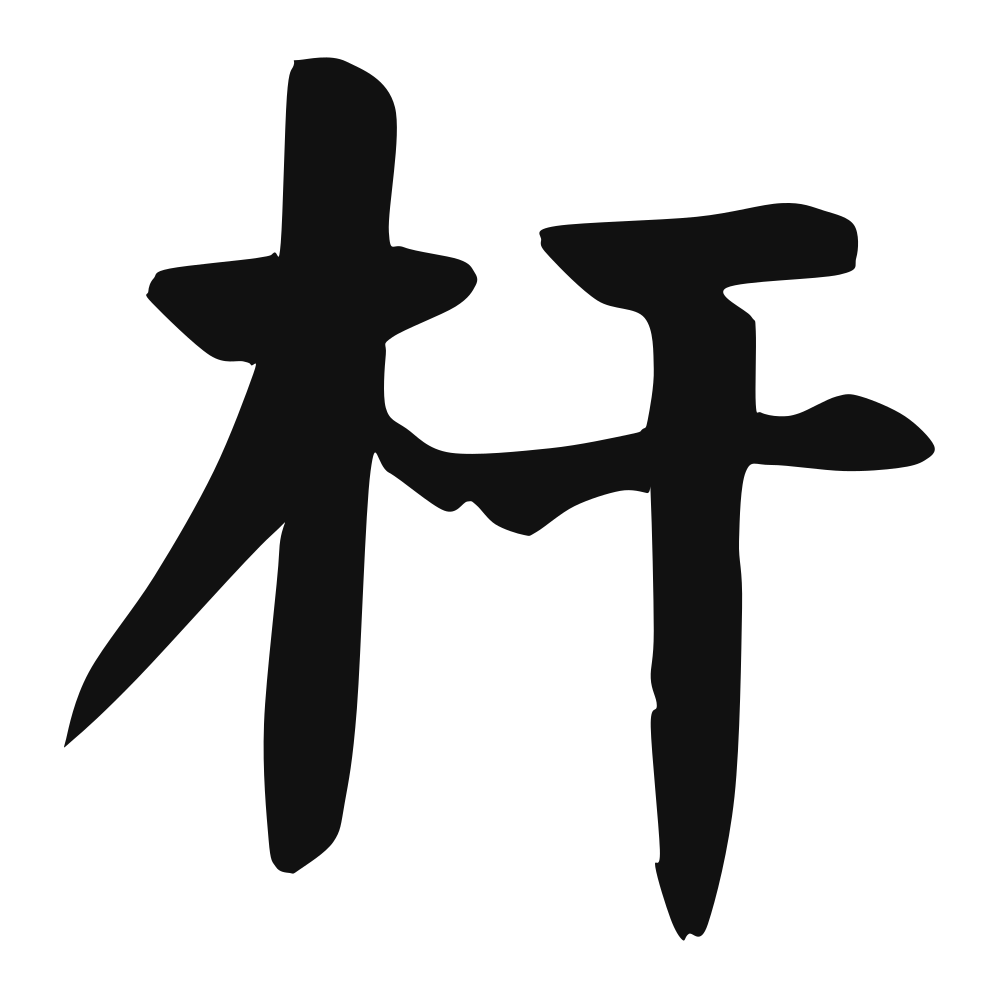
杆
(bound form) pole; shaft; stick; pole; lever
Closest English meanings
pole·rod·shaft
The Calligrapher — Yán Zhēnqīng 颜真卿
Tang master of robust regular script; co-creator of the enduring 'Yan style'.
Tang calligrapher (709–784), master of regular script/running script — the Tang moral paragon whose upright, muscular regular script became the model of Chinese integrity in writing. Tang dynasty
Cultural Story
杆 is a slender wooden shaft, a word that names the straight stick before it names what hangs on it. The flagpole before the yamen, the railing along a bridge — 杆 is the support made simple. It is a working word, never the subject of a poem, only the thing a thing leans on to stand.
Common words & phrases
- 杆子 pole · rod
- 旗杆 flagpole
- 栏杆 railing · balustrade
- 杠杆 lever
- 杆菌 bacillus
Read the story behind the character
杆 props up the physical world: 旗杆 flies the national flag at a school; 栏杆 keeps you from the subway edge; 杠杆 is the physics teacher's first diagram. 杆菌 is the rod-shaped germ in a microbiology textbook. The character is infrastructure, the plain shaft you grab without ever naming it.
Why this character belongs on skin
A gān is a straight pole — the staff you lean a lantern on, the rod that holds a banner up so the wind can read it, the bare vertical line that says direction when everything around is noise. On its own it is nothing: a stick. Set with intention, it becomes the spine of something. We are rarely the banner. More often we are the pole — plain, load-bearing, unnoticed, doing the unromantic work of holding something higher than ourselves in place. To wear gān is to accept that role without shame. The tattoo is a single clean stroke down the arm or the back, the kind of line a person draws when they want to remember they can stand. Not for show. Simply: I am the thing that holds, and I am still upright.
Own this character
Purchase delivers the original SVG of this glyph, brushed by Yán Zhēnqīng 颜真卿, ready to place on skin, paper, or screen.