
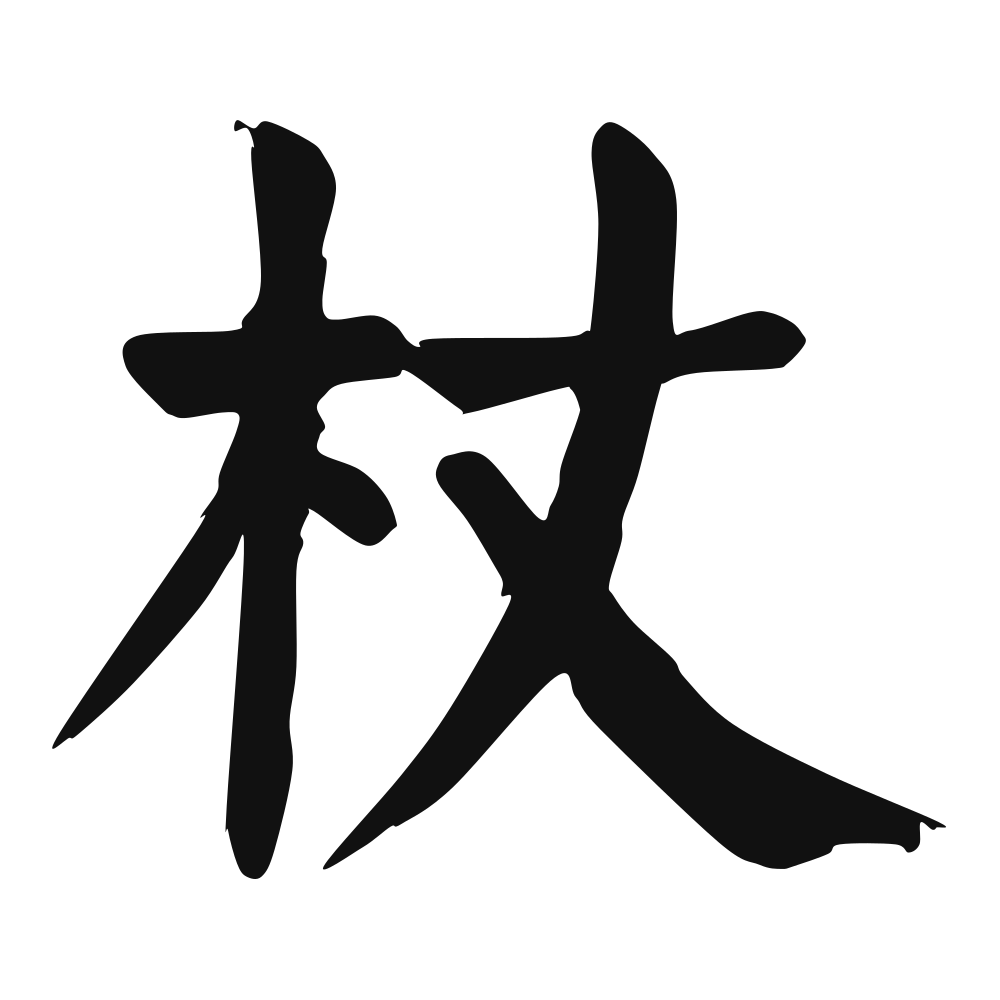
杖
a staff; a rod; cane; walking stick; to flog with a stick (old)
Closest English meanings
cane·staff·stick
The Calligrapher — Yán Zhēnqīng 颜真卿
Tang master of robust regular script; co-creator of the enduring 'Yan style'.
Tang calligrapher (709–784), master of regular script/running script — the Tang moral paragon whose upright, muscular regular script became the model of Chinese integrity in writing. Tang dynasty
Etymology & Meaning · 字义溯源
### Soundzhàng — zhàng (4th tone). Free-standing morpheme ### Original meaningZhàng (4th tone). The Shuowen Jiezi defines it as 「杖,持也。从木,丈聲」 — 'to hold', from 木 with 丈 as phonetic; the Kangxi dictionary, quoting the Shuowen under the other reading, gives 「所以扶行也」 — 'that by which one supports walking'. Both belong to the same word: the staff is what the hand holds and what the body leans on. Its oldest citations are martial and ceremonial: 《尚書·牧誓》 「王左杖黃鉞」 — 'the king held the yellow axe in his left hand'; 《漢書·蘇武傳》 「杖漢節牧羊」 — he herded sheep holding the Han envoy's staff. But its deepest classical life is as the mark of age and of mourning. 《禮記·王制》 grades a life by it: 「五十杖於家,六十杖於鄉,七十杖於國,八十杖於朝」 — the staff at fifty in the house, at sixty in the village, at seventy in the state, at eighty at court — and 《禮記·曲禮》 「大夫七十而致事,若不得謝,則必賜之几杖」. 《禮記·喪服小記》 gives the funerary pair: 「父喪,苴杖竹也;母喪,削杖桐也」 — for a father, the rough bamboo staff; for a mother, the trimmed paulownia. Honest disclosure, and it matters: 杖 is also 杖刑, the statutory beating — from the Sui code one of the five punishments — and 《孔子家語》 has 舜 '小棰則待過,大杖則逃走'. Kangxi 7 画 (木部 + 3); the naming tables read Wood (木). ### The structure (形聲 · 从木,丈聲 — wood (木) with 丈 ('a grown man, ten feet') as phonetic; the measure of a man in the measure of a stick)①木mùwood, treethe material the staff is cut from②丈zhànga grown manthe phonetic, itself a measure of height — a man's reach③杖zhàngstaffwhat is held, and what holds you up④杖刑zhàngxíngjudicial caningthe same graph in the law-courts — the sense no buyer expects ### In use todayItemReading / meaningNoteReadingzhàng (4th tone)single syllableCore sensea staff; to hold; to lean onhonourable age, but also punishment and mourningGrammarfree morpheme (noun and verb)手杖 · 拐杖 · 禪杖 · 杖刑 · 苴杖Tattoo fitcaution — the staff is real, but so are the caning and the funeral staffdisclose all three senses before inking ### Closest words in English — and what each misses - Strength — 力/強 hold 'strength'; 杖 is a support — it admits the need for one - Wisdom — 智/慧 hold 'wisdom'; 杖 marks age and office, not understanding - Walk — 行/步 hold 'to walk'; 杖 is the thing that makes walking possible - Old — 老/耆 hold 'old'; 杖 is the emblem given to the old, not the word for ageAn honest note on grammar. Free morpheme — 手杖 (walking stick), 禪杖 (monk's staff), 拐杖 (crutch); also a verb 'to hold, to lean on', and the noun 杖刑 (judicial caning)Where a Western reader can stand: 杖 (zhàng) is the staff — what the hand holds and the body leans on. In the 禮記 a life is measured by it: the staff at fifty in the house
Cultural Story
杖 is the staff a traveler leans on and the rod a magistrate used to beat — 杖刑 was a standard punishment, counted in strokes. The 論語 shows the old teacher with his 杖. A 權杖 marks a king. The character is support and authority at once, the stick that helps you walk or strikes you down without changing hands.
Where a Western reader can stand: 杖 (zhàng) is the staff — what the hand holds and the body leans on. The Liji measures a life by it: staff at fifty in the house, eighty at court. Su Wu herded sheep nineteen years with the Han staff in hand, so it can mean loyalty as much as frailty. The honest caution: the same graph writes 杖刑, judicial caning, and the mourning staff at a parent's funeral. As a tattoo it reads as weathered, patient support — if all three senses are known.
Common words & phrases
- 拐杖 walking stick · crutch
- 手杖 cane · staff
- 權杖 scepter
- 杖刑 caning punishment
Read the story behind the character
杖 is the cane by the door: 拐杖 for a grandmother's slow mile, 手杖 for the hiker on a mountain. 杖刑 is historical, a punishment you read about in a museum case on the Tang legal code. The character has lost its violent job and kept its helpful one; it is the stick that steadies.
Why this character belongs on skin
The zhàng is the staff you take when the legs begin to doubt — the cane, the pilgrim's rod, the piece of wood between you and the ground when the ground gets far. It is not a crutch for the weak. It is the wise man's instrument, the thing that lets a long life keep walking. Every journey worthy of the name eventually requires one. To mark zhàng on the body is to make a pact with your own future: when the strength thins, I will still find a way forward, and I will not be ashamed of the help. The tattoo is the staff drawn in ink, carried nowhere and everywhere. A line down the forearm like a second bone — proof that to keep going, at any cost, was always the point. The mark is the promise to continue.
Own this character
Purchase delivers the original SVG of this glyph, brushed by Yán Zhēnqīng 颜真卿, ready to place on skin, paper, or screen.