
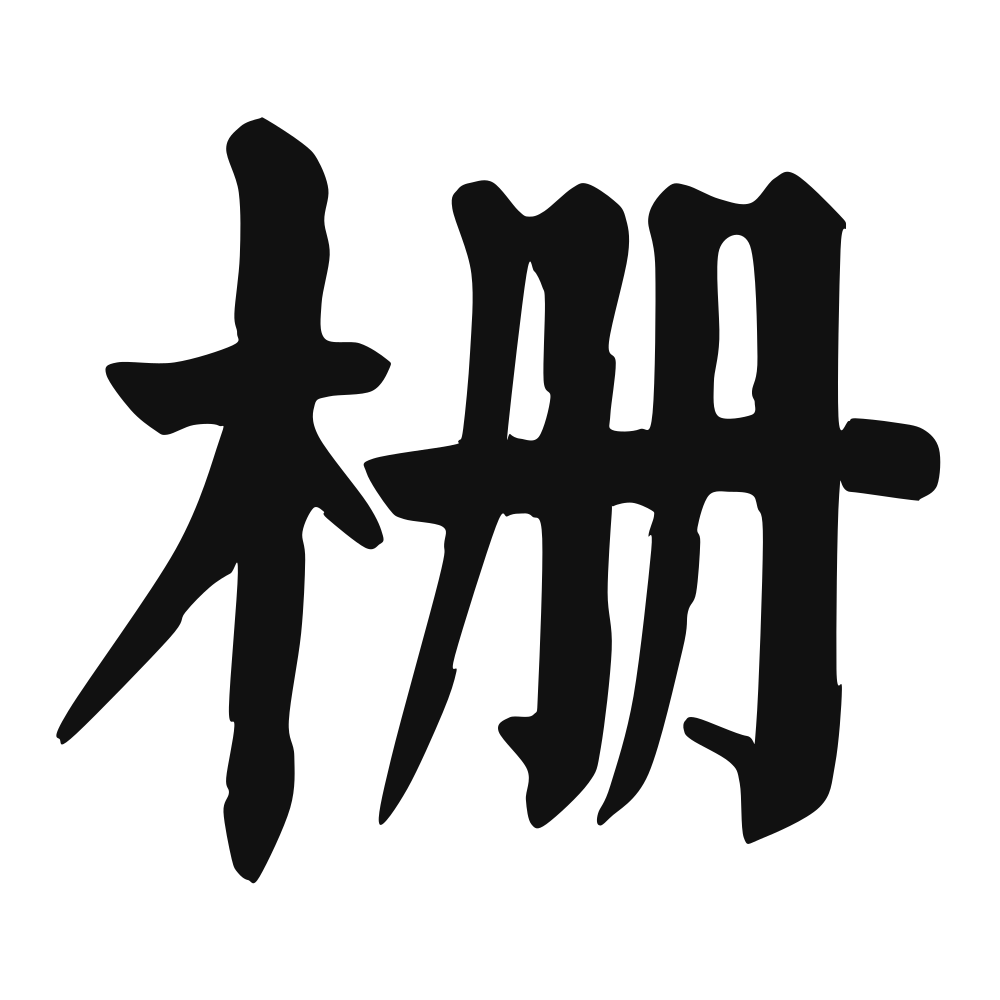
The Calligrapher — Yán Zhēnqīng 颜真卿
Tang master of robust regular script; co-creator of the enduring 'Yan style'.
Tang calligrapher (709–784), master of regular script/running script — the Tang moral paragon whose upright, muscular regular script became the model of Chinese integrity in writing. Tang dynasty
Cultural Story
栅 is a fence of stakes, the 木 set in a row to mark and guard a boundary — the word of the pen and the palisade. It is a builder's term, never a poet's; the character names the line drawn to keep sheep in or raiders out. Structure, not sentiment, is the whole of its ancient business.
Common words & phrases
- 栅栏 fence · railing · palisade
- 栅极 grid · gate electrode
- 栅门 gate · fence gate
Read the story behind the character
栅 is the barrier and the circuit: 栅栏 the fence around a construction site, 栅门 the gate to a schoolyard, 栅极 the control grid inside a vacuum tube. The character is both the wooden line you can't cross and the metal lattice in a device. It is containment, literal and electronic, doing the same job.
Why this character belongs on skin
The wooden bars keep the wolf out and the child in. The fence, the railing, the boundary drawn so that something precious can be safe. To fence is not to fear the world but to honor what's inside: the garden, the sleep, the unguarded hour. The hermit walled his hut not to hide but to choose his threshold, who crossed and who did not. A boundary is a kind of love, it says this far, and no further, and here I am whole. To carry this mark is to claim your lines, the edges you defend, the perimeter of a self worth protecting. Ink it as a band around the bicep or the ankle, a fence in line. You are not closed. You are circumscribed, deliberately, the way a sacred ground is marked. Cross, and you will know you were permitted.
Own this character
Purchase delivers the original SVG of this glyph, brushed by Yán Zhēnqīng 颜真卿, ready to place on skin, paper, or screen.