
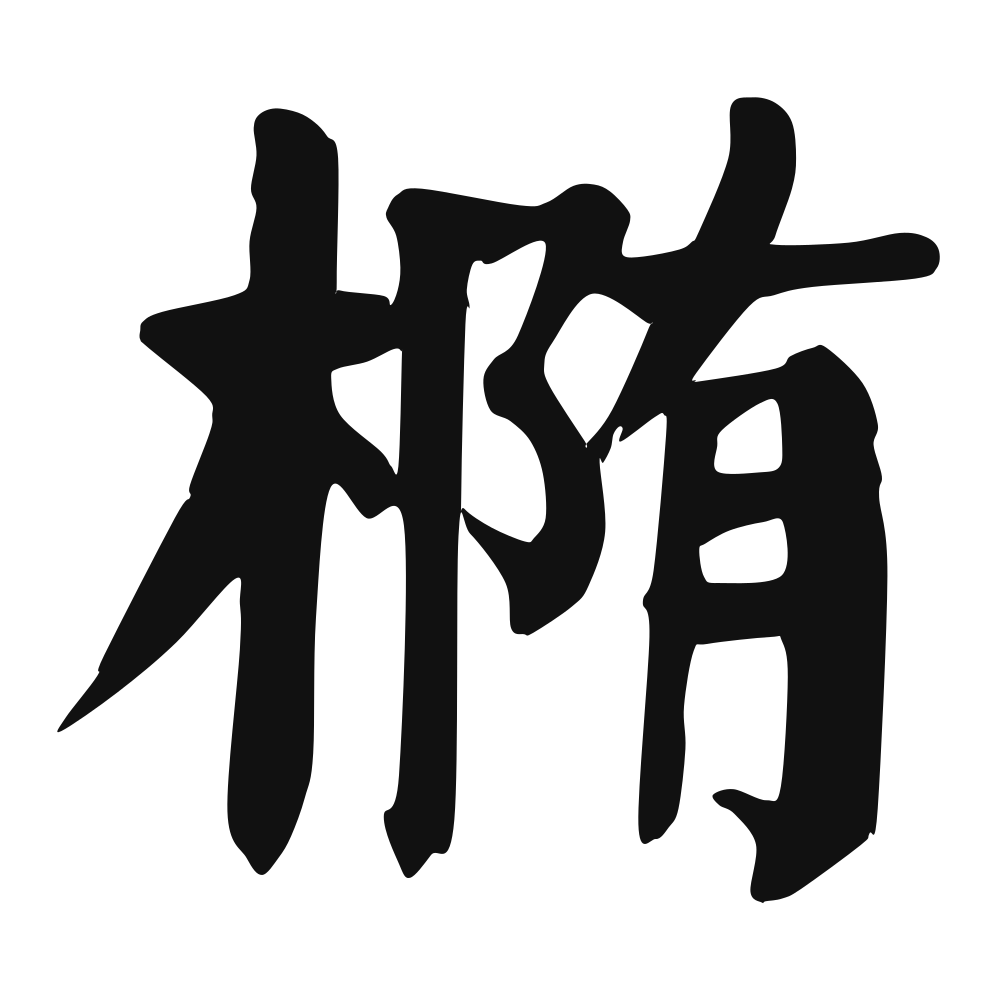
The Calligrapher — Yán Zhēnqīng 颜真卿
Tang master of robust regular script; co-creator of the enduring 'Yan style'.
Tang calligrapher (709–784), master of regular script/running script — the Tang moral paragon whose upright, muscular regular script became the model of Chinese integrity in writing. Tang dynasty
Cultural Story
椭 is a late, technical character — an oval or elongated circle, the 木 of a long-handled implement by old form, but in modern use purely a geometric shape. It has no poem, no dynasty; it is the vocabulary of the math class and the astronomy diagram. The ellipse is all it means to anyone now.
Common words & phrases
- 椭圆 oval · ellipse
- 椭球 ellipsoid
Read the story behind the character
椭 is the shape of orbits and eggs: 椭圆 the ellipse a planet traces and the oval of a dining table, 椭球 the ellipsoid a geographer models. You meet it in a textbook or a CAD file. The character is pure geometry, the stretched circle, with no classical life to speak of at all.
Why this character belongs on skin
Not every truth is a circle. The tuo — the oval — is what the egg is, what the moon nearly is, what the face becomes when seen in honest profile. The Greeks sought perfection in the sphere, but the hand that drew the first oval knew the world is longer than it is wide, and more interesting for it. To carry tuo in ink is to reject the tyranny of the perfect round, to honor the shape that fits the hand and the eye at once. It is a small heresy against symmetry, a love letter to the slightly off. Let this character lie along a rib or a collarbone, a quiet pledge that you are not a circle closed upon yourself but an open curve, still becoming, never quite finished, and far more beautiful for the asymmetry.
Own this character
Purchase delivers the original SVG of this glyph, brushed by Yán Zhēnqīng 颜真卿, ready to place on skin, paper, or screen.