
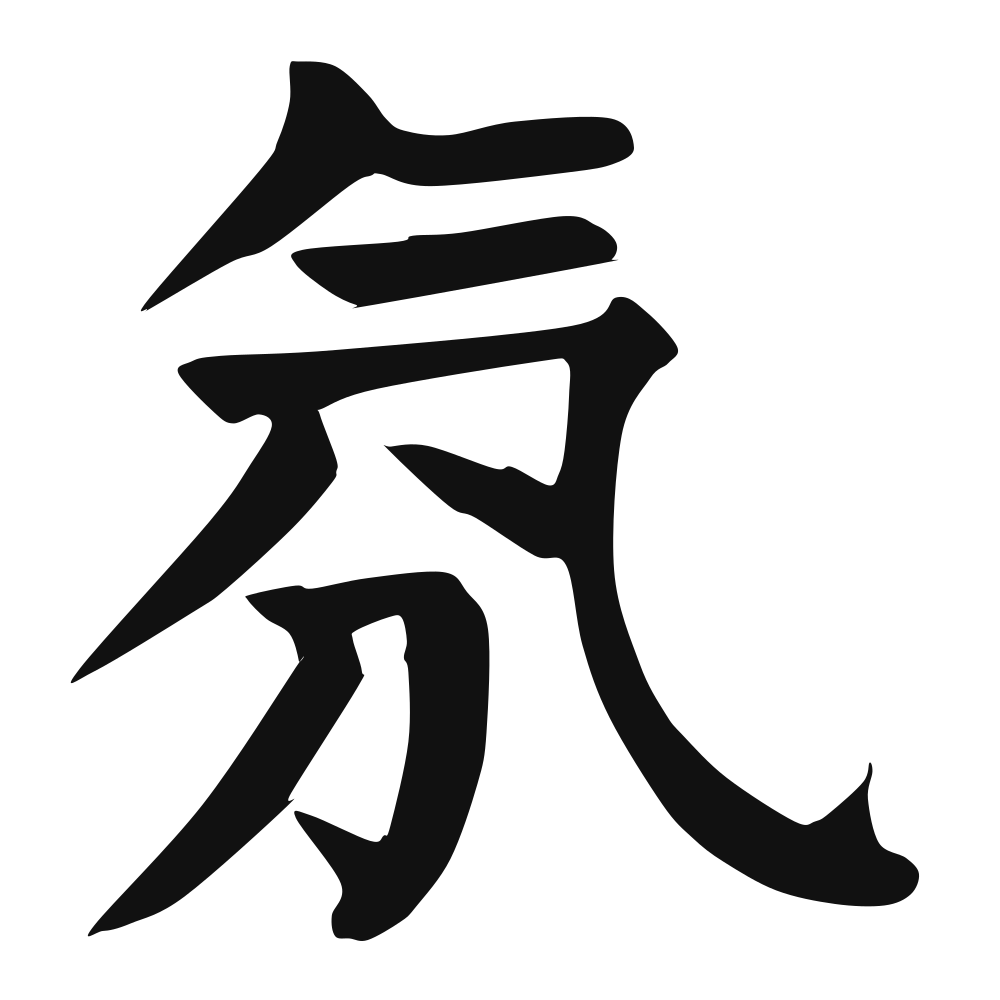
The Calligrapher — Yán Zhēnqīng 颜真卿
Tang master of robust regular script; co-creator of the enduring 'Yan style'.
Tang calligrapher (709–784), master of regular script/running script — the Tang moral paragon whose upright, muscular regular script became the model of Chinese integrity in writing. Tang dynasty
Cultural Story
氛 is the aura or vapors hanging in the air; the 說文解字 gives '祥氣也', auspicious vapor, though it often meant an ominous haze before battle. In classical poetry 氛 was the charged air of a place or moment — the mood made almost visible, a cloud of feeling settling over a scene.
Common words & phrases
- 气氛 atmosphere
- 氛围 ambience · atmosphere
Read the story behind the character
氛 names the mood: a wedding has a warm 氣氛 (atmosphere), a meeting a tense one. We speak of 氛圍 (ambience, atmosphere) in a café or classroom. The character captures the invisible tone of a room — the feeling you sense the moment you walk in, before anyone has said a word.
Why this character belongs on skin
Walk into a room and you know before a word is spoken whether you can breathe. That invisible weather is 氛—the atmosphere, the mood, the quality of the air itself. Its root is 气, the breath of the world, the qi the physicians felt moving through the body and the landscape alike. A place can hold a 氛 of mourning or of joy, and you inherit it the moment you cross the threshold, whether you believe in it or not. To be sensitive to 氛 is to be alive to the unseen, to read the room the way a reed reads the wind. To wear this character is to claim that sensitivity, that you are moved by what cannot be measured. Let it rest where the air touches you first, a small character of ink that says you felt it, the weather of the soul, and you were honest about the cold.
Own this character
Purchase delivers the original SVG of this glyph, brushed by Yán Zhēnqīng 颜真卿, ready to place on skin, paper, or screen.