
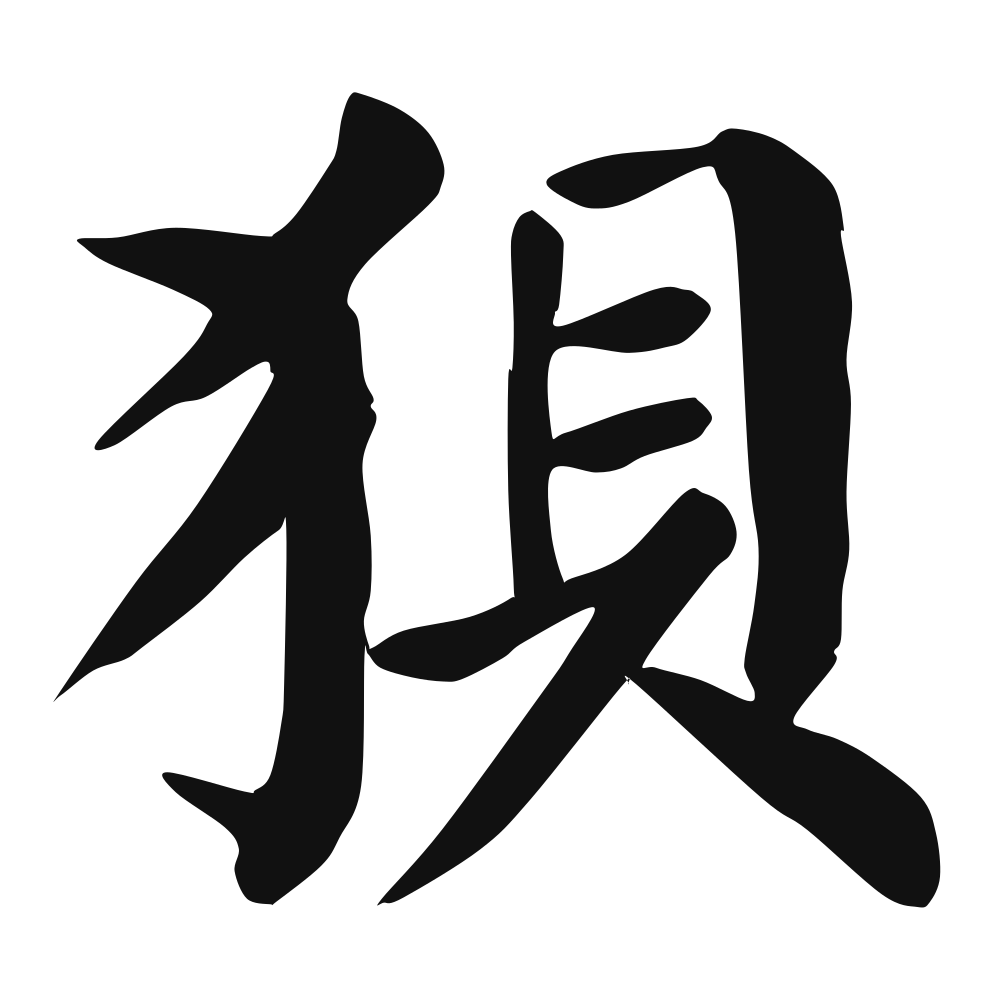
狈
a legendary wolf; distressed; wretched
Closest English meanings
(in 狼狈) in a fix
The Calligrapher — Yán Zhēnqīng 颜真卿
Tang master of robust regular script; co-creator of the enduring 'Yan style'.
Tang calligrapher (709–784), master of regular script/running script — the Tang moral paragon whose upright, muscular regular script became the model of Chinese integrity in writing. Tang dynasty
Cultural Story
狈 is a legendary beast said to walk only by riding on a wolf's neck; alone it falls. The phrase 狼狈 describes a fix where two depend on each other and both fail. The Hou Hanshu and fables use 狼狈不堪 for utter embarrassment and distress. The char is the comic, telling image of helpless entanglement, caught, leaning, and toppling together in public.
Common words & phrases
- 狼狈 in a difficult position · in a fix
- 狼狈不堪 utterly embarrassed · in great distress
Read the story behind the character
We say someone is 狼狈 in a difficult position, and 狼狈不堪 utterly embarrassed after a fall in public. The folk 狼狈, a wolf with a 狈 on its back, explains why two crooks fail together. Though 狈 alone is rare, the phrase paints every awkward scene, spilled coffee, missed trains, the red-faced stumble we laugh about later with friends.
Why this character belongs on skin
Some creatures were never meant to stand alone. Bèi is the mythic beast the old bestiaries described as frontless and feeble, able to walk only by riding the shoulders of its wolf—and the wolf, in turn, gained the cunning it lacked. Together they were a partnership the language later bent toward trouble, but whose root was pure interdependence. To ink this on your skin is to confess a beautiful truth: you have a wolf, and you are someone's bèi. You lean, and in leaning you make another whole. Let it rest where you would let a trusted body press. Pride is a lonely invention. The mark is your pledge to the one who carries you, and the quiet pride of being worth carrying.
Own this character
Purchase delivers the original SVG of this glyph, brushed by Yán Zhēnqīng 颜真卿, ready to place on skin, paper, or screen.