
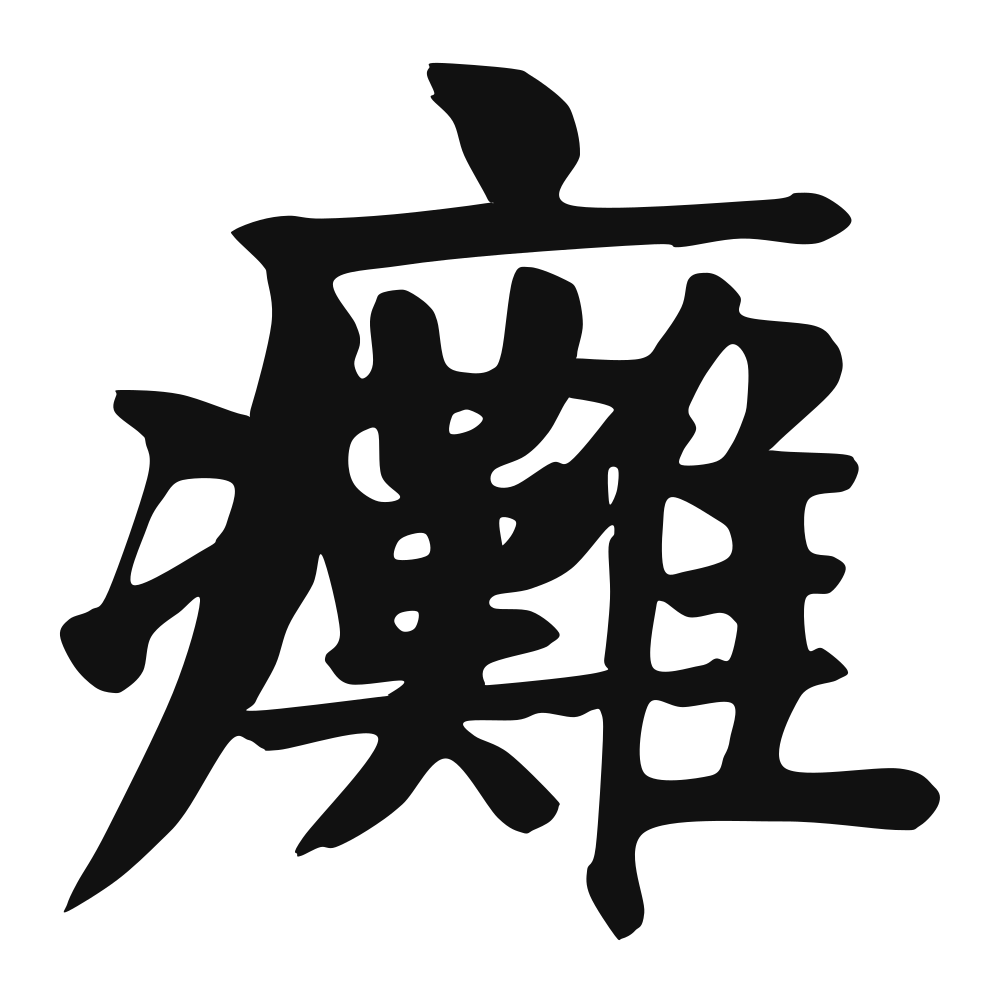
The Calligrapher — Yán Zhēnqīng 颜真卿
Tang master of robust regular script; co-creator of the enduring 'Yan style'.
Tang calligrapher (709–784), master of regular script/running script — the Tang moral paragon whose upright, muscular regular script became the model of Chinese integrity in writing. Tang dynasty
Cultural Story
瘫 rides on 难, difficulty: the body that difficulty has conquered. Qing case records describe stroke survivors left 瘫痪, families hiring bonesetters and monks in equal measure, and physicians arguing bitterly over whether needle, drug or sheer stubborn will might summon the cold limbs back to life.
Common words & phrases
- 瘫痪 paralysis · paralyzed
- 瘫软 limp · weak
- 瘫子 paralytic
Read the story behind the character
Real medicine aside, 瘫痪 (paralysis) became China's favorite system-crash word: the metro's payment system 瘫痪, a livestream platform 瘫痪 during a concert sale, the office printer 瘫痪 before a deadline. Then you drag home 瘫软 (limp) and become, proudly, a sofa-bound 瘫子 (paralytic).
Why this character belongs on skin
Some days the body simply quits. 瘪's darker cousin, 瘫 is the collapse—limbs gone to stone, the hour you could not get out of bed, or the night exhaustion hit like a switch thrown. Modern Chinese speaks of being 瘫 in front of the phone after work, a whole generation joking at the edge of real exhaustion. But underneath the joke is something the character dignifies: stillness that is not chosen, and the long, humiliating, heroic work of learning to move again. Stroke survivors know this character intimately, stroke by relearned stroke—fingers remembering how to hold a spoon. It belongs on the body of anyone who has been flattened and has gotten up slowly, without an audience, one grinding centimeter at a time. The paralysis was real. So is the standing. Ink the testimony.
Own this character
Purchase delivers the original SVG of this glyph, brushed by Yán Zhēnqīng 颜真卿, ready to place on skin, paper, or screen.