
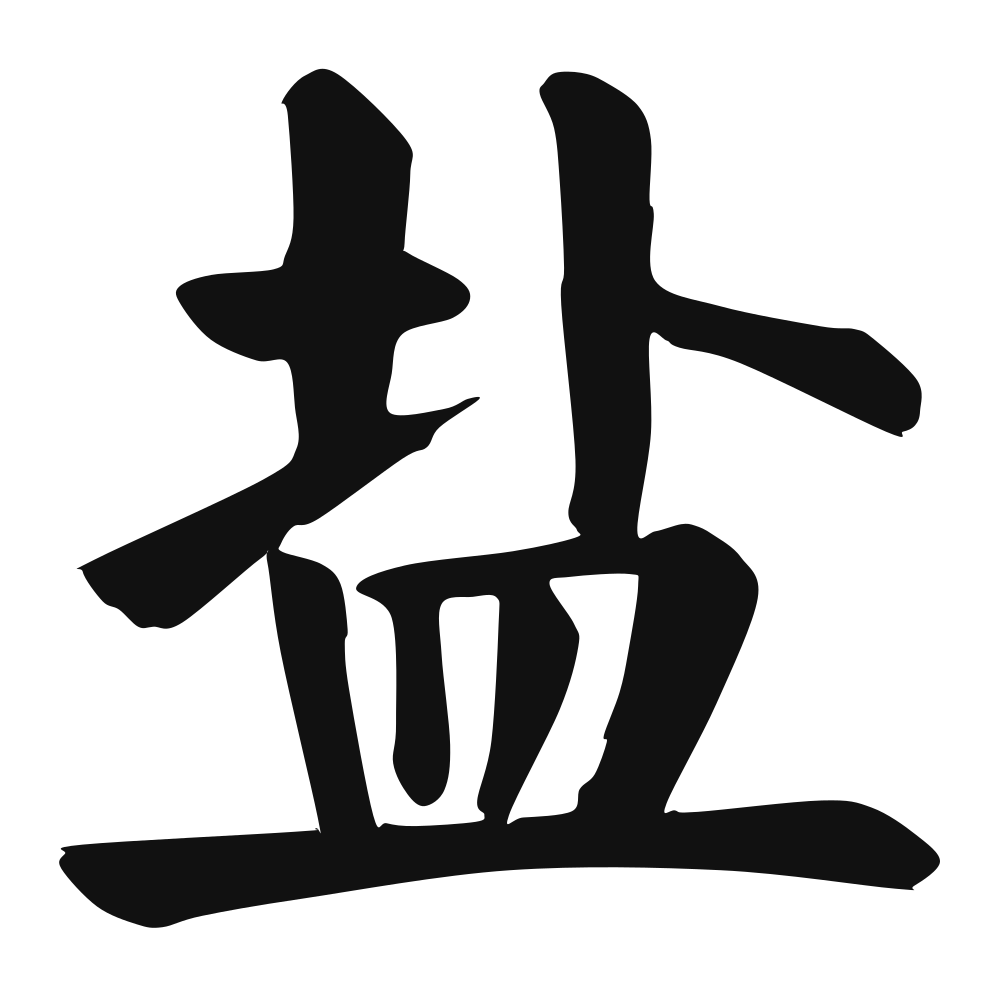
The Calligrapher — Yán Zhēnqīng 颜真卿
Tang master of robust regular script; co-creator of the enduring 'Yan style'.
Tang calligrapher (709–784), master of regular script/running script — the Tang moral paragon whose upright, muscular regular script became the model of Chinese integrity in writing. Tang dynasty
Cultural Story
Salt fed empires and treasuries. The statesman Guan Zhong made salt a state monopoly in Qi, and the Han court's great debate over the salt trade became the book 盐铁论. Coastal families boiled 海盐 from seawater, inland wells yielded brine, and a pinch of salt sealed both kitchen and oath.
Common words & phrases
- 食盐 table salt
- 盐巴 salt
- 海盐 sea salt
- 盐酸 hydrochloric acid
Read the story behind the character
Salt is a humble supermarket item now: bags of 食盐 and trendy 海盐 sit by the checkout, grandmothers still call it 盐巴, and the school lab stocks 盐酸 for chemistry class. Health news, meanwhile, keeps warning everyone to shake far less of it onto dinner.
Why this character belongs on skin
Before there was sugar there was salt, the white necessity rubbed into meat so it would survive the long winter, the mineral the body craves and the tear already carries. This is salt — the covenant mineral, the thing the ancients seasoned their sacrifices with, the thing a soldier carries in a pouch against the desert. The Teacher called his followers the salt of the earth, the preservative, the small sharp truth that keeps the world from rotting. The Daoist knows salt in the sea and in the sweat of labor. To ink this is to claim the preserving power of plainness, the quiet essential you cannot do without. Not the spice of spectacle, but the salt — the steadying, the saving, the taste that says: this is real, this is life, this is enough.
Own this character
Purchase delivers the original SVG of this glyph, brushed by Yán Zhēnqīng 颜真卿, ready to place on skin, paper, or screen.