
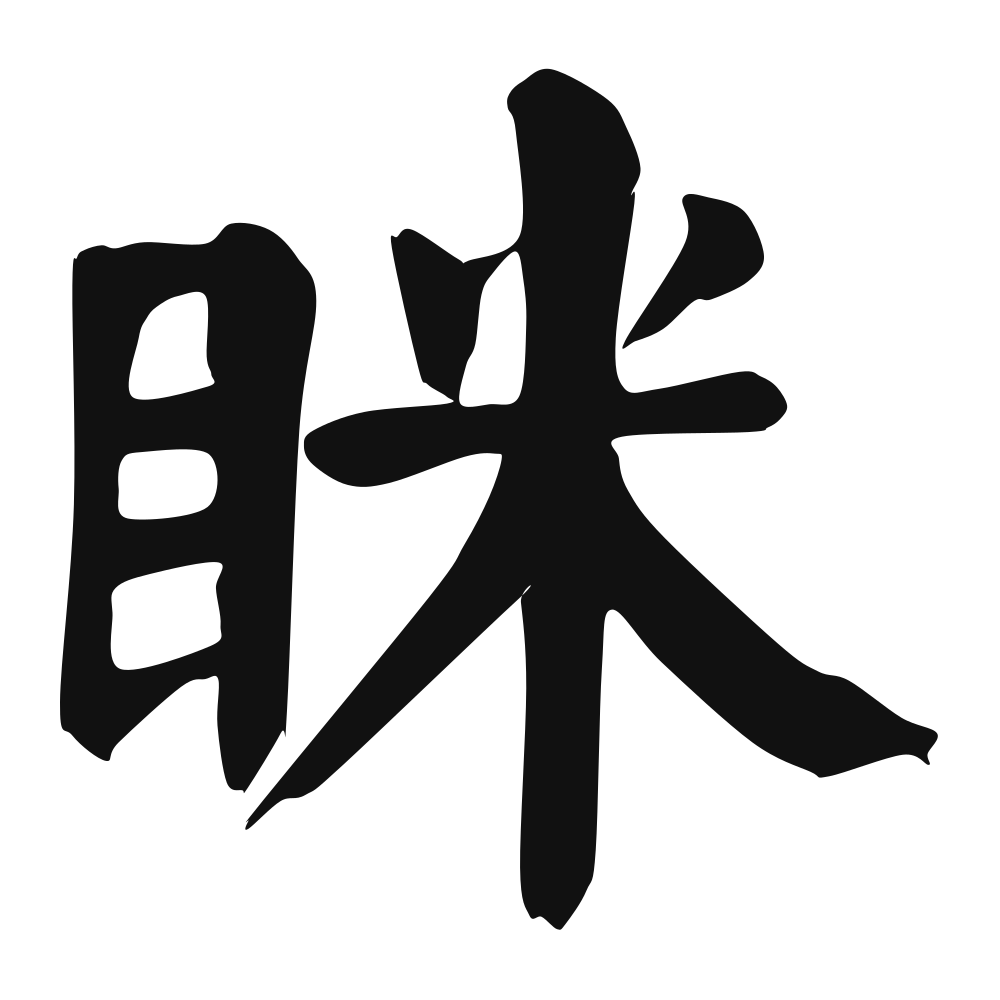
眯
to blind (as with dust); Taiwan pr. [mi3]; to narrow one's eyes; to squint; (dialect) to take a nap
Closest English meanings
to squint·to narrow eyes
The Calligrapher — Yán Zhēnqīng 颜真卿
Tang master of robust regular script; co-creator of the enduring 'Yan style'.
Tang calligrapher (709–784), master of regular script/running script — the Tang moral paragon whose upright, muscular regular script became the model of Chinese integrity in writing. Tang dynasty
Cultural Story
眯 is the narrowed eye — squinting against sun, smoke, or stitches of laughter. Old comedy gave squinting eyes to misers counting coins, and countless childhood memories hold a grandmother 眯着眼睛 threading a needle beside the window at dusk.
Common words & phrases
- 眯眼 to squint · to narrow one's eyes
- 眯縫 to squint · half-closed (eyes)
Read the story behind the character
Squinting is a daily reflex: riders 眯眼 into the morning sun, swimmers 眯缝 their eyes through the chlorine, and anyone outside without sunglasses narrows up fast. Colloquially 眯一会儿 means grabbing a quick nap, so a lunchtime 眯十分钟 might mean either — context decides.
Why this character belongs on skin
We narrow our eyes not only against the sun but against feeling too much. The character folds the lids to a line, a half-closing that is also a focusing, the way a marksman squints to find the target or a lover half-shuts to keep a sight from fading. It is restraint as a form of tenderness, the gaze that withholds so it may hold. The Daoist squints at the obvious to see the hidden current beneath; the soldier squints into the glare and does not flinch. To wear it is to claim the disciplined eye, the one that knows when to look away in order to see truly. Let it rest near the eye as a quiet art, the small line that says you have learned the mercy of not taking everything in at once.
Own this character
Purchase delivers the original SVG of this glyph, brushed by Yán Zhēnqīng 颜真卿, ready to place on skin, paper, or screen.