
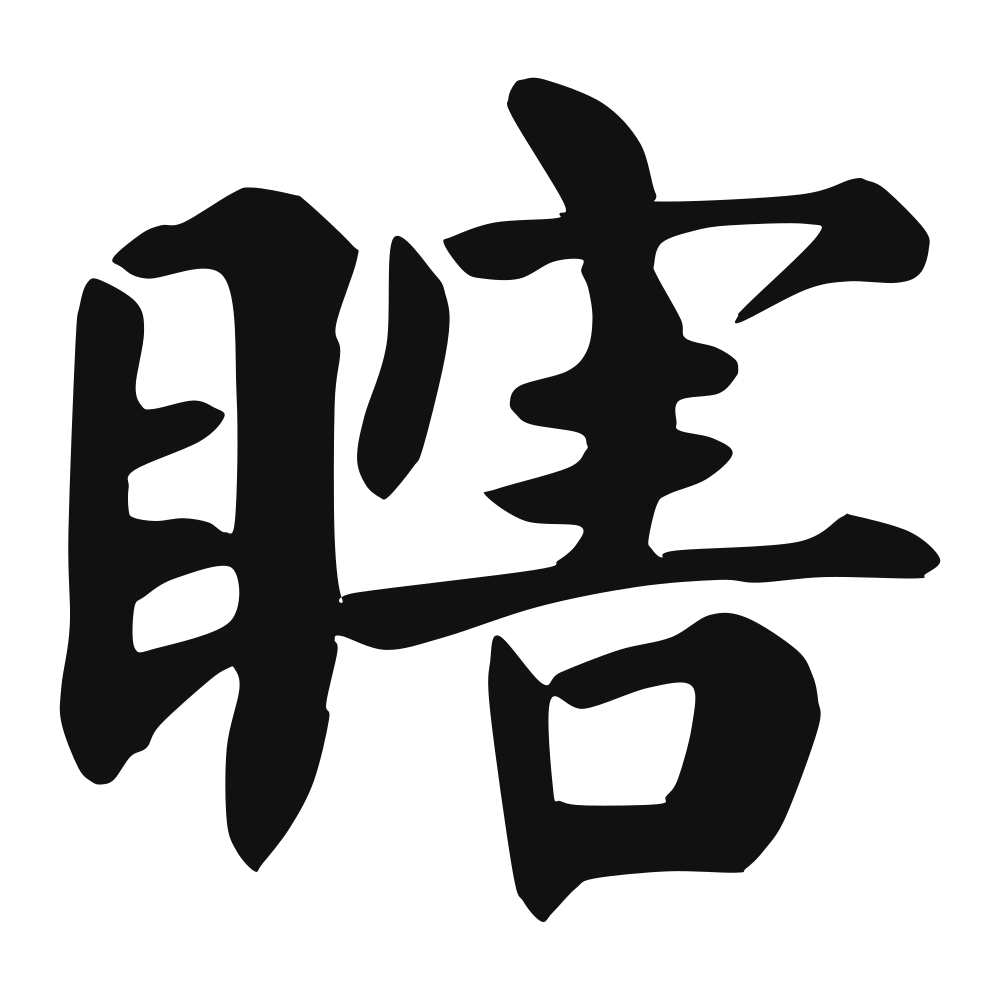
瞎
blind; groundlessly; foolishly; to no purpose
Closest English meanings
blind·foolishly
The Calligrapher — Yán Zhēnqīng 颜真卿
Tang master of robust regular script; co-creator of the enduring 'Yan style'.
Tang calligrapher (709–784), master of regular script/running script — the Tang moral paragon whose upright, muscular regular script became the model of Chinese integrity in writing. Tang dynasty
Cultural Story
瞎 pairs the eye radical with 害, 'harm': eyes harmed into darkness. It is a relatively late, earthy word, absent from early bronze inscriptions, and it lived chiefly in the spoken language, in proverbs, and in Ming–Qing fiction, where blind fortune-tellers, blind street singers, and blind masseurs move through market scenes — figures both pitied and credited with uncanny insight into what sighted people miss.
Common words & phrases
- 瞎子 blind person
- 瞎说 talk nonsense
- 瞎眼 blind eyes
- 瞎话 lies · nonsense
Read the story behind the character
Today 瞎 has strayed far from the eye. People 瞎说 (talk nonsense) in group chats, 瞎猜 at exam answers, and complain of 瞎忙 — rushing about aimlessly. A friend who exaggerates is telling 瞎话 (lies, nonsense) with a grin. The blind musician 阿炳, forever linked to his erhu piece 二泉映月, still carries the old word 瞎子 (blind person) in memory, though polite speech now prefers 盲人.
Why this character belongs on skin
The eye radical beside a phonetic of harm—the character states its case without softening: blind, sightless, and by extension, done recklessly, blindly, without a plan. It names a condition we all know in its truer form. Tiresias saw more from his darkness than the sighted court around him; the Buddha taught that most of us walk with open eyes and no vision, mistaking the painted wall for the horizon. Blindness of the body is a misfortune; blindness of the spirit is the default human setting—we blunder through careers, marriages, decades, guessing. But here is the turn: admitting you cannot see is the beginning of sight. The blind beggar in the gospel story would not be silenced, and his insistence was counted as faith. This character, chosen freely, is exactly that insistence—a confession worn as armor. Ink it somewhere you choose who reads it, and let it say what the humble know: I do not see everything. I never did. And so I walk carefully, listen harder, love without assuming. The blind man is the one who finally, truly, looks.
Own this character
Purchase delivers the original SVG of this glyph, brushed by Yán Zhēnqīng 颜真卿, ready to place on skin, paper, or screen.