
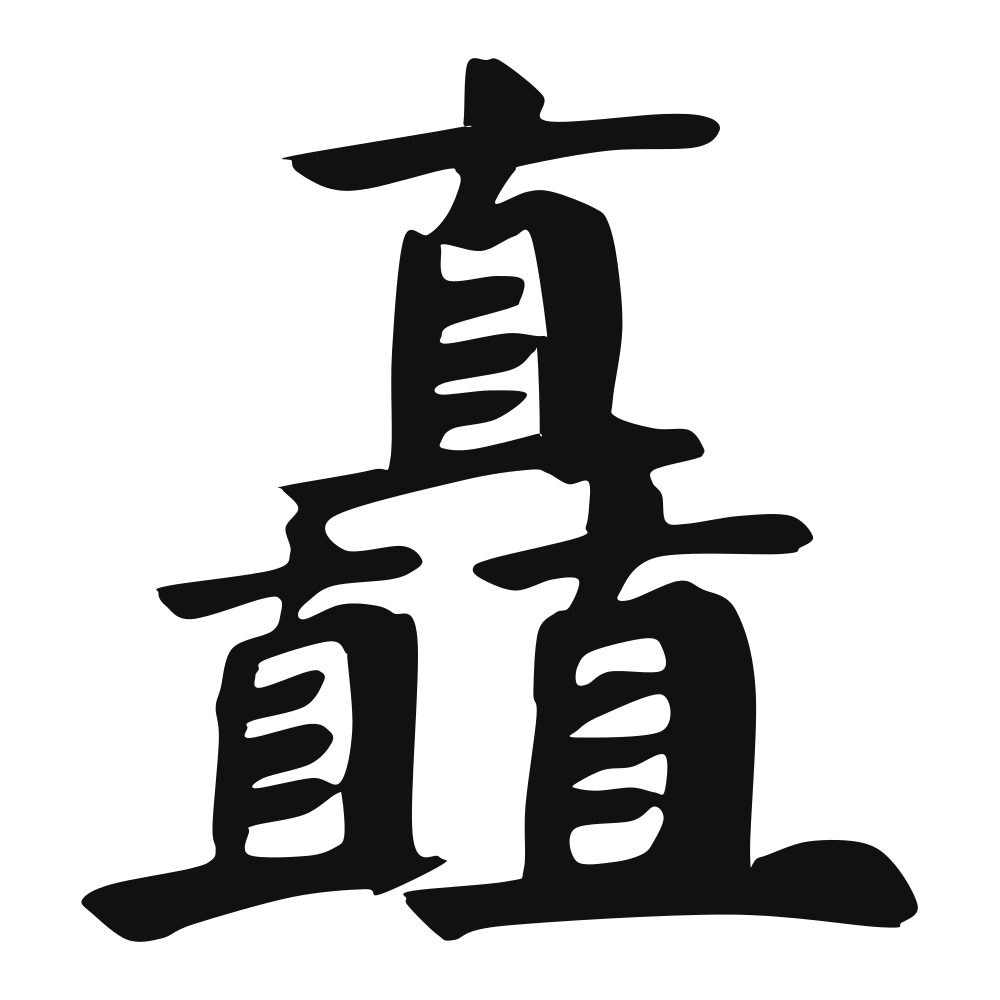
矗
lofty; upright
Closest English meanings
towering·upright·standing tall
The Calligrapher — Yán Zhēnqīng 颜真卿
Tang master of robust regular script; co-creator of the enduring 'Yan style'.
Tang calligrapher (709–784), master of regular script/running script — the Tang moral paragon whose upright, muscular regular script became the model of Chinese integrity in writing. Tang dynasty
Cultural Story
Stack three strokes of 'straight' 直 and you build 矗, a character that stands as tall as its meaning. Du Mu's rhapsody on the Epang Palace makes it famous: 矗不知其几千万落 — towers rising, who could count them, by the tens of thousands — a fantasy of Qin grandeur told pointedly as a warning to Tang extravagance.
Common words & phrases
- 矗立 stand tall · tower
Read the story behind the character
The skyline is the character's modern habitat. Travel copy promises glass towers that 矗立 (stand tall, tower) over the Bund or Victoria Harbour; night photographs show lit spires 矗立 against the haze. Reports of a finished bridge or a rocket on its launch pad reach for the same verb, because nothing says upright permanence in Chinese quite like 矗立.
Why this character belongs on skin
Say 矗 and you say one straight line three times—three 目, three eyes, stacked like a pagoda, staring straight up. The character means to rise sheer: 矗立, to stand towering, the way a watchtower breaks a skyline or a cypress breaks the fog on a mountain shoulder. It has no soft syllables. Where most Chinese characters borrow motion or feeling, this one borrows only verticality—the geometry of everything that refuses to lean. Monks built pagodas nine stories high for exactly this reason: a tall thing is a prayer visible from far away, proof that someone believed in height. To wear 矗 is to commit to posture as philosophy—to stand when sitting would be easier, to be the vertical line in a room of shrugging shoulders. The wind tests everything tall. That is not an argument against height; it is the whole point of it. Rise on purpose.
Own this character
Purchase delivers the original SVG of this glyph, brushed by Yán Zhēnqīng 颜真卿, ready to place on skin, paper, or screen.