
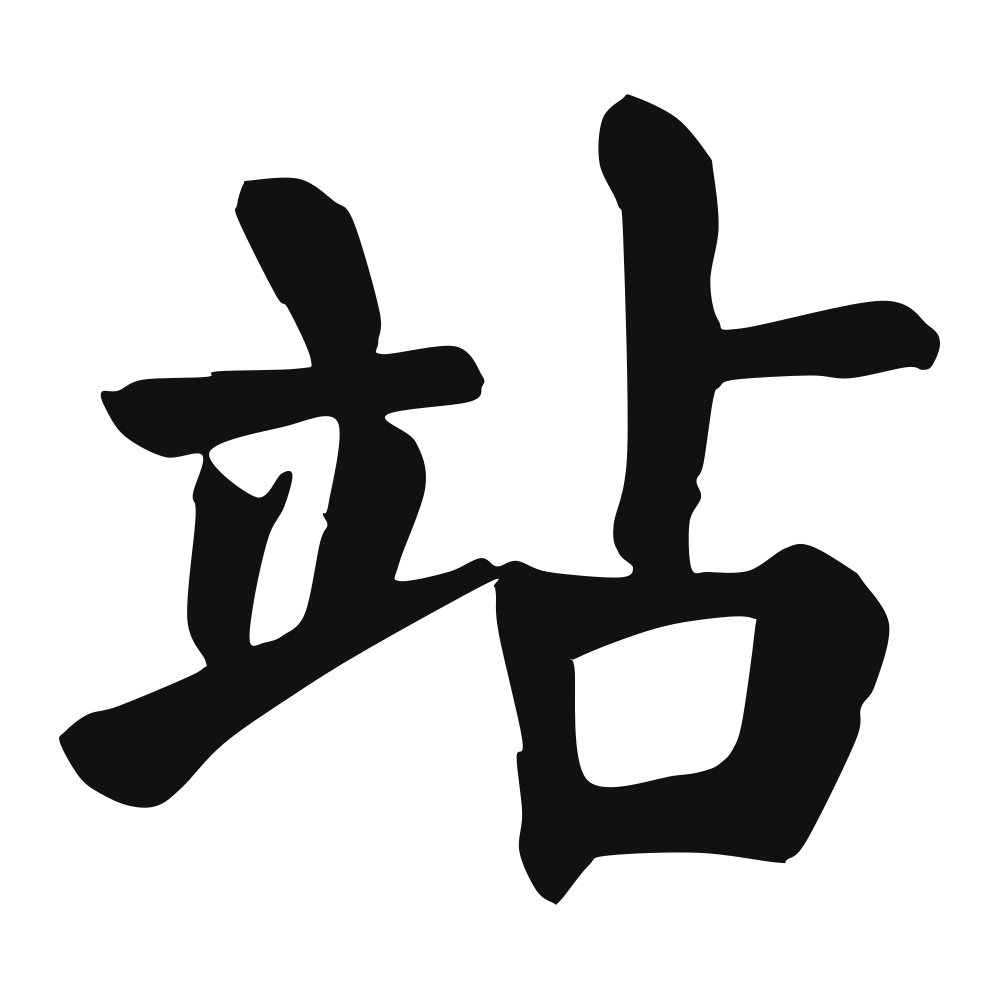
站
station; to stand; to halt; to stop; branch of a company or organization; website
Closest English meanings
station·to stand·stop
The Calligrapher — Yán Zhēnqīng 颜真卿
Tang master of robust regular script; co-creator of the enduring 'Yan style'.
Tang calligrapher (709–784), master of regular script/running script — the Tang moral paragon whose upright, muscular regular script became the model of Chinese integrity in writing. Tang dynasty
Cultural Story
站 is surprisingly young for such a basic idea. Classical Chinese used 立 to say 'stand'; 站 arrived with the Mongol era, when 站 named a postal relay stop on the Yuan dynasty's horse-and-rider network. The travel sense of 'stop' and the body's sense of standing fused into one character.
Common words & phrases
- 车站 station · stop
- 站立 stand · stand up
- 站长 station master
- 站岗 stand guard · be on sentry
- 网站 website
Read the story behind the character
Every commuter lives by 站: the 车站 (station) where buses and subways pulse through, the announcement to 站立 (stand) steady behind the yellow line, the 站长 (station master) on the platform. Online, a 网站 (website) is a 'standing place' too, and guards 站岗 (stand sentry) at gates everywhere.
Why this character belongs on skin
There is a dignity in simply remaining upright when every excuse to sit down has arrived. The old word for standing piles the sign for to stand beside the sign for a long stay — as if to stand were also to reside, to inhabit your ground. The sentinel does not advance; he merely does not leave. In a culture of motion we forget the power of the fixed point, the one who is where he said he would be. Wear it where you have held your post through the long night of something. Let the ink be the proof of station — not that you marched, but that you stayed, a quiet monument to the self that refused to move.
Own this character
Purchase delivers the original SVG of this glyph, brushed by Yán Zhēnqīng 颜真卿, ready to place on skin, paper, or screen.