
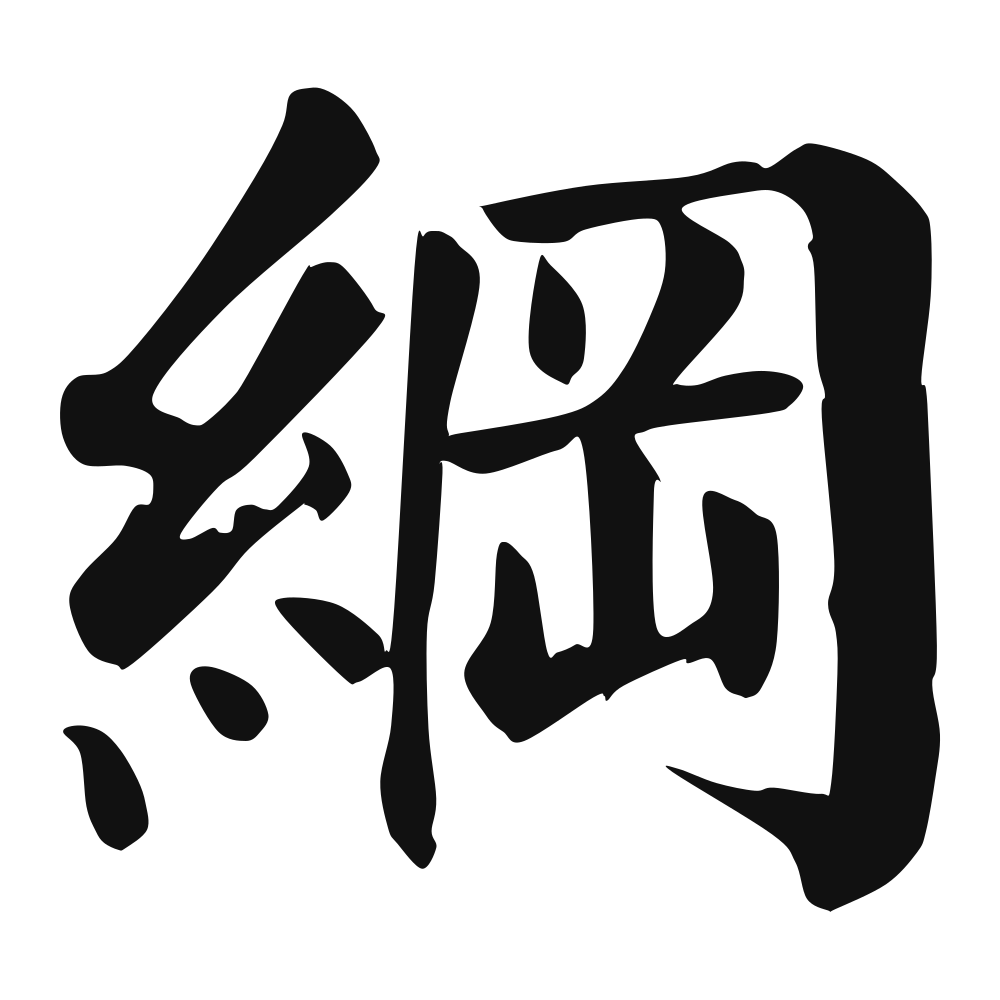
纲
head rope of a fishing net; guiding principle; key link; class (taxonomy); outline; program
Closest English meanings
key link·outline·class
The Calligrapher — Yán Zhēnqīng 颜真卿
Tang master of robust regular script; co-creator of the enduring 'Yan style'.
Tang calligrapher (709–784), master of regular script/running script — the Tang moral paragon whose upright, muscular regular script became the model of Chinese integrity in writing. Tang dynasty
Etymology & Meaning · 字义溯源
### Soundgāng — gāng (1st tone). Often a bound morpheme — needs a partner word ### Original meaningGāng (1st tone). The Shuowen Jiezi defines it as 「維紘繩也。从糸岡聲」 — the great rope of a net, from 糸 (thread) with 岡 (gāng, ridge) as the phonetic. The image is exact, and the classics use it as a picture of government itself: 《書·盤庚》「若網在綱,有條而不紊」 — like a net held by its main rope, ordered and not tangled — and 《詩·大雅》「綱紀四方」 with the note 「綱者,網之大繩」. From the rope it went to the principle: 綱 is the governing thread of anything, hence 大綱, 綱領, 綱要 and the saying 綱舉目張 (lift the main rope and every mesh opens). It also names the three bonds of later Confucian ethics — 《禮緯含文嘉》「君爲臣綱,父爲子綱,夫爲妻綱」 — the 三綱 that 綱常 abbreviates, which is the part of this character a modern buyer should think through honestly. There are plainer senses too: the cord that ties the archery target to its frame (《儀禮·鄉射禮》「乃張侯下綱」, 註 持舌繩也), and from the Tang onward the batching of tribute cargo (花石綱, 生辰綱). 綱 is written 纲 in simplified script (7 strokes) and 綱 in 康熙 (14 strokes, 糸部 + 8). Honest disclosure: 纲 is a strong, clean, classical character for 'the governing thread', but it is also the 綱 of 三綱五常 — ruler over subject, father over son, husband over wife — and in modern Chinese it reads more like 'outline' (大綱) or 'programme' (綱領) than like anything poetic. Wuxing: Wood (木) in the naming tables, consistent across sources. ### The structure (形聲 · 从糸,岡聲 — thread (糸) for the sense, 岡 (gāng, ridge) for the sound; the rope that runs along the top like a ridge-line)①糸mìsilk / threadthe material the rope is made of②岡gāngridgethe phonetic, and the image of the high line along the top③網wǎngthe net綱 is the one rope that holds all of it④綱gāngthe governing thread若網在綱,有條而不紊 ### In use todayItemReading / meaningNoteReadinggāng (1st tone)single syllable; not a surnameCore sensethe net's main rope; the governing principlemodern use leans bureaucratic (大綱, 綱領)Grammarbound morpheme大綱 · 綱領 · 綱要 · 綱舉目張Tattoo fityes-standalone — strong, classical, cleanknow that it is also the 綱 of 三綱 ### Closest words in English — and what each misses - Rope — 繩/索 hold 'rope' plainly; 綱 is the one rope that governs all the others - Principle — 理/道 hold principle; 綱 is a principle imagined as a thing you can pull - Outline / agenda — that is 綱's flat modern sense (大綱, 綱領); the classical image is far stronger - Hard / firm — 剛 (gāng) is the homophone buyers often confuse it with; it means firm, not the ropeAn honest note on grammar. Bound morpheme — 大綱 (outline), 綱領 (programme), 綱要, 綱舉目張; also a biological class (綱) and a classifier for t
Cultural Story
纲 was the thick main rope of a fishing net: lift it and every mesh follows, which is why the Shangshu says governance should be like a net on its 纲, orderly and never tangled. Generals studied 纲目-style digests that boiled histories into headings. 提纲挈领, grasping the head-rope and the collar, became the very image of clear thinking.
Where a Western reader can stand: 纲 (gāng) is the main rope of a net — pull it and every mesh opens, nothing tangles. An ancient book calls good government 'like a net on its main rope.' Yan Zhenqing's strokes are the load-bearing model later hands follow. Honest note: 纲 also names the hierarchical 'three bonds' of imperial ethics, so wear it for order and principle, and know that history.
Common words & phrases
- 綱領 guiding principle · program
- 大綱 outline
- 提綱 outline · synopsis
- 綱要 essentials · outline
- 總綱 general outline
Read the story behind the character
Every student lives by 纲. Before finals the teacher hands out a 复习大綱, the outline of everything testable; an essay starts with a 提綱, a plan of headings, before a word of prose is written. Ministries publish a 綱要, a guideline document; party members memorize the 總綱, the general program, at study sessions.
Why this character belongs on skin
Lift a fishing net by its top rope and the whole thing rises orderly behind it — every mesh, every catch, every empty space held in relation. That rope is the principle, the single line that makes the tangle make sense. The sages said grasp the 纲 and the rest follows; lose it and you drown in detail. Confucian order rests here, in knowing which thread is load-bearing. But the word also names the bonds between ruler and subject, parent and child — the ties we did not choose and cannot cut without cost. To carry it is to confess you believe something holds, that chaos is only the unlifted net. It is a mark for the one who orders his own life by a hidden rope. Let it sit on you as a quiet authority: I know what bears the weight. The rest is merely mesh.
Own this character
Purchase delivers the original SVG of this glyph, brushed by Yán Zhēnqīng 颜真卿, ready to place on skin, paper, or screen.