
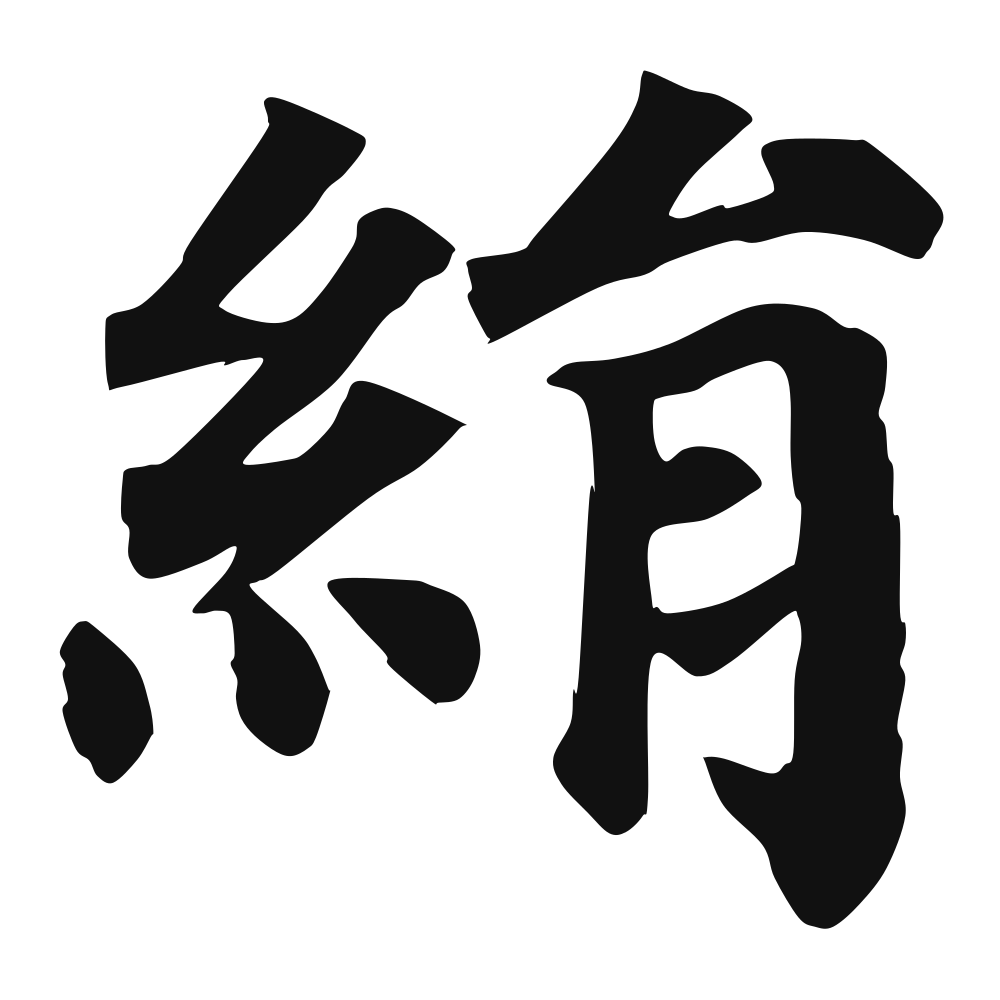
绢
thin, tough silk fabric
Closest English meanings
thin silk·silk
The Calligrapher — Yán Zhēnqīng 颜真卿
Tang master of robust regular script; co-creator of the enduring 'Yan style'.
Tang calligrapher (709–784), master of regular script/running script — the Tang moral paragon whose upright, muscular regular script became the model of Chinese integrity in writing. Tang dynasty
Etymology & Meaning · 字义溯源
### Soundjuàn — juàn (4th tone). Free-standing morpheme ### Original meaningJuàn (4th tone; traditional 絹). The Shuowen Jiezi defines it as 「繒如麥䅌」 — 'a silk fabric (繒) the colour of the wheat-ear' (the transmitted text of this gloss varies between 麥䅌 and 麥絹, and editors differ on the reading). 《釋名》 gives a phonetic gloss that is also a description of the weave: 「絹,䋌也,其絲䋌厚而疏也」 — thickish in the thread and open in the weave; 《廣韻》 flatly 「縑也」, a heavy plain silk. So 絹 is the plain, honest silk: not 錦 (brocade) and not 綾 (damask), but the even, strong, unpatterned cloth. Its earliest appearance is entirely practical: 《墨子·辭過》「治絲麻,捆布絹,以為民衣」 — 'prepare silk and hemp, bind cloth and 絹, to clothe the people'. From the Han onward 絹素 — the plain white silk that takes ink — becomes the standard word for the ground of a painting. Honest disclosure: 絹 is a material, not a virtue; and in everyday modern Chinese its commonest appearance is 手絹 (a handkerchief). There is also a second, less pretty sense: in 《周禮·秋官·冥氏》 絹 stands for 罥, a snare for birds and beasts (「所以扃絹禽獸」). ### The structure (形聲 · 从糸,肙聲 — silk (糸) for the field, 肙 (yuān) for the sound; the even, unpatterned weave)①糸mìsilk (radical)the field: spun thread, and cloth made of it②肙yuānsmall / (phonetic)the sound-bearer③絹素juàn sùplain white silkthe ground a painter works on — the character's second life④罥juànsnare / netthe borrowed sense in the Zhouli: 絹 for 罥, a trap for birds and beasts ### In use todayItemReading / meaningNoteReadingjuàn (4th tone)single syllable; traditional 絹Core senseplain-weave silkthickish thread, open weave; neither brocade nor gauzeGrammarfree noun絹素 silk for painting · 絹本 a silk-ground painting · 手絹 handkerchiefTattoo fityes-standalone — a clean material wordreads as silk and as the blank ground; disclose the handkerchief association ### Closest words in English — and what each misses - Silk (general) — 絲 is the thread itself; 絹 is the woven cloth, and specifically the plain weave - Brocade / Luxury — 錦 holds brocade and splendour; 絹 is deliberately plain — the honest cloth, not the rich one - Canvas / Paper — 絹素 does serve as a painting ground, but it is silk; 紙 is paper and 布 is cloth - Purity / Blankness — 素 holds plainness and the unbleached; 絹 is the material that can be blank, not blankness itselfAn honest note on grammar. Free morpheme — stands alone as a noun (絹 = plain-weave silk); also 絹素 (silk for painting), 絹本 (a painting on silk), 手絹 (handkerchief)Where a Western reader can stand: 绢 (juàn) is plain-weave silk — the thickish, open, unpatterned cloth, as distinct from broc
Cultural Story
绢 was fine, tightly woven silk, smooth enough to hold a brushstroke without bleeding, which made it the ground of painters: Song dynasty fan leaves and long handscrolls marked 绢本, on silk, still glow after a thousand years. Before paper cheapened writing, serious drafts went on 绢, and merchants measured wealth in bolts of it stored against hard years.
Where a Western reader can stand: 绢 (juàn) is plain-weave silk — the thick, open, unpatterned cloth, not brocade or gauze. In painting it is 绢素, the silk ground the brush works on, so it also means 'the blank that receives the mark.' Yan Zhenqing's surfaces are exactly that prepared ground. Honest notes: today it often means 'handkerchief' (手绢), and an old text borrows it for a bird-snare — so don't over-romanticise.
Common words & phrases
- 手绢 handkerchief
- 绢本 silk scroll
- 绢花 silk flower
- 绢绸 fine silk
Read the story behind the character
Juàn is the quiet nostalgia fabric. Grandmothers still tuck a 手绢, handkerchief, into a handbag despite a pocket full of tissues; festival stalls sell 绢花, silk flowers, that never wilt on the family altar. Auction catalogs describe every old scroll as 绢本, silk ground, and a bridal shop advertises 绢绸 gowns cut like 1960s movie costumes.
Why this character belongs on skin
Thin as a held breath, the silk was the empire's secret and the lover's letter. The character bears the silkworm's thread and the trade that moved mountains of gold. To wear silk was to be touched by distance, by the hands of strangers who spun beauty from a grub's devotion. There is tenderness in such fabric, the way it cools the skin and hides nothing. The poets wrapped their grief in it; the warriors carried maps drawn on its pale face. To ink this character is to choose the fine over the coarse, the thing that whispers against the body. Let it lie where you are softest, a vow to the beauty that asks only to be near. Some cloth outlives the empire that made it.
Own this character
Purchase delivers the original SVG of this glyph, brushed by Yán Zhēnqīng 颜真卿, ready to place on skin, paper, or screen.