
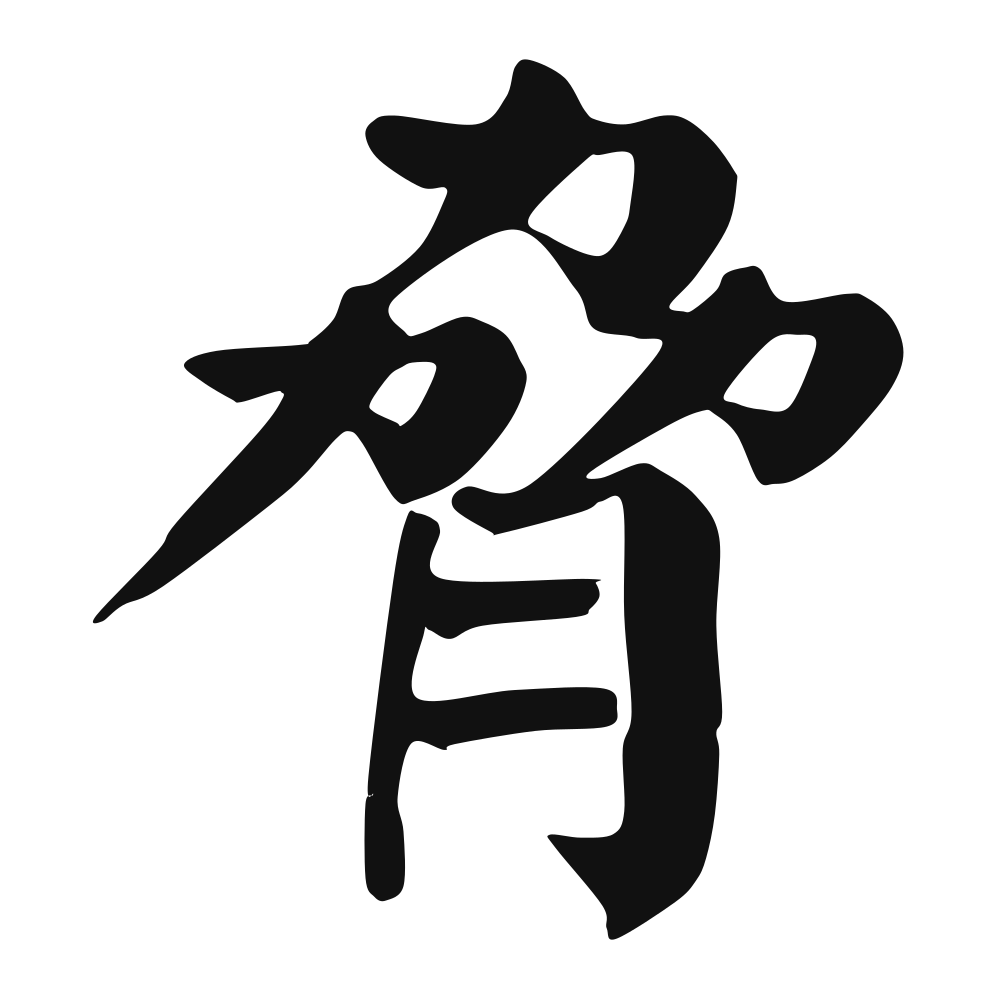
胁
flank (the side of one's torso); to coerce; to threaten
Closest English meanings
coerce·threaten·flank
The Calligrapher — Yán Zhēnqīng 颜真卿
Tang master of robust regular script; co-creator of the enduring 'Yan style'.
Tang calligrapher (709–784), master of regular script/running script — the Tang moral paragon whose upright, muscular regular script became the model of Chinese integrity in writing. Tang dynasty
Etymology & Meaning · 字义溯源
### Soundxié — xié (2nd tone); xiàn ('to hinder') and xī ('to contract') in older glossaries. Free-standing morpheme ### Original meaningXié (2nd tone; traditional 脅; also written 脇). The Shuowen Jiezi defines it as 「兩膀也。从肉劦聲」 — 'the two flanks', from 肉 (flesh) with 劦 for the sound; 劦 is itself three 力 (plough-strength) stacked, so the written character already carries the idea of force gathered on both sides. 《釋名·釋形體》「脅,挾也,在兩旁臂所挾也」 — 'the flank is what the arms clamp, on either side'; 《玉篇》「身左右兩膀」. The classic anecdote is anatomical: 《左傳·僖公二十三年》「曹共公聞其駢脅,欲觀其裸」 — the Duke of Cao heard that Chong'er's ribs were grown into a single plate, and wanted to see him stripped. From 'two sides pressing inward' came the verb, and the verb is where the character lives now: 《書·胤征》「殲厥渠魁,脅從罔治」 — 'destroy the ringleaders; those who were coerced into following go unpunished' — and 《禮記·樂記》「强者脅弱,衆者暴寡」. 《漢書·王莽傳》 uses it for contraction (師古: 脅,收斂也) and 《史記》 for the ribs broken under the bastinado. Honest disclosure: in modern Chinese 脅's dominant life is 威脅 / 脅迫 — 'to threaten, to coerce'. ### The structure (形聲 · 从肉,劦聲 — flesh (肉) for the field, 劦 (xié, three 力) for the sound; strength stacked on either side of the body)①肉ròuflesh (radical)the field: the body②劦xiéthree strengths / (phonetic)the sound-bearer — three 力 stacked, force gathered on both sides③兩膀liǎng bǎngthe two flanksthe Shuowen definition — armpit to the end of the ribs④脅從xié cóngto follow under duressthe modern shadow of the word: the coerced accomplice ### In use todayItemReading / meaningNoteReadingxié (2nd tone)traditional 脅; older glossaries also give xiàn and xīCore sensethe flank / to coerceanatomy first, compulsion second — and compulsion now dominatesGrammarbound morpheme (modern)威脅 to threaten · 脅迫 to coerce · 脅從 accomplice under duressTattoo fitcaution — classical anatomy, modern 'threat'buyers must hear 威脅 before they commit ### Closest words in English — and what each misses - Strength — 力 holds strength; 脅's 劦 is three strengths arranged as pressure on the body's side — which became coercion - Side — 旁/側 hold plain 'side'; 脅 is the living side of a torso, and by extension what happens to it - Ribs — 肋 (lèi) is the everyday word for ribs; 脅 is the whole flank from armpit down, and it is literary - Courage — 勇 holds courage; nothing in 脅's history is voluntary — 脅從 is the one who followed because he had no choiceAn honest note on grammar. Free morpheme in classical usage (兩膀也; 脅從罔治); in modern Mandarin almost always bound — 威脅 (to threaten), 脅迫 (to coerce), 脅從 (coerced accomplice), 胸脅 (the chest and f
Cultural Story
胁 is the flank, the ribs' soft side — and to press it is to coerce. Classical history is full of 胁迫 coercion: the 鸿门宴 banquet where Xiang Yu pressed Liu Bang, the 胁从 accomplice under duress whom law treated more leniently. 裹胁 described crowds swept along by an army, will bent by fear.
Where a Western reader can stand: 胁 (xié) is the flank — the side of the body from armpit to ribs. The Shuowen says 兩膀也, 'the two flanks,' and the character carries 劦, three strength-radicals stacked, so it already pictures force on both sides. That is how it became the verb in 威脅, 'to threaten.' The honest warning for a buyer is that the living sense of this character is 'threat'; the classical anatomy (駢脅, fused ribs) is real but no longer the everyday reading.
Common words & phrases
- 威脅 threaten · menace
- 脅迫 coerce · compel
- 脅從 accomplice under duress
- 裹脅 coerce · force
Read the story behind the character
The word survives in news and drama: a scammer 威脅 threatens a victim with leaked photos, a witness describes how 脅迫 coercion forced the signature. Courts still weigh whether someone was a 脅从 accomplice under duress, and reporters write of villagers 裹胁 coerced by armed men into fleeing their homes.
Why this character belongs on skin
The ribs are where the breath is kept. In the bone-script, 胁 sat at the side of the body—the flank a warrior guards, the place a sword finds first. It meant the soft wall between your heart and the world. Later it became coercion, the threat pressed against that same softness: do this or the blade comes closer. There is a lesson in the double meaning. The thing you most protect is the thing most easily used against you. Yet the Daoist smiles—what is gripped too tightly slips; what is offered loosens the hand. To carry 胁 is to know you have been threatened and survived it, that your flank still rises and falls with breath. It is the scar turned outward, the side that learned to stand in the wind. Wear it where your own ribs are, a quiet acknowledgment that you were pressed, and did not break.
Own this character
Purchase delivers the original SVG of this glyph, brushed by Yán Zhēnqīng 颜真卿, ready to place on skin, paper, or screen.