
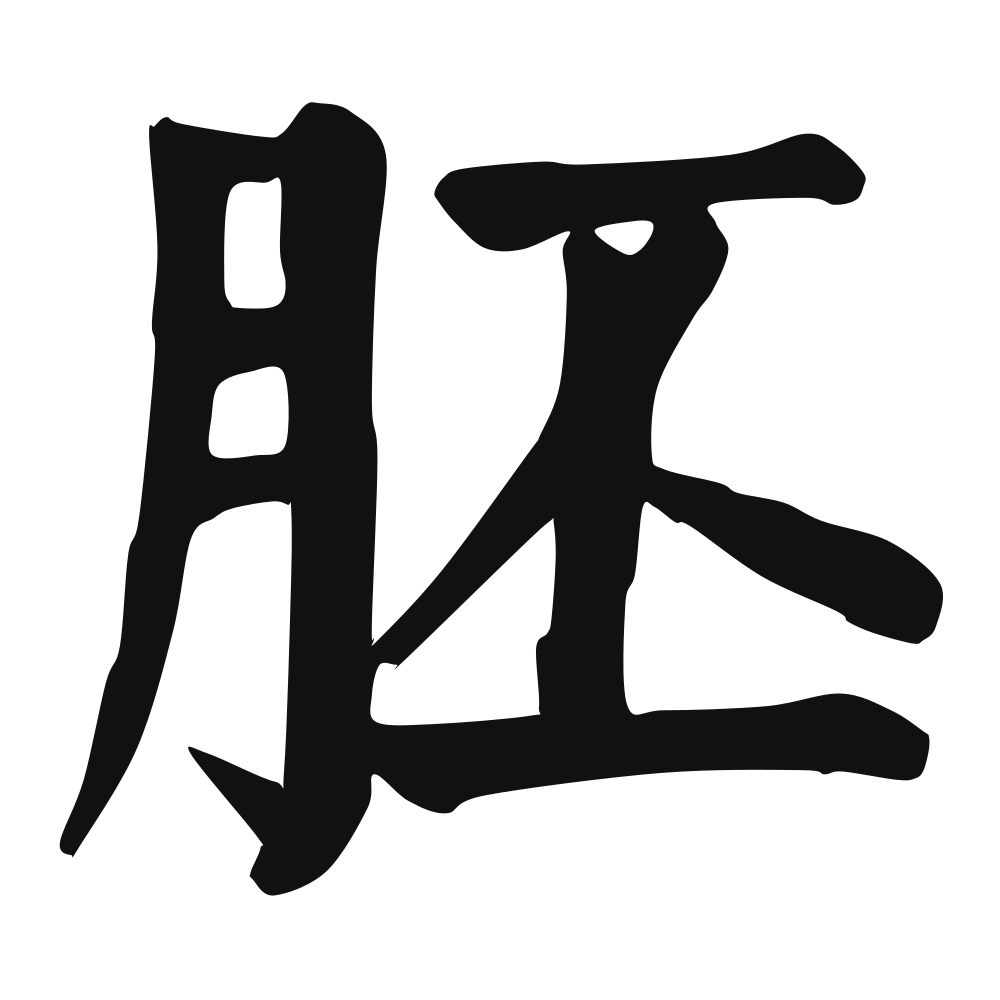
The Calligrapher — Yán Zhēnqīng 颜真卿
Tang master of robust regular script; co-creator of the enduring 'Yan style'.
Tang calligrapher (709–784), master of regular script/running script — the Tang moral paragon whose upright, muscular regular script became the model of Chinese integrity in writing. Tang dynasty
Cultural Story
胚 is the embryo, the sealed beginning of a life or a thing. Classical agriculture spoke of seed with its 胚芽 sprout waiting inside the husk; metallurgists called a rough casting a 毛胚 blank, shaped but unfinished. The character itself carries the sense of a life held in suspension, not yet begun.
Common words & phrases
- 胚胎 embryo
- 胚芽 sprout · bud · germ
- 毛胚 blank · semi-finished product
Read the story behind the character
In the IVF clinic a 胚胎 embryo is transferred with a nurse's quiet congratulations; on the breakfast table, wheat 胚芽 sprout bread is praised as health food. A machinist inspects a 毛胚 blank before the lathe takes its first pass — in factory language, everything great begins as a rough 胚.
Why this character belongs on skin
Before the name, before the face, there is the seed. 胚 is that seed — the character for the embryo, the first clotting of life inside the womb, unseen and already intentional. The classical physicians wrote of it as the beginning of form, the moment potential takes a shape it will not quite lose. There is a hush around 胚, the reverence of something not yet but already becoming. To carry it is to honor your own origins, the unformed self that nonetheless insisted on arrival. It is a mark of faith in the not-yet-seen. Buddhist and Christian both bow to the hidden beginning; so might you. Put it where life feels closest, and whisper a vow: I was a possibility before I was a person. I am still becoming, and the becoming is holy. The embryo does not doubt. Neither should you, and the ink is the yes I said before I knew how.
Own this character
Purchase delivers the original SVG of this glyph, brushed by Yán Zhēnqīng 颜真卿, ready to place on skin, paper, or screen.