
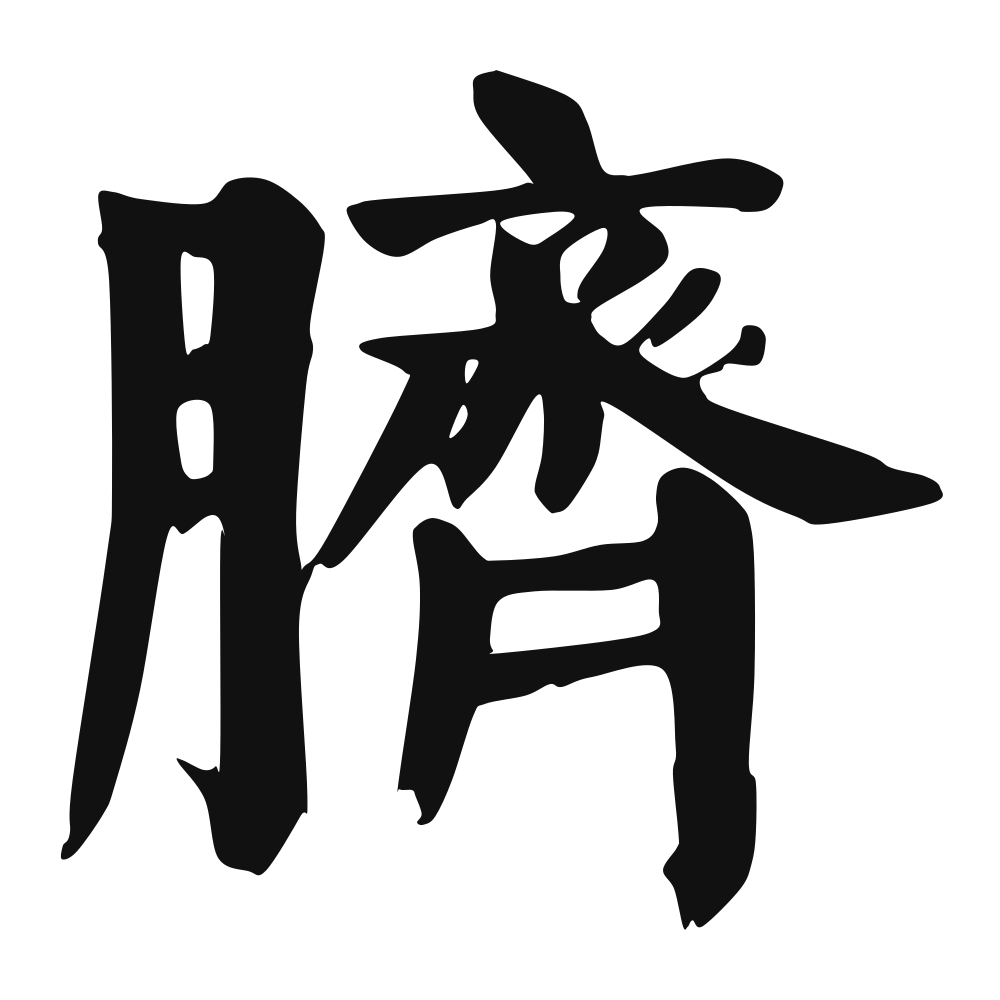
脐
(bound form) the navel; the umbilicus; (bound form) the belly flap of a crab; apron
Closest English meanings
navel·umbilicus
The Calligrapher — Yán Zhēnqīng 颜真卿
Tang master of robust regular script; co-creator of the enduring 'Yan style'.
Tang calligrapher (709–784), master of regular script/running script — the Tang moral paragon whose upright, muscular regular script became the model of Chinese integrity in writing. Tang dynasty
Cultural Story
脐 is the navel, the sealed harbor where the unborn took its nourishment. Classical medicine located the dantian just below it, the furnace of breath; midwives tied and cut the 脐带 umbilical cord with silk and care, for a mishap meant newborn tetanus — the dreaded wind of the navel.
Common words & phrases
- 肚脐 navel · belly button
- 脐带 umbilical cord
- 脐橙 navel orange
Read the story behind the character
A farmer splits a 脐橙 navel orange at the market stall, the twin fruit crowning it like a signature. In the delivery room, the 脐带 umbilical cord is clamped and cut; later, toddlers proudly point to their 肚脐 navel during bath time. Everyone carries the mark of where life was plugged in.
Why this character belongs on skin
There is a small scar at the center of every body, the only proof we keep of having been carried. The character 脐 names the navel, the 肚脐, the place where another life once fed us and then let go. To touch it is to touch the origin, the cord cut so we could become ourselves, the first and kindest wound. The Daoists spoke of the lower 丹田 near the navel as the furnace of vitality; the Christian marks the belly as the site of incarnation; every mother knows it as the knot that tied her to a stranger. We outgrow the need for the cord and keep the mark forever, a quiet heraldry of dependence and release. Ink this as the symbol of your beginning, the proof you were loved into being. Let it rest at your center, a small dark circle that says: you began as a gift, and the cutting was the start of freedom.
Own this character
Purchase delivers the original SVG of this glyph, brushed by Yán Zhēnqīng 颜真卿, ready to place on skin, paper, or screen.