
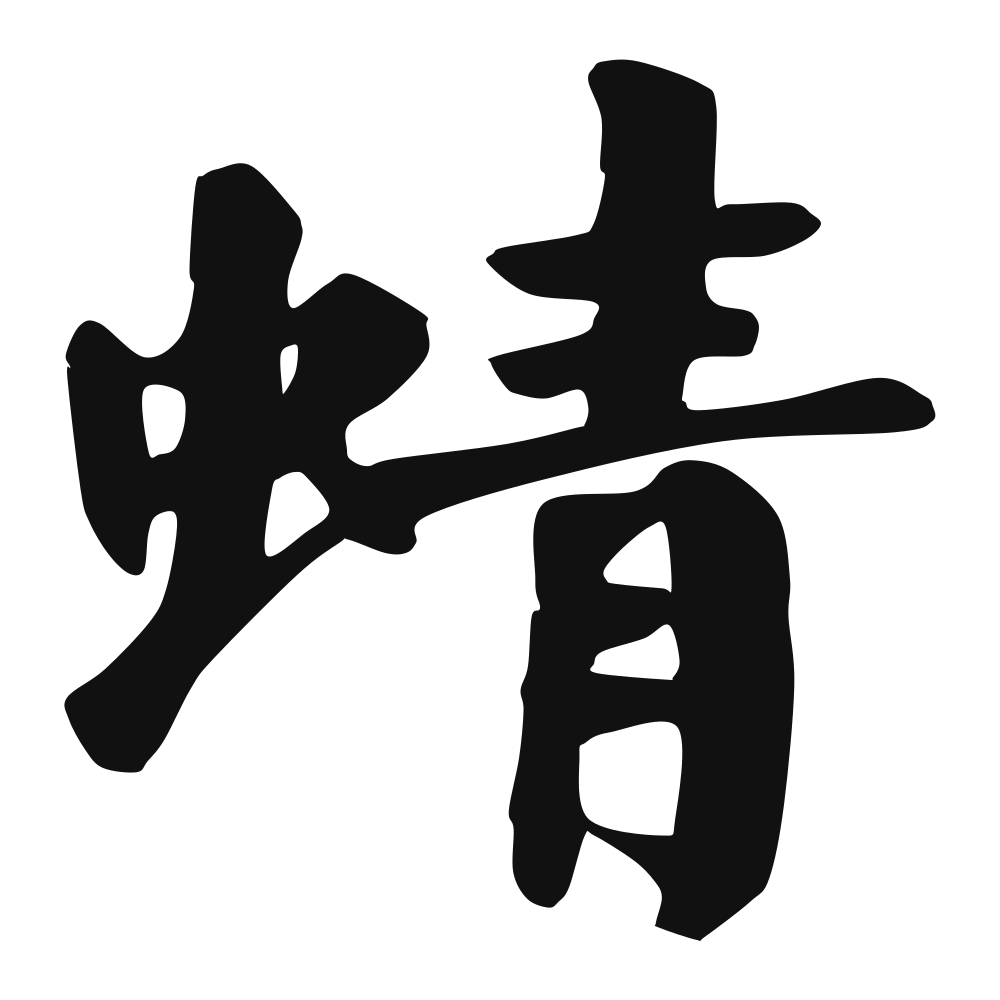
蜻
usually seen in: the sword moves like a dragon-fly (modern idiom) (剑走蜻蛉); green lacewing (草蜻蛉); damselfly (蜻蛉); Odonata, order consisting of about 6,000 species of dragonflies and damselflies (蜻蛉目)
Closest English meanings
dragonfly (part)
The Calligrapher — Yán Zhēnqīng 颜真卿
Tang master of robust regular script; co-creator of the enduring 'Yan style'.
Tang calligrapher (709–784), master of regular script/running script — the Tang moral paragon whose upright, muscular regular script became the model of Chinese integrity in writing. Tang dynasty
Cultural Story
Yang Wanli, the Song-dynasty poet, caught the first dragonfly of summer perched on a just-unfurling lotus tip, 早有蜻蜓立上头, the closing line of his 小池. The 蜻 appears only paired with 蜓, yet the insect it names had long haunted Chinese gardens as a sign of still, clear water. Painters of the Song and Yuan ages set a single 蜻蛉 above a lotus pad and called the whole scroll summer. To see a dragonfly hover was to know the pond was alive and the heat had truly arrived.
Common words & phrases
- 蜻蜓 dragonfly
- 蜻蛉 dragonfly
Read the story behind the character
At a rice paddy outside the city, a boy counts the 蜻蜓 skimming the water and learns they eat the mosquitoes that bite his ankles. On a phone, a nature-app user snaps a 蜻蛉 and waits for the identification. A biologist in a wetlands office logs dragonfly sightings as a marker of clean water, since the insects vanish where rivers are poisoned. From the paddies to the screen to the field survey, 蜻 still marks the places where the air is clear and the water is worth protecting.
Why this character belongs on skin
蜻蜓 — and suddenly it is a summer afternoon by water, the light gone honey-colored, a dragonfly hanging above the pond on the thinnest wires in nature. 蜻 carries the insect radical and a sound that means light, clear, cool — the character is built out of the exact feeling of the thing. The dragonfly lands on the reed, tilts, is gone; it touches nothing long enough to be touched. Zen teachers love it for this. One haiku: a dragonfly — the moon-bright pond it hovers over cannot keep it either. Japanese painters drew it as the emblem of the present moment, and old warriors wore it as a crest, because it never flies backward, only forward, quick and sure. Two truths in one insect: impermanence and courage, the willingness to be light. Touch lightly, then, this character says — to the day, to the lover, to the whole passing world. Be here entirely, then move on without dragging your shadow. Fourteen strokes in flight on your skin. Everything passes. The passing can be beautiful. Pin the moment to your arm and let it hover there forever.
Own this character
Purchase delivers the original SVG of this glyph, brushed by Yán Zhēnqīng 颜真卿, ready to place on skin, paper, or screen.