
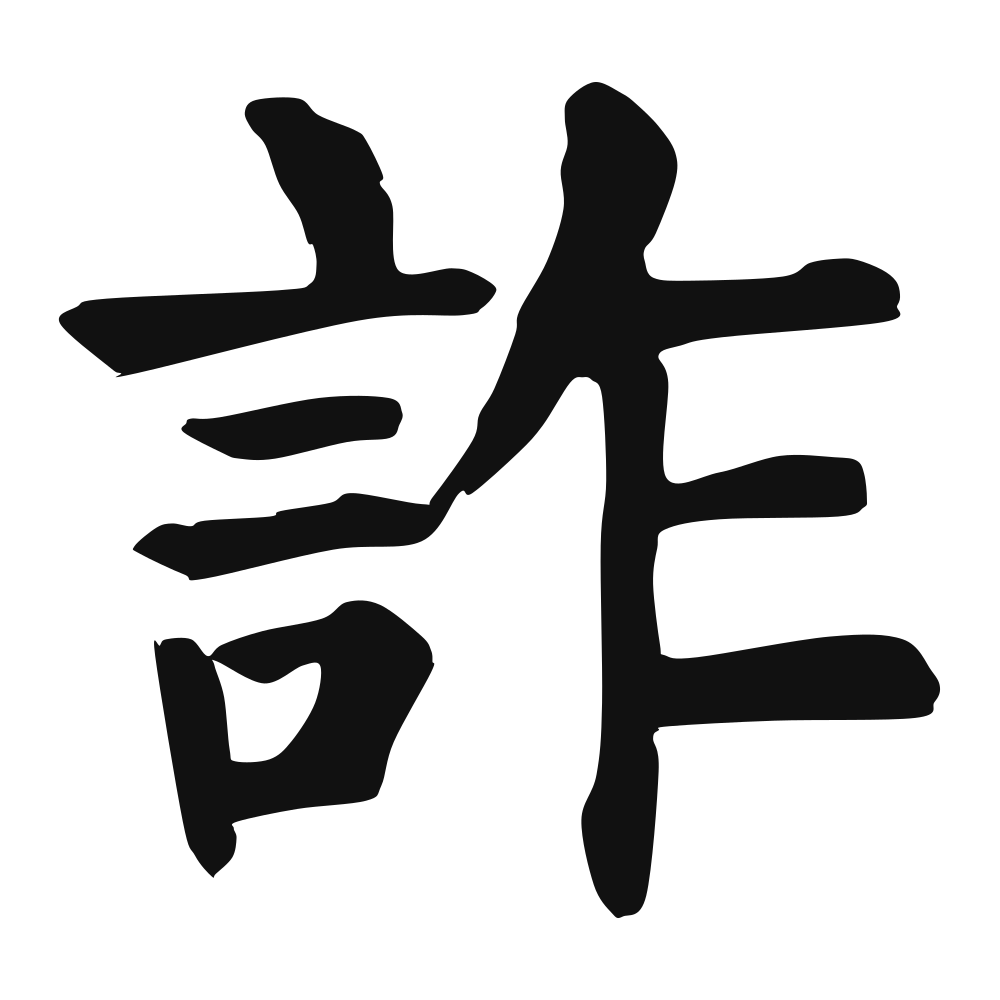
诈
to cheat; to swindle; to pretend; to feign; to draw sb out; to try to extract information by deceit or bluff
Closest English meanings
cheat·feign
The Calligrapher — Yán Zhēnqīng 颜真卿
Tang master of robust regular script; co-creator of the enduring 'Yan style'.
Tang calligrapher (709–784), master of regular script/running script — the Tang moral paragon whose upright, muscular regular script became the model of Chinese integrity in writing. Tang dynasty
Etymology & Meaning · 字义溯源
### Soundzhà — zhà (4th tone). Often a bound morpheme — needs a partner word ### Original meaningZhà (4th tone). The Shuowen Jiezi is blunt: 「詐,欺也。从言乍聲」 — to deceive. 《爾雅·釋詁》 glosses it 偽也 'false', and the legal definition in 《晉書·刑法志》 is 「背信藏巧謂之詐」 — hiding cunning behind broken good faith is 詐. The classical citations are uniformly condemnations: 《荀子·修身》「匿行曰詐」 — concealing one's conduct is deceit; 《說苑·貴德》「巧詐不如拙誠」 — clever deceit is worse than clumsy honesty; 《左傳·宣十五年》「我無爾詐,爾無我虞」 — no deceit on my side, no wariness on yours, the formula of a truce. The one honourable context is military: 兵不厭詐 — in war, stratagem is not refused — and 《孫子》「兵者,詭道也」; but even there the word names the trick, not the virtue. Kangxi: 12 strokes (言部+5, traditional 詐; the simplified 诈 is 7); naming tables assign Metal (金). Honest verdict: this is the word for fraud, and it should not be inked as a personal emblem. ### The structure (形聲 · 从言乍聲 — speech (言) + phonetic 乍; 乍 itself carries 'suddenly', which fits the sense of a sudden feint)①言yánspeechthe radical: the deception is done in words②乍zhàsuddenlythe phonetic, and the feel of a sudden feint③欺qīto deceivethe Shuowen definition in one word: 詐,欺也④誠chéngsinceritythe counter-word: 「巧詐不如拙誠」 ### In use todayItemReading / meaningNoteReadingzhà (4th tone)single syllableCore senseto deceive; fraud欺詐 · 詐騙 · 詐取Grammarbound and pejorative詐死 to feign death; 兵不厭詐 in war, ruse is not refusedTattoo fitno — it reads as fraud to any Chinese readerfor 'cunning' or 'strategy' show 謀 · 智 · 變 ### Closest words in English — and what each misses - Cunning — 謀/智 hold planning and wisdom; 詐 is specifically deceit, not cleverness - Strategy — 略/策 hold 'strategy'; 兵不厭詐 permits ruse in war but 詐 still names the trick - Trick (neutral) — 計/術 hold neutral 'device, method'; 詐 always implies bad faith - Trickster (mythic) — the Chinese figure is the fox spirit 狐 — a folk image, not a meaning of this characterAn honest note on grammar. Bound in modern Chinese and almost always pejorative — 欺詐 fraud, 詐騙 to swindle, 奸詐 treacherous; occasionally 'to feign' (詐死 to feign death), and in military writing 'stratagem' (兵不厭詐)Where a Western reader can stand: 诈 / 詐 (zhà) means to deceive — the character used in 欺詐 'fraud' and 詐騙 'to swindle'. The Shuowen says plainly 欺也; 《荀子》 defines it as concealing one's conduct; the Han maxim is that clumsy honesty beats clever deceit. Its one non-condemning use is in warfare, where ruse is permitted — but that is a licence for the battlefield, not a personal motto. We do not recommend it as ink, and if cunning or strategy is the idea
Cultural Story
The Art of War teaches, 'The army prevails by deception', bing yi zha li, yi li dong, making zha, feint and stratagem, the very condition of survival on the field. The character joins words to a false move; to zha was never mere cheating but the craft of seeming other than you are, the ambush behind the open gate. From the general's banner to the hunter's stillness, zha is the old art of winning by not being read.
Where a Western reader can stand: 诈 / 詐 (zhà) means to deceive, to cheat, to swindle — 欺诈, 诈骗 — and it is one of the few characters with no redeeming classical use. The only context where it is not condemned is warfare (兵不厭詐, 'in war one does not shrink from ruse'), and even there it names the trick rather than praising it. As a tattoo a Chinese reader sees deceit, plainly. If 'cunning' or 'strategy' attracts you, the honest words are 謀 (to plan), 智 (wisdom) and 變 (to adapt).
Common words & phrases
- 诈骗 fraud · swindle
- 敲诈 extort · blackmail
- 欺诈 deceive · fraud
- 诈唬 bluff
- 诈死 feign death
Read the story behind the character
A caller runs zha pian, fraud, on the elderly; a gang qiao zha, extorts, a shop; a liar qi zha, deceives, a buyer; a poker player zha hu, bluffs, with a weak hand; a possum zha si, feigns death, on the road. The character lives in the crooked economy of trickery, the scam, the heist, the bluff. It names the moment trust is weaponized, the human talent for pretending, whether on the battlefield, at the table, or in the long grass.
Why this character belongs on skin
The words come, and they are not true—that is 诈, deception, the false move, the trick laid over reality like a mask. The character is speech and a sudden turn, the lie that strikes and vanishes. The strategists of the Warring States made 诈 an art of war; the honest man makes it his enemy. There is a cold education in being deceived, a hardening that can become its own kind of wisdom. The Daoist warns that the world trades in illusions; the sage sees the fraud and is not surprised. To wear 诈 is not to celebrate deceit but to name it, to carry the scar of having been fooled and the resolve never to be again. Some people lie their whole lives. This mark is the truth you earned through deception, the vigilance etched where the betrayal struck. Let it rest as a warning and a weapon, the knowledge that you see the false now. The mask fell. You were watching.
Own this character
Purchase delivers the original SVG of this glyph, brushed by Yán Zhēnqīng 颜真卿, ready to place on skin, paper, or screen.