
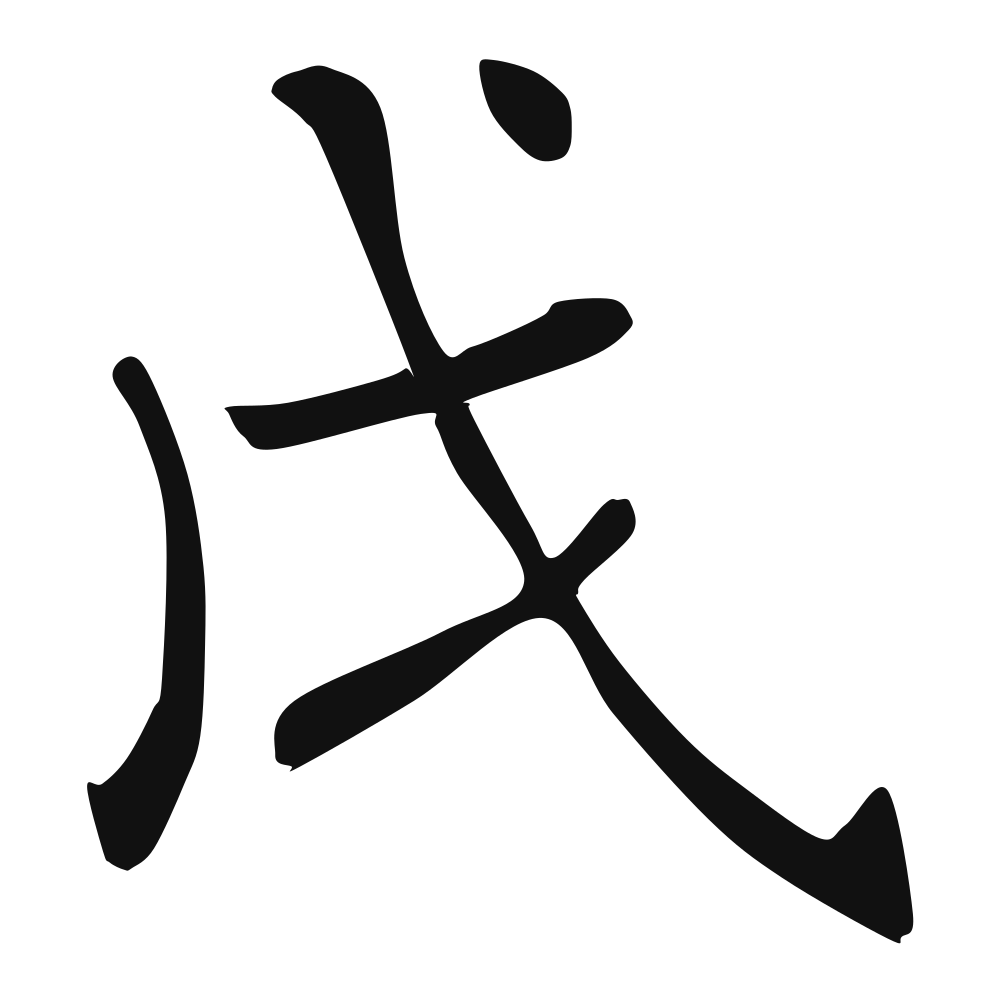
戊
fifth of the ten Heavenly Stems 十天干[shi2 tian1 gan1]; fifth in order; letter "E" or Roman "V" in list "A, B, C", or "I, II, III" etc; penta
Closest English meanings
fifth heavenly stem·year Wu·(5th)
The Calligrapher — Chǔ Suíliáng 褚遂良
Tang chancellor and regular-script master of elegant, balanced strokes.
Tang calligrapher (596–658), master of regular script — Tang master of graceful, tensile regular script favored by the imperial court. Tang dynasty
Cultural Story
戊 is the fifth of the ten heavenly stems, the marker a calendar uses to name a year or a day. It marches in the cycle 甲乙丙丁戊 and anchors the sexagenary pairs — 戊戌, 戊午 — that dated everything from harvests to births. Alone it is a counter, not a thing.
Common words & phrases
- 戊戌 Wuxu (year of cycle)
- 戊烷 pentane
Read the story behind the character
戊 shows up in chemistry as the stem for five-carbon chains — 戊烷, pentane — borrowed straight from the old cycle. It also names the year in 戊戌, which anyone who has read modern Chinese history meets at the 戊戌变法 reform of 1898. A numbering tool that quietly labels both molecules and moments.
Why this character belongs on skin
In the great round of the ten stems, 戊 is the fifth—the number of center, the place where things turn from rising to settling. It belongs to the earth itself, the hum of midday when work is half done and the field still waits. To carry 戊 is to honor the middle of the story rather than its spark or its close: the long, unphotographed stretch where a life is actually lived. The West chases beginnings and endings; the wise know the middle is where character is forged. This is a quiet character, almost forgotten between its louder neighbors, and that is its gift. It asks nothing of you but steadiness. Wear it where only you can see it, a private compass pointing always to the center of your own wheel. Let it remind you that to hold the middle, unmoved, is its own kind of mastery.
Own this character
Purchase delivers the original SVG of this glyph, brushed by Chǔ Suíliáng 褚遂良, ready to place on skin, paper, or screen.