
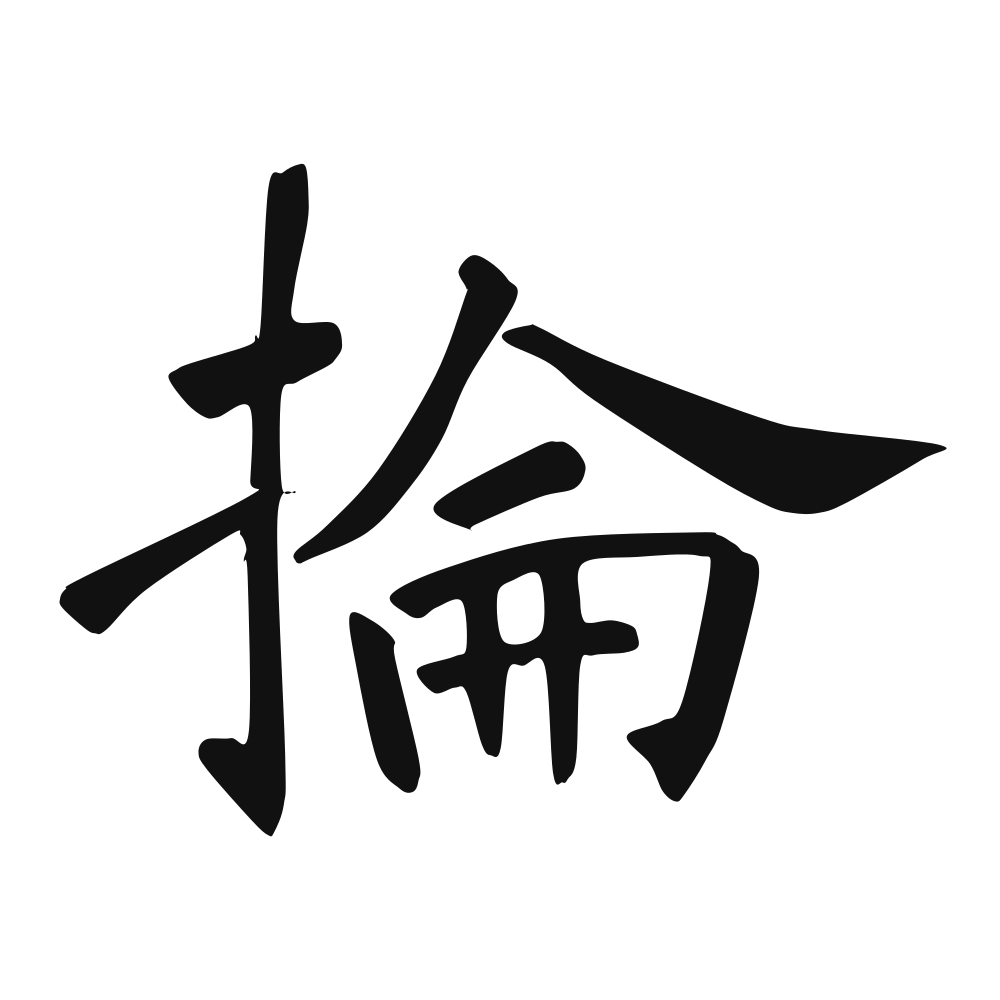
抡
to swing (one's arms, a heavy object); to wave (a sword, one's fists); to fling (money); to select
Closest English meanings
swing·brandish·select
The Calligrapher — Chǔ Suíliáng 褚遂良
Tang chancellor and regular-script master of elegant, balanced strokes.
Tang calligrapher (596–658), master of regular script — Tang master of graceful, tensile regular script favored by the imperial court. Tang dynasty
Etymology & Meaning · 字义溯源
### Soundlún (also lūn) — lún (2nd tone) classical / lūn (1st tone) modern — two readings, two different words. Often a bound morpheme — needs a partner word ### Original meaningLún (2nd tone) in the classical reading; lūn (1st tone) in modern speech — traditional 掄; note that the Kangxi dictionary heads 掄, not the simplified 抡. The Shuowen Jiezi defines it as 「擇也。从手侖聲」 — 'to select', a hand (手) with 侖 (lún) as phonetic. Duan Yucai sharpens the point: 鄭玄 glosses the 周禮 phrase as 「掄猶擇也」 rather than 「擇也」, which in Duan's reading means Zheng did not take 'select' to be the original sense; 廣韻 separately gives 「貫也」 (to thread). The classical usage is institutional and dignified: 《周禮·地官·山虞》「凡邦工入山林而掄材不禁」 — when the state's craftsmen enter the forest to choose timber, they are not restricted — and 《國語·晉語八》「君掄賢人之後,有常位於國者而立之」 (Wei Zhao: 掄,擇也). From this comes 掄材/掄才, 'to select timber / to select talent', and the examination words 掄元 and 掄魁. Slang and vernacular then took the same graph for a swinging arm: 掄刀, 掄拳, 《水滸全傳》「那後生掄着棒又趕入來」, and 《兒女英雄傳》「掄起大巴掌來」. Honest disclosure: buy 掄 for 掄材 and you are buying a real classical word; write the simplified 抡 alone and most modern readers will first think of swinging a fist. ### The structure (形聲 · 从手,侖聲 — hand (手) + 侖 (lún) phonetic; 侖 carries 'ordered series', which suits the classical sense of choosing in order)①手shǒuhandselecting and swinging are both done by hand②侖lúnordered seriesphonetic; carries the sense of things arranged in order③擇zéto selectthe Shuowen gloss — though 鄭玄 wrote 掄猶擇也, hedging④掄材lún cáito select timber / talentthe classical phrase from 《周禮》 that gives the character its dignity ### In use todayItemReading / meaningNoteReadinglún (selection) / lūn (to swing)two readings, two meanings — say which one you meanCore senseto select talent; to swing掄材 select timber/talent; 掄拳 swing a fistGrammarbound morpheme, transitive verb掄選, 掄元; colloquially 掄刀, 掄起拳頭Tattoo fitcaution — polyphonic; use 掄材 if you mean selectionlone 抡 usually reads as 'to swing' ### Closest words in English — and what each misses - Choose — 擇/選 hold plain 'to choose'; 掄 is choosing by walking among candidates — timber, men — as an officer of the state - Swing — 揮 holds 'to wave, to brandish'; 掄 (lūn) is the rougher, colloquial swing of a fist or a club - Strength — 力/勁 hold strength; 掄 is an action, not a quantity of force - Promote — 拔/擢 hold 'to raise up, promote'; 掄 is the selecting step that comes before promotionAn honest note on grammar. Bound morpheme in both readings — 掄材/掄才 (select talent), 掄選, 掄元; colloquially 掄刀, 掄拳, 掄起拳頭Where a
Cultural Story
抡 is to swing a thing in the hand — a fist, a blade. The old tales have the hero 抡刀 as he charges, and the word kept the circular violence of the raised arm. The hand with 仑, to order, is the stroke that gathers force. It is the brandish, the swing that means business.
Where a Western reader can stand: 抡 has two readings. As lún it means 'to select' - classical officials 'selected timber', and by extension talent. As lūn it is the modern vernacular for swinging a weapon or a fist. A lone simplified character drifts to the second; pair it with 材 or state the reading so the meaning stays 'chosen', not 'swung'. Chu Suiliang's refined script favours the dignified sense.
Common words & phrases
- 掄拳 swing a fist
- 掄刀 brandish a knife
- 掄才 select talent
Read the story behind the character
抡 is the swing: 抡拳 the punch thrown, 抡刀 the chopper raised, 抡才 the rare old phrase for selecting talent. It names the arc of the armed hand, the motion that ends in a hit. Mostly you meet it where someone is about to connect, hard.
Why this character belongs on skin
Raise it and let the arc decide. 抡 is the swing—the arm circling a weapon or a tool, the full-bodied motion that puts the whole body behind the strike. It is not the careful cut but the wide, committed arc, the farmer's sickle and the warrior's blade sharing one movement. There is freedom in the swing, the moment you stop calculating and let momentum carry you. To wear this character is to honor the decisive motion, the times you committed fully and trusted the arc. A tattoo of 抡 is for the person who knows the power of following through, who would rather swing wide than tap timid. Carry it as a reminder that some things are won not by precision but by the courage to wind up and release. The West measures; 抡 whirls. Wear it as a mark of the body in full motion, the arm raised, the world held for one suspended second before the blow lands true.
Own this character
Purchase delivers the original SVG of this glyph, brushed by Chǔ Suíliáng 褚遂良, ready to place on skin, paper, or screen.