
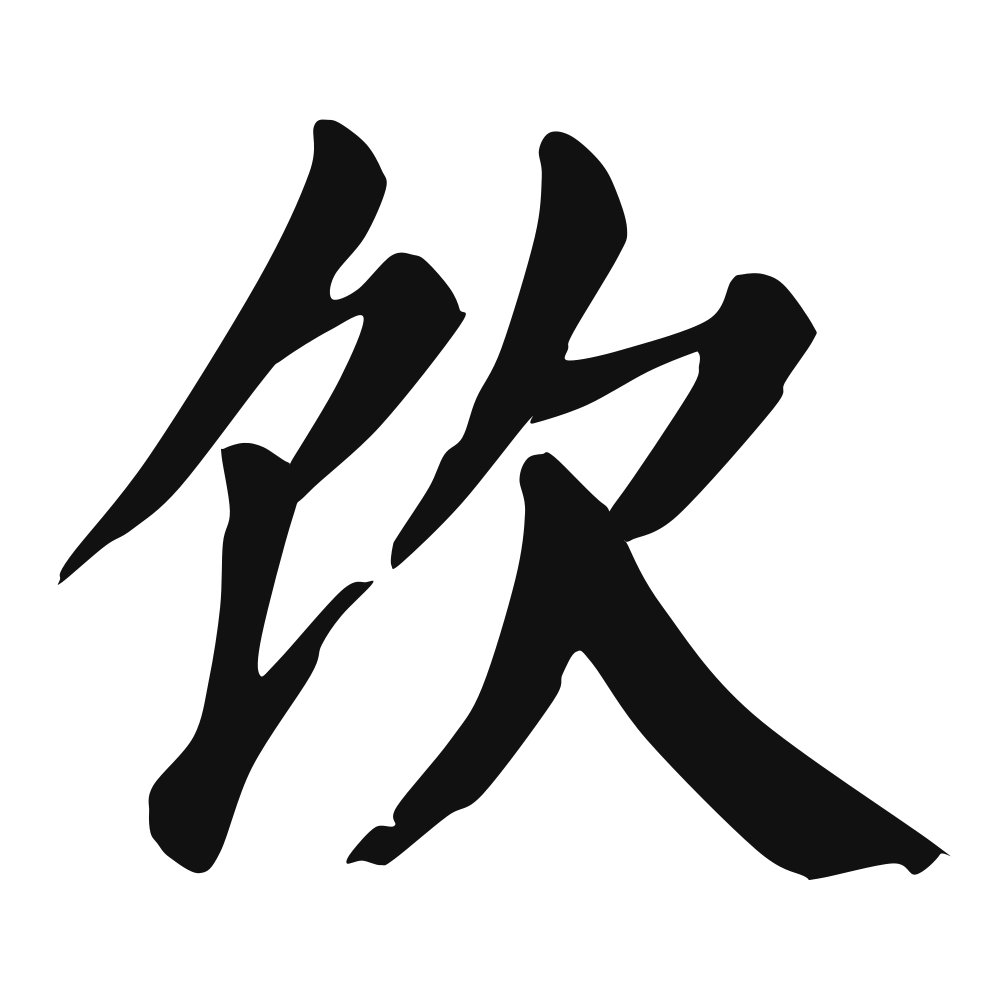
饮
to drink; to give (animals) water to drink
Closest English meanings
drink·beverage
The Calligrapher — Yán Zhēnqīng 颜真卿
Tang master of robust regular script; co-creator of the enduring 'Yan style'.
Tang calligrapher (709–784), master of regular script/running script — the Tang moral paragon whose upright, muscular regular script became the model of Chinese integrity in writing. Tang dynasty
Etymology & Meaning · 字义溯源
### Soundyǐn — yǐn (3rd tone; yìn = to water an animal). Free-standing morpheme ### Original meaningYǐn (3rd tone; also yìn, 'to water livestock'). The Shuowen gives 「飮, 飮也」 — a circular definition resolved by the bronze script, which shows a person bending to a 酉 (wine jar) with tongue out: the picture of drinking. 《易·需》 「君子以饮食宴乐」 pairs it with food and ease; 《孟子·告子上》 「冬日则饮汤,夏日则饮水」 uses it plainly for drinking. From the lip it also means 'to hold in the heart' — 饮恨 (to swallow one's grief), 饮誉 (to enjoy a name). Kangxi naming tables assign 土 (Earth); other schools print 金 (Metal) or 水 (Water) (verify). Be honest: 饮 means 'to drink', and at its root it is the cup and the lip — not 'wine' (酒) as a substance and not 'joy' (乐); 饮恨 shows its somber edge. ### The structure (会意 · 从人从酉从舌 — the person, the wine-jar (酉), the tongue; the act of drinking)①人rénpersonwho bends to drink②酉yǒuwine jarthe vessel, the source③舌shétonguewhat reaches the jar④饮yǐnto drinkthe act; also 饮恨, to swallow a feeling ### In use todayItemReading / meaningNoteReadingyǐn (3rd tone; yìn to water beasts)single syllableCore senseto drink; to hold a feeling in — 饮恨the lip and the cupGrammarfree morpheme — 饮水, 饮酒, 饮誉饮誉 = enjoy a nameTattoo fitcaution — 'to drink' is plain; 饮恨 is somberWuxing disputed (土/金/水) ### Closest words in English — and what each misses - Wine — 酒 holds 'wine'; 饮 is 'to drink' it, not the drink itself - Joy / feast — 乐/宴 hold merriment; 饮 is the act, and 饮恨 is grief - Thirst — 渴 holds 'thirst'; 饮 is the drinking, not the want - Eat — 食 holds 'to eat'; 饮 is specifically to drinkAn honest note on grammar. Free morpheme — 饮水 drink water, 饮酒 drink wine, 饮恨 swallow griefWhere a Western reader can stand: 饮 (yǐn) means 'to drink'. Its old picture is a person bending to a jar with tongue out. Plainly it is the cup and the lip (冬日饮汤,夏日饮水). But it also means to swallow a feeling — 饮恨, to drink grief whole. As a tattoo it reads as the daily, bodily act, or as quiet endurance. Note the element is disputed (土 / 金 / 水).
Cultural Story
饮 (yǐn) shows a person bending to a vessel, built from 食 and 欠, “to gasp or yawn.” 《説文解字》 glosses it 歠也, “to sip or swallow,” capturing the act of drinking liquids down the throat since earliest writing.
Where a Western reader can stand: 饮 (yǐn) means 'to drink' — its old picture is a person bending to a jar. Plainly it is the cup and the lip; but it also means to swallow a feeling — 飲恨, to drink grief whole. Yan Zhenqing's weighty hand gives it gravity. Read it without cliché: the daily act, or quiet endurance — and its element is disputed (土/金/水).
Common words & phrases
- 飲料 beverage · drink
- 飲食 diet · food and drink
- 飲水 drink water
- 暢飲 drink freely
- 飲酒 drink alcohol
Read the story behind the character
饮 is all about drinks. We buy 饮料 (beverages), balance 饮食 (diet), 饮水 (drink water) for health, 畅饮 (drink freely) at parties, and 饮酒 (drink alcohol) at festivals. The character keeps its simple, thirsty shape.
Why this character belongs on skin
Cup to the lips, and the whole evening changes. Yǐn is the long pull of water after thirst, wine after loss, the river lifted to the mouth of a man who has walked too far. In the old poems a warrior drinks the wind before battle; a monk drinks silence at the cold spring. To drink is to take the world inside you, to let it run down your throat and become part of the blood. There is a Buddhist lesson in the cup: you cannot hold it forever, you can only receive, swallow, and let it pass. Love is a kind of drinking too — the risk of letting someone pour into you. To carry this character is to admit you are thirsty, and unashamed, and willing to be filled. Let it lie at the hollow of your throat, where every drink begins, a mark that says you came to taste.
Own this character
Purchase delivers the original SVG of this glyph, brushed by Yán Zhēnqīng 颜真卿, ready to place on skin, paper, or screen.