
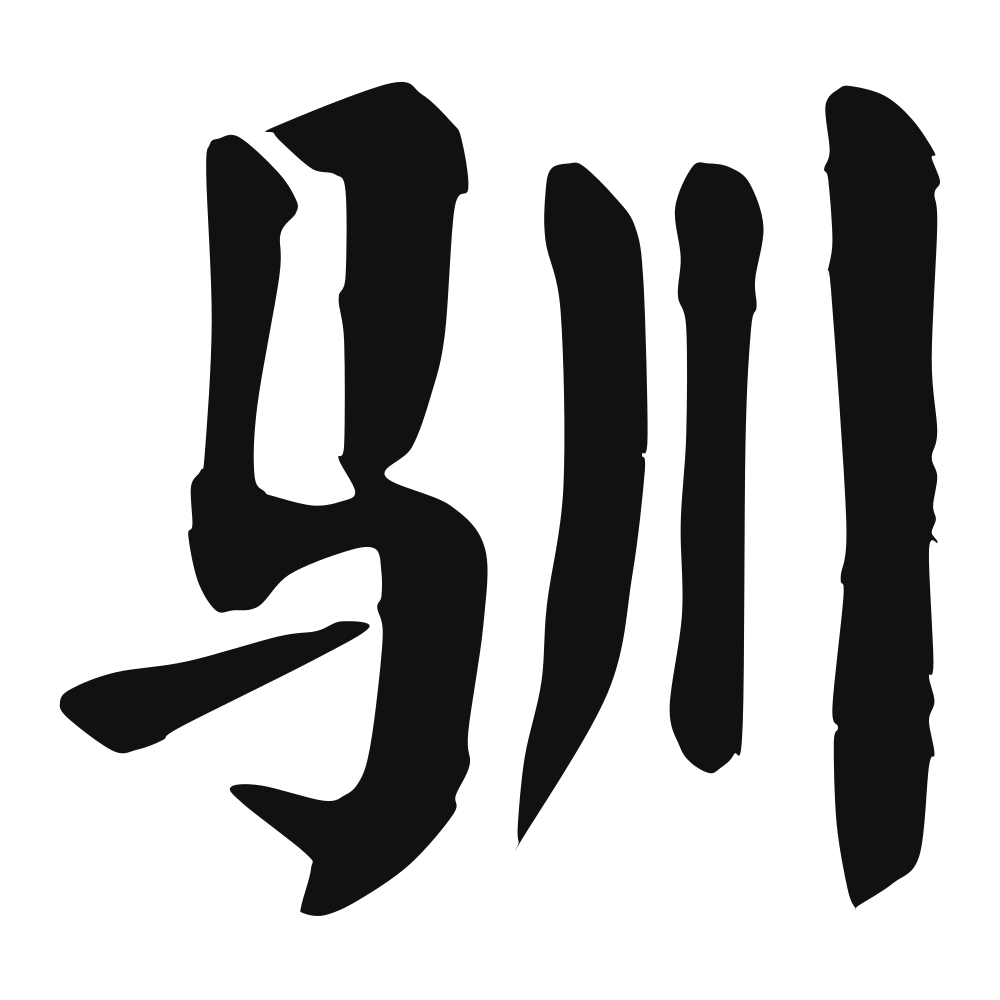
驯
to attain gradually; to tame; Taiwan pr. [xun2]
Closest English meanings
tame·docile·trained
The Calligrapher — Yán Zhēnqīng 颜真卿
Tang master of robust regular script; co-creator of the enduring 'Yan style'.
Tang calligrapher (709–784), master of regular script/running script — the Tang moral paragon whose upright, muscular regular script became the model of Chinese integrity in writing. Tang dynasty
Etymology & Meaning · 字义溯源
### Soundxùn — xùn (4th tone). Free-standing morpheme ### Original meaningXùn (4th tone). The Shuowen defines 馴 as 「馬順也」 — 'the horse is obedient', built from 馬 (horse) and 川 (sound, also 'to flow'). Its sense widened from the broken horse to any creature brought to hand: 《易·坤》 「驯至其道,至坚冰也」 means 'by gradual steps one comes to the hard ice' — 驯 is the slow, natural approach. 《史记·五帝纪》 「其文不雅驯」 uses it for 'refined, apt' (the records were not 'tame' enough for the gentlemen). It also stands in for 训, 'to instruct' (《史记·汉文本纪》 教驯其民). Kangxi naming tables assign 金 (Metal). Be honest: 驯 means 'tame / gentle / obedient' — a real virtue of softness, but also 'broken-in', the wildness gone; it is not 'wild' (野) and not quite 'free'. ### The structure (形声 · 从馬,川声 — 馬 (horse) + 川 (sound, 'to flow'); the horse that flows to the hand)①馬mǎhorsethe creature broken to hand②川chuānstream / soundwhat flows, the obedience③驯xùntame / gentlethe horse that submits④训xùnto instructthe old substitute; 驯 once meant 'to teach' ### In use todayItemReading / meaningNoteReadingxùn (4th tone)single syllableCore sensetame, gentle, obedient — also 'gradual'驯至 = by degreesGrammarfree morpheme — 驯良, 驯服; old form of 训驯服 = tamedTattoo fityes-standalone — soft, positive, but know 'tamed'not 'wild' ### Closest words in English — and what each misses - Wild — 野 holds 'wild'; 驯 is its opposite, the broken-in - Free — 自由/逸 hold 'free'; 驯 implies brought to hand - Teach — 训 holds 'to teach'; 驯 only old-substitutes for it - Strong — 强 holds 'strong'; 驯 is softness, not forceAn honest note on grammar. Free morpheme — 驯良 gentle, 驯服 tamed; old form of 训 'to teach'Where a Western reader can stand: 驯 (xùn) means 'tame' — the horse that comes to the hand (馬順也). Its large sense is gentle, obedient, brought to order, reached 'by gradual steps' (驯至其道). As a tattoo it reads as softness and self-mastery. Be clear it is the tamed, not the wild, virtue.
Cultural Story
驯 (xùn) joins 馬 with the phonetic 川. 《説文解字》 reads 馬頟也, “a horse that obeys,” a beast broken to the bridle. The word widened to any creature made gentle and teachable by training.
Where a Western reader can stand: 驯 (xùn) means 'tame' — the horse that comes to the hand. Its large sense is gentle, obedient, reached 'by gradual steps' (winter arrives by degree). Yan Zhenqing's calm, monumental hand makes it self-mastery. Read it without cliché: the tamed, not the wild, virtue — softness, not freedom.
Common words & phrases
- 馴服 tame · subdue
- 馴養 domesticate · breed
- 溫馴 gentle · tame
- 馴良 tame and good
Read the story behind the character
驯 means tame and gentle. People 驯服 (tame, subdue) wild animals, 驯养 (domesticate, breed) them for farms, a pet stays 温驯 (gentle), and a 驯良 (tame and good) dog earns trust. The character speaks of patient training.
Why this character belongs on skin
To tame is to teach the wild thing to stay — 驯 shows a horse and a thread of order, the moment the creature chooses the hand over the horizon. We fear taming as if it were only cage. But there is a gentleness in it too: the horse that learns your voice, the self that learns its own. To wear 驯 is to admit you have been made softer by love, broken of some wildness that was never serving you. It is not surrender. It is the peace that follows being known. Put it where your pulse is loudest, a quiet record of the parts of you that finally settled. The mark doesn't celebrate the cage. It celebrates the choice — that you stayed, that something wild in you decided the hand was worth the horizon it gave up.
Own this character
Purchase delivers the original SVG of this glyph, brushed by Yán Zhēnqīng 颜真卿, ready to place on skin, paper, or screen.