
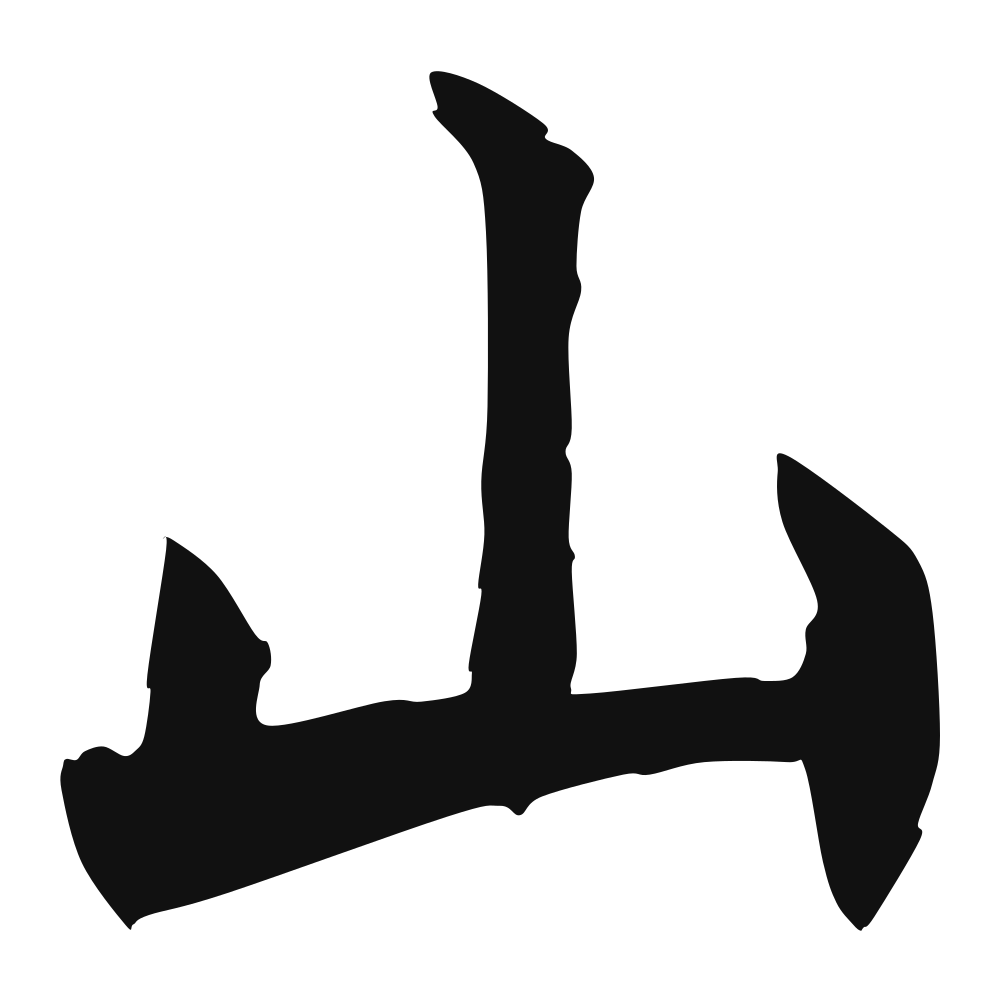
山
山 (shān) — mountain. Pictograph of three peaks; one of the most ancient characters. Classical life: 仁者乐山 — the benevolent love mountains (Confucius). Grammar: free morpheme — also: surname Shan; mountain; hill (CL:座[zuo4]); (coll.) small bundle of straw for silkworms to spin cocoons on
Closest English meanings
mountain·hill·peak·mount·summit
The Calligrapher — Yáng Shìqí 杨士奇
Ming statesman renowned for his regular script and the Taige (court) style.
Ming calligrapher (), master of regular script — known for 台阁体. Ming dynasty
Etymology & Meaning · 字义溯源
2 · The Character: 山 Shān (1st tone). The Shuowen Jiezi defines 山 as 「宣也。宣气散,生万物,有石而高。象形」 — that which spreads the breath of life and births the myriad things, rocky and high; the graph is a picture of peaks. The Songs fix it: 《诗经·小雅·斯干》 「幽幽南山」 — 'the deep, dark Southern Mountain.' In the Changes, Gen is the mountain trigram: 《易·说卦》 「艮为山」, stillness and boundary. Qu Yuan's Shejiang cries 「山峻高以蔽日兮」 — 'the mountains rise high and block the sun.' 山 means mountain, steadiness, and the rooted. It is a free morpheme and stands cleanly alone — a single 山 on the skin reads as 'mountain / foundation', a common, positive tattoo. Disclosures: 山 is a very common surname (think 孙中山), so a literate reader may first read it as a name; and 山 alone can be shorthand for 山水 (landscape). Element tables assign Earth (土).
Cultural Story
山 is a pictograph of three peaks, meaning mountain; the Shuowen gives a mountain. The Shijing sings of 山川 (mountains and rivers), and hermits climbed a 高山 (high mountain) to escape the court. A 火山 (volcano) awed the ancients, and the 山顶 (summit) was where one met the immortals above the clouds.
Where a Western reader can stand: Where a Western reader can stand: 'mountain' — as the pillar of state; Yang Shiqi, chief grand secretary of three reigns, makes it 国之柱石. Honest caveat: 山 is a common surname — disclose.
Energy Reading
Earth (土)
Comparative symbology, not fortune-telling.
Common words & phrases
- 山水 landscape · scenery · mountains and rivers · nature · view
- 高山 high mountain · alp · lofty peak · mountain · summit
- 山顶 mountain top · summit · peak · crest · mountaintop
- 火山 volcano · volcanic mountain · fire mountain
- 山川 mountains and rivers · landscape · terrain · scenery
Read the story behind the character
You post photos of 山水 (landscape, mountains and rivers) on holiday and hike a 高山 (high mountain) for the view. The 山顶 (mountain top, summit) rewards a hard climb, and a 火山 (volcano) makes the news when it erupts. 山川 (mountains and rivers) still names the country's beauty — the character is bedrock of Chinese scenery.
Why this character belongs on skin
The mountain does not announce itself. It is simply there — unmoved by the dynasty that falls at its feet, the lover who weeps against its slope, the century that erases the names of all who climbed it. 山 is stillness as a form of permanence, the quiet authority of the thing that has decided to stay. The Daoist hermit withdrew to its silence to find what the city could not offer; the poet looked up and felt his smallness become a kind of freedom. We mistake stillness for inactivity, the pause for the end. This character knows better — that to be unmovable is its own profound action. Wear it, and you root yourself to something older than your anxiety, a mark that says: let the weather pass. I am the mountain, and I am not going anywhere.
Own this character
Purchase delivers the original SVG of this glyph, brushed by Yáng Shìqí 杨士奇, ready to place on skin, paper, or screen.