
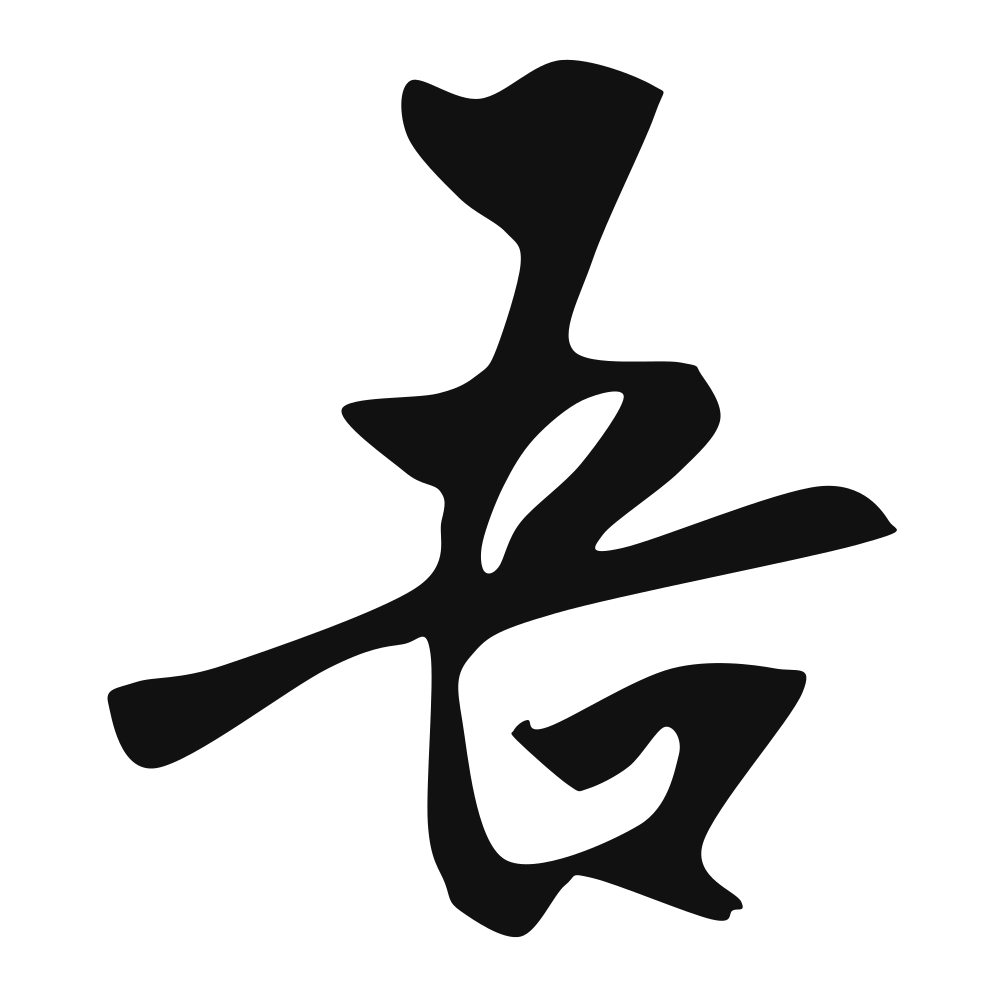
吾
surname Wu; (old) I; my
Closest English meanings
I·my·we (classical)
The Calligrapher — Yáng Wéizhēn 杨维桢
Yuan master of running and cursive script famed for his wild style.
Yuan calligrapher (), master of running script/cursive script — known for 铁崖体. Yuan dynasty
Cultural Story
吾 is a classical first-person pronoun—"I," "my," "we"—used by Confucius and 莊子 with easy grace; 論語 has the master say 吾日三省吾身, "I examine myself thrice daily." It yields 吾辈 (we/us) and 吾国 (our country) in later prose, while 支吾 means to hem and haw, evading with the mouth. The character is the scholar's "I," intimate yet dignified across two millennia of Chinese letters and speech.
Common words & phrases
- 吾辈 we · us
- 吾人 we · our
- 吾国 our country
- 支吾 to hem and haw · to evade
Read the story behind the character
Patriotic essays still invoke 吾国 (our country) with pride, and a writer addresses 吾辈 (we/us) as a generation with a mission. A nervous witness 支吾 (hems and haws/evades) when questioned, unable to give a straight answer. Though 吾 sounds bookish today, it surfaces in speeches, slogans, and period dramas—the elegant "we" and "I" of a China that remembers its own voice across the centuries of change.
Own this character
Purchase delivers the original SVG of this glyph, brushed by Yáng Wéizhēn 杨维桢, ready to place on skin, paper, or screen.