
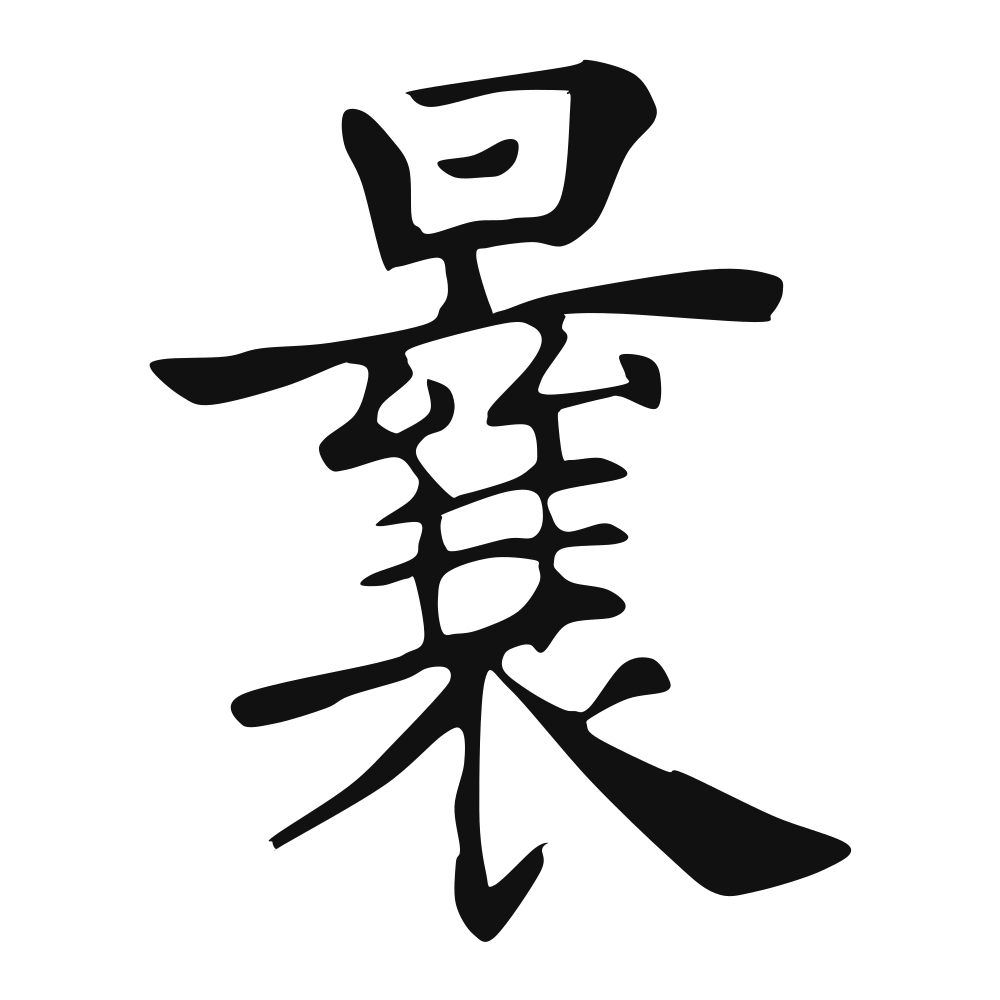
The Calligrapher — Chǔ Suíliáng 褚遂良
Tang chancellor and regular-script master of elegant, balanced strokes.
Tang calligrapher (596–658), master of regular script — Tang master of graceful, tensile regular script favored by the imperial court. Tang dynasty
Etymology & Meaning · 字义溯源
### Soundnǎng — nǎng (3rd tone). Often a bound morpheme — needs a partner word ### Original meaningNǎng (3rd tone). The Shuowen Jiezi is brief and exact: 「曩,曏也。从日,襄聲」 — 'formerly', from 日 with 襄 as phonetic, and 段玉裁's note simply supplies the line from 《爾雅·釋言》 it answers to. The Kangxi entry gives the working definition and the citations: 《爾雅·釋言》 「曩,曏也」, with the gloss 「在今而道既往,或曰曩,或曰曏」 — 'speaking now of what has gone by, one says 曩 or one says 曏'. So 曩 is precisely the word for the past as the past is spoken of from here: 《左傳·襄二十四年》 「曩者志入而已」 ('a while ago it was only a matter of getting in'), 《國語·晉語》 「曩而言戲乎」 ('was that said in jest just now?'), 《楚辭·九章》 「猶有曩之態也」 ('still the manner of former days'). 《爾雅·釋詁》 gives a longer reach: 「曩,久也」 — 'long ago'. The word's most humane appearance is in 柳宗元 《捕蛇者說》: 「曩與吾祖居者,今其室十無一焉」 — of the families that lived here with my grandfather, not one in ten remains. Kangxi 21 画 (日部 + 17) — one of the heaviest common graphs in the language; the naming tables read Fire (火). ### The structure (形聲 · 从日,襄聲 — day (日) with 襄 as phonetic; a time-word written in the day-series, like 曏 and 暇)①日rìsun / daytime measured by daylight, as in 曏 and 暇②襄xiāngto raise / to assistthe phonetic; it contributes sound, not sense③曏xiǎnga short while agothe near twin: 《尔雅》 says one may use either word for the past④曩者nǎngzhěformerly, a while backthe form the histories actually use ### In use todayItemReading / meaningNoteReadingnǎng (3rd tone)single syllableCore senseformerly, of old《尔雅·释诂》 pushes it further: 久也, 'long ago'Grammarliterary time-adverb曩者 · 曩日 · 曩昔 · 曩時 · 曩年Tattoo fitcaution — an adverb, not an image; and 21 strokes will clog at small sizesconsider 昔 (8 画) or 往 for the same idea ### Closest words in English — and what each misses - Past — 過去 holds 'the past' as a noun; 曩 is an adverb meaning 'formerly', and modifies rather than names - Memory — 憶/念 hold 'to remember'; 曩 points at a time, not at an act of mind - Ancient — 古/昔 hold 'ancient, of old'; 曩 can mean only as far back as the speaker's own yesterday - Nostalgia — nostalgia is a feeling; 曩 is a plain temporal marker with no sentiment built inAn honest note on grammar. Literary time-adverb — 曩者, 曩日, 曩昔, 曩時; it modifies rather than names, and does not occur in modern speechWhere a Western reader can stand: 曩 (nǎng) means 'formerly' — the past as you speak of it from where you now are. The oldest gloss puts it exactly: 在今而道既往, 'speaking now of what has gone by'. Its most moving appearance is in Liu Zongyuan's essay on the snake-catchers: of the households that lived beside my grandfathe
Cultural Story
曩 is the long-ago. 曩日 the days gone; 曩者 'formerly,' the historian's hinge. 曩昔 the past the exile names. The word is memory with distance — the then set well back, the years the chronicler reaches for. The Shuowen sees the sun and the old. A single character for the far behind, the 'of old' that opens the tale.
Where a Western reader can stand: 曩 means 'formerly' or 'of old' - the classical Chinese adverb for the past. It is a time-word, not a picture or a virtue, so it has nothing to depict and reads oddly alone. At 21 strokes it needs size to stay legible. As a tattoo it is a memorial tense - 'formerly' - worn with what is being remembered, never as 'memory' itself.
Common words & phrases
- 曩日 former days
- 曩者 formerly · before
- 曩昔 in the past
Read the story behind the character
曩日 is the literary 'former days'; 曩者 the formal 'before.' 曩昔 the rare 'in the past.' You will not say it in talk. The word survives in the memorial and the classical line — the old times invoked. From the elegy to the footnote, 曩 is the far then, the 'of old' the scholar reaches for when the present is not enough to explain the now.
Own this character
Purchase delivers the original SVG of this glyph, brushed by Chǔ Suíliáng 褚遂良, ready to place on skin, paper, or screen.