
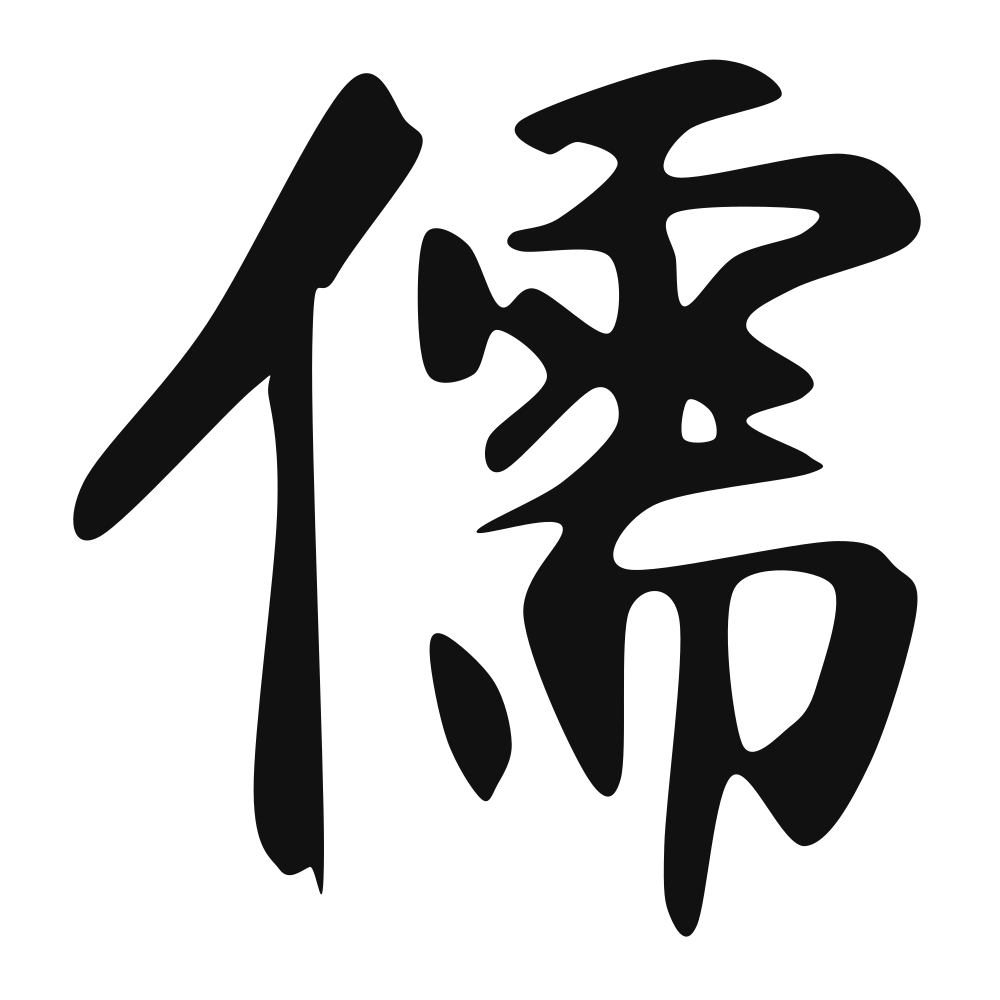
儒
scholar; Confucian
Closest English meanings
Confucian·scholar
The Calligrapher — Yú Jí 虞集
Yuan official calligrapher of refined regular script.
Yuan calligrapher (), master of regular script — known for 《垂纶亭记》. Yuan dynasty
Etymology & Meaning · 字义溯源
2 · The Character: 儒 儒 (rú, 2nd tone) means 'Confucian scholar, literatus' — a person-radical word for the learned, ritual class. It names the man (a Confucian), while 儒家 names the school. 腐儒 ('pedantic scholar') is its shadow, so it can read as 'studious' rather than 'heroic'.
Cultural Story
When Qin Shi Huang burned the books and buried the 儒 alive in 212 BCE, he struck at the scholars who kept the old learning by memory and brush. The 儒家, the school of Confucius, survived the pit and the flame to shape two thousand years of state and home. The word 儒 named the man who read, taught, and remembered.
Where a Western reader can stand: Yu Ji (1272–1348) was the foremost literary figure of the Yuan court, first among the Four Great Masters of Yuan poetry, and a regular-script writer in the Tang orthodox line (Ouyang Xun, Yu Shinan). 儒 in his lucid, restrained hand is civilised learning — the scholar, not the school (儒家). Honest caveat: it is a noble but bookish word; 腐儒 ('pedantic scholar') is its shadow, so it can read 'studious' rather than 'heroic'. Pair it (儒雅) for elegance, or use it as a quiet self-label of the learned life.
Common words & phrases
- 儒家 Confucian · Confucian school
- 儒教 Confucianism · Confucian religion
- 儒学 Confucianism · Confucian learning
- 儒生 Confucian scholar · scholar
- 儒雅 refined · scholarly · cultured
Read the story behind the character
A 儒家 reading group meets on Sundays; the 儒教 is taught as history, not creed. The student is a 儒生 of the exam grind, and the host is 儒雅 at the dinner. The word still means the learned and the civil — a scholar, a gentle manner — the stamp of the bookish man, now as often a style as a school of thought.
Why this character belongs on skin
Two millennia before the West coined 'public intellectual,' China had 儒: the scholar in soft robes whose weapon was the taught word, whose loyalty was to propriety, learning, and the stubborn belief that a state can be moral. Confucius himself was one—unemployed for much of his life, unappreciated by princes, convinced that ritual, music, and honest study could civilize even the worst century. The radical is a person; beside it, the character for need—because a scholar, the etymology teases, is someone needed. That is the tender joke and the true one: societies rise on their teachers and rot without them. To wear 儒 is to choose the long, unglamorous war—the essay over the epithet, the examined life over the loud one. It suits a back or a forearm, somewhere the reader must lean in close, the way one leans toward a voice worth hearing.
Own this character
Purchase delivers the original SVG of this glyph, brushed by Yú Jí 虞集, ready to place on skin, paper, or screen.