
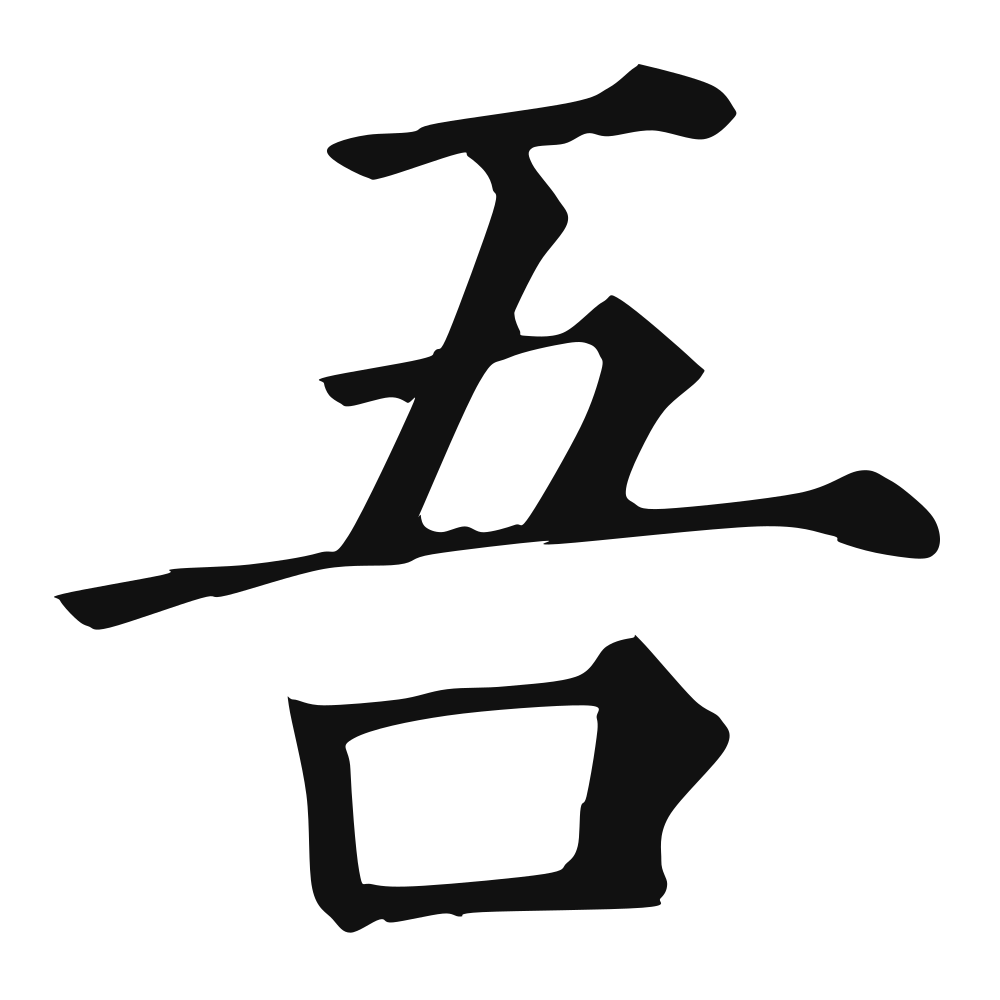
吾
surname Wu; (old) I; my
Closest English meanings
I·my·we (classical)
The Calligrapher — Yǔ Jiānwú 庾肩吾
Liang scholar-critic who authored Shupin, the first systematic graded ranking of calligraphers.
南朝梁 calligrapher (), master of regular script — known for 《书品》. Liang dynasty (Southern Dynasties)
Etymology & Meaning · 字义溯源
2 · The Character: 吾 Wú (2nd tone). The Shuowen Jiezi is terse: 「吾,我自称也。从口五声」 — 'the way one names oneself', a mouth (口) with 五 for sound. 《尔雅·释诛》 agrees: 「吾,我也」. It is the pronoun of the classical self, and the sentences it carries are the ones China memorised: 《论语·学而》 「吾日三省吾身」 — 'daily I examine myself on three counts'; 《论语·里仁》 「吾道一以贯之」; 《楚辞·离骚》 「吾令羲和弥节兵」, where Qu Yuan commands the sun-charioteer. Zhu Xi's note to 《楚辞·九章》 even distinguishes register: 「余平而吾倮」 — 余 is level, 吾 stands taller. Honest disclosure: 吾 is literary and archaic. Modern Chinese says 我; a solo 吾 reads as 'I' in classical costume, which without a predicate says very little. It is safe but semantically thin alone — pair it (吾心, 吾道, 三省吾身) so the sentence finishes.
Cultural Story
吾 is a classical first-person pronoun—"I," "my," "we"—used by Confucius and 莊子 with easy grace; 論語 has the master say 吾日三省吾身, "I examine myself thrice daily." It yields 吾辈 (we/us) and 吾国 (our country) in later prose, while 支吾 means to hem and haw, evading with the mouth. The character is the scholar's "I," intimate yet dignified across two millennia of Chinese letters and speech.
Where a Western reader can stand: Yu Jianwu was a Liang-dynasty calligrapher and theorist, a man who wrote about writing. Set 吾 — the classical 'I / we' — in his cursive and it reads as the self spoken in an old, literary voice, like 'I' rendered as 'thy' would be in English. Western wearers get a dignified first-person mark; pair it with 我 if they want the plain modern 'I.'
Common words & phrases
- 吾辈 we · us
- 吾人 we · our
- 吾国 our country
- 支吾 to hem and haw · to evade
Read the story behind the character
Patriotic essays still invoke 吾国 (our country) with pride, and a writer addresses 吾辈 (we/us) as a generation with a mission. A nervous witness 支吾 (hems and haws/evades) when questioned, unable to give a straight answer. Though 吾 sounds bookish today, it surfaces in speeches, slogans, and period dramas—the elegant "we" and "I" of a China that remembers its own voice across the centuries of change.
Own this character
Purchase delivers the original SVG of this glyph, brushed by Yǔ Jiānwú 庾肩吾, ready to place on skin, paper, or screen.