
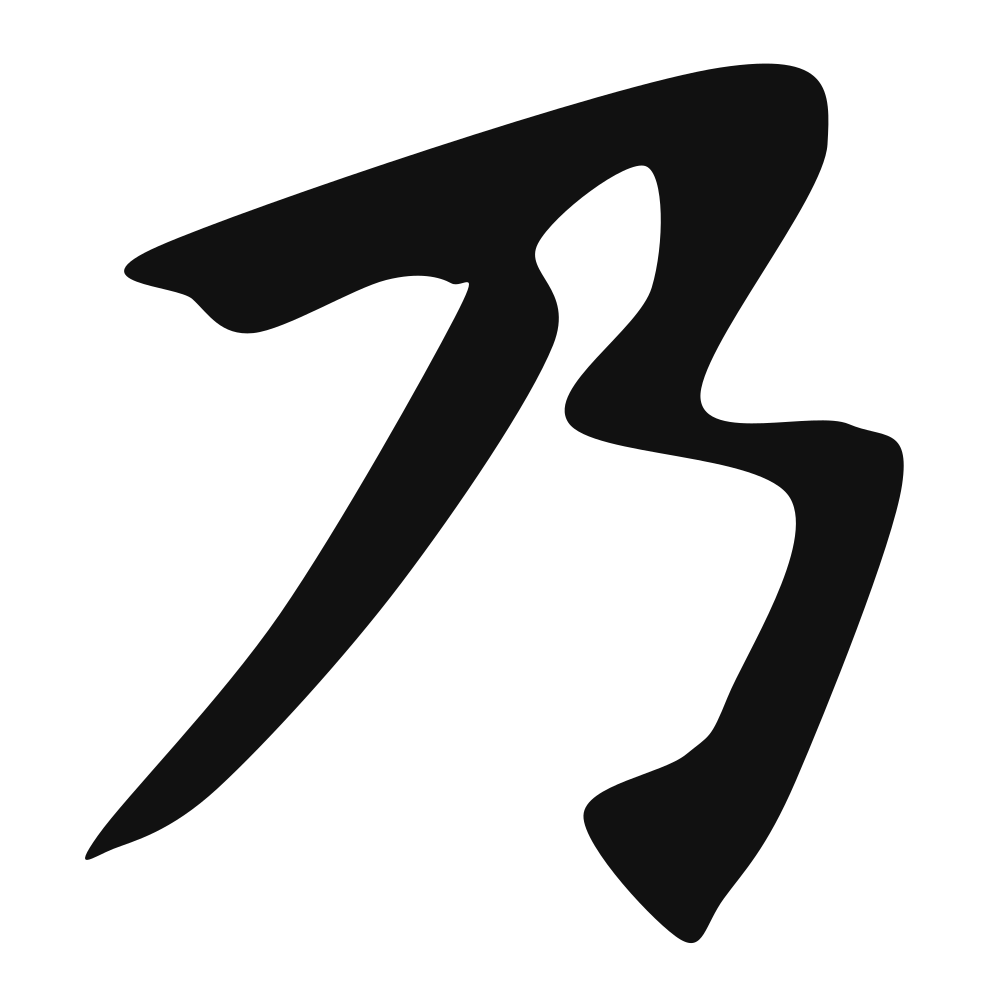
乃
to be; thus; so; therefore; then; only; thereupon
Closest English meanings
thus·to be·then·you (classical)
The Calligrapher — Yú Shìnán 虞世南
Tang court calligrapher revered for refined, restrained regular script.
Tang calligrapher (558–638), master of regular script — Tang master of quiet, inward regular script and teacher to the imperial academy. Tang dynasty
Etymology & Meaning · 字义溯源
2 · The Character: 乃 乃 (nǎi, 3rd tone) is, in Xu Shen, breath made grammar: 曳詞之難也。象氣之出難 — 'a drawn-out particle of difficulty; shaped like breath coming out with effort.' It is the copula and adverb 'then, is, you (archaic).' The classics use it for consequence and address: the Shujing (大禹谟) '乃圣乃神' (then sage, then spirit); the Liji (月令) and Shijing (大雅, written 廼) employ it as the linking 'then/thereupon'; Lu You's line '家祭無忘告乃翁' (at the family rite, forget not to tell your father) fixes 乃 as 'your.' As a free morpheme 乃 means 'then, is, you,' functional and archaic — 乃尔, 乃心. Honest disclosure: 乃 is a particle, not a noun; alone on skin it is a single curved stroke and reads as a comma, a flourish, or a typo. It is elegant as a tiny mark of consequence ('and then…') but needs context. In Japanese it is nari. Do not sell it as a 'self' or 'you' word without the archaic framing.
Cultural Story
乃 is a curved stroke the 說文 reads as thus, thereupon, the word a historian used to turn a page: and so it happened. The 史記 loves it, 乃下令, and then he gave the order. 乃父 addressed a son's dead father with formal respect. It is the connective sigh of old prose, the hinge between event and consequence, rarely heard now except in tombs and edicts.
Where a Western reader can stand: Yu Shinan was one of the Four Great Masters of early Tang calligraphy, tutor to Emperor Taizong, who carried the Wang Xizhi orthodox regular script into the court — calm outside, with concealed strength (the Confucius Temple Stele). 乃 in that composed hand is a small, consequential particle — 'then / thereupon'. Honest caveat: 乃 is a grammatical particle, not a noun; alone on skin it is one curved stroke that reads like a comma or flourish. Elegant as a tiny 'and then' mark, but it needs context — do not sell it as 'self' or 'you' without the archaic framing.
Common words & phrases
- 乃是 is · turns out to be
- 乃至 and even · down to
- 乃尔 like this · to such an extent
- 乃父 your late father (classical)
Read the story behind the character
乃是 shows up in written explanations, 其本质乃是, its nature is in fact. 乃至 stretches a list to its extreme, 全村乃至全县. The lone 乃 is a literary fossil, the kind of word a news commentator reaches for to sound weighty. You will not hear it at a noodle stand. It survives in print as a slightly solemn thus, the punctuation of serious Chinese.
Own this character
Purchase delivers the original SVG of this glyph, brushed by Yú Shìnán 虞世南, ready to place on skin, paper, or screen.