
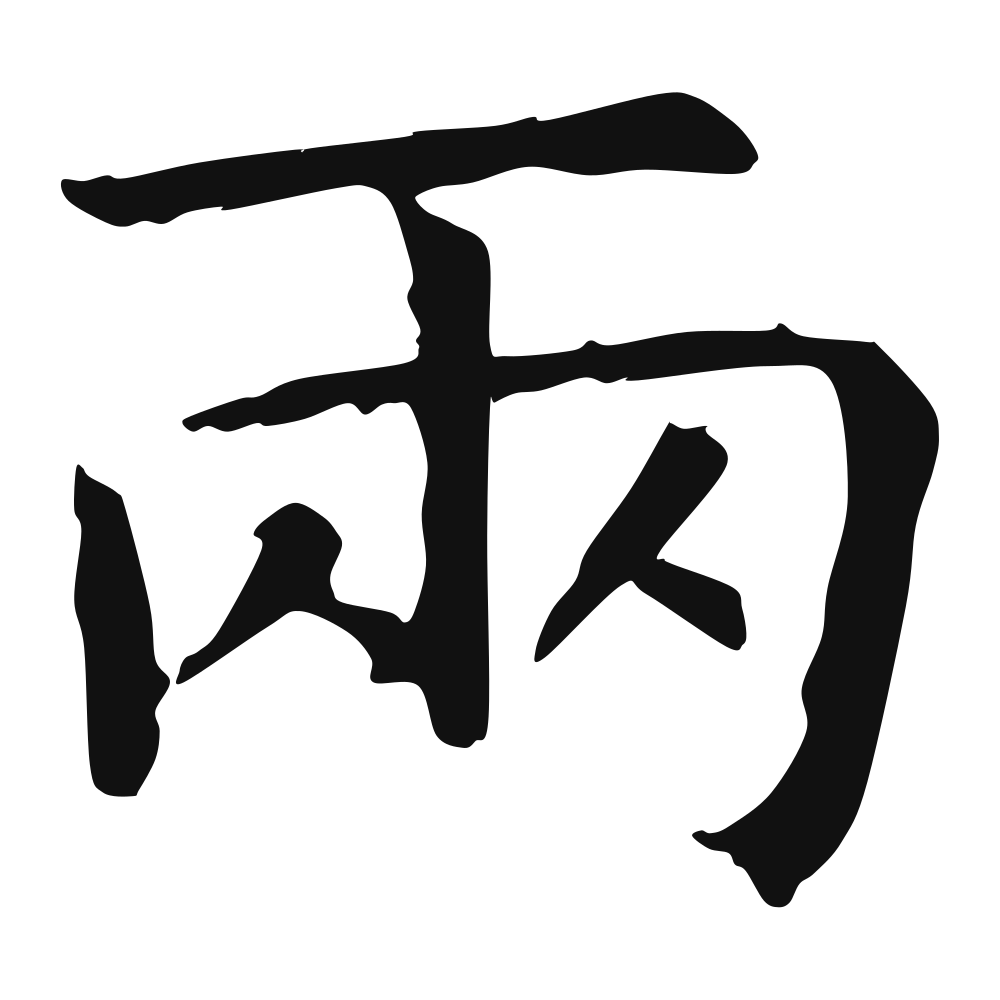
兩
two; both; some; a few; tael, unit of weight equal to 50 grams (modern) or 1⁄16 of a catty 斤[jin1] (old)
Closest English meanings
two·both·ounce
The Calligrapher — Yú Shìnán 虞世南
Tang court calligrapher revered for refined, restrained regular script.
Tang calligrapher (558–638), master of regular script — Tang master of quiet, inward regular script and teacher to the imperial academy. Tang dynasty
Etymology & Meaning · 字义溯源
### Soundliǎng — liǎng (3rd tone). Free-standing morpheme ### Original meaningLiǎng (3rd tone). The Shuowen Jiezi defines it as 「二十四銖爲一兩。从一;㒳,平分,亦聲」 — 'twenty-four zhu make one liang': built from 一 with 㒳, 'to divide evenly', which also supplies the sound. So the headword is not the number two at all but a weight, and Duan Yucai explains the arithmetic carefully: 「《禾部》曰:十二粟爲一分,十二分爲一銖……兩之爲兩,二十四銖爲兩」 — twelve grains make a scruple, twelve scruples a zhu, twenty-four zhu a liang, which is why the Qin-Han half-tael coin carried the legend 半兩. From there the word generalised into pairing, and that is where the classics use it: 《易·繫辭》「兼三才而兩之」 (take the three powers together and double them), 《周禮·天官·大宰》「以九兩繫邦國之民」 with its comment 「兩猶耦也,所以協耦萬民,聯繫不散」 (to bind the people together in pairs), and 《詩·召南》「百兩御之」 — a hundred carts, since a cart counts by wheels. The 《說卦》 line 「參天兩地而倚數」 (heaven takes three, earth takes two) is the reason 兩 sits at the bottom of Chinese cosmology: the Two Modes from which the rest unfolds. Its famous line is 《荀子·勸學》「目不能兩視而明,耳不能兩聽而聰」 — the eye cannot see two things clearly at once. ### The structure (會意兼形聲 · 从一,从㒳(㒳,平分也,亦聲) — the top stroke with the divided pair beneath; 'one' over what is shared out equally)①一yīonethe single standard above the division②㒳liǎngto divide evenlythe pair made equal; also the sound③兩liǎngone taelthe Shuowen headword — a weight before it was a number④耦ǒua paired yoke《周禮》's gloss: 兩猶耦也 — things bound two by two so they do not drift apart ### In use todayItemReading / meaningNoteReadingliǎng (3rd tone)single syllableCore sensetwo; a pair; the taelShuowen root is the weightGrammarnumeral / measure兩個人 · 兩扇門 · 兩全其美 · 半兩錢Tattoo fitcaution — a number, not a virtueuse 衡 or 平 if what you mean is balance ### Closest words in English — and what each misses - Balance — 衡/平 hold the level and the scales; 兩 is simply what is being weighed - Duality / Yin-yang — the philosophical pairing is 兩儀 or 陰陽; the plain numeral carries no cosmology on its own - Together — 共/合 hold joining; 兩 only notes that there are two - Double / Twice — 倍 holds multiplication; 兩 states a number and leaves the arithmetic to youAn honest note on grammar. Free morpheme but grammatical rather than poetic: the numeral 'two' used before measure words and with paired objects (兩個人, 兩扇門); also the tael, a unit of weight; also 'both' (兩全, 兩難).Where a Western reader can stand: 兩 (liǎng) means 'two', 'a pair', 'both' — and originally something more concrete, a weight: the Shuowen says twenty-four zhu make one liang, which is why the old coin was called 半兩, 'half
Cultural Story
The old weight 兩 balanced a string of coins; twenty-four grains of millet made one. The form showed a pair of measures. The Tribute of Yu tallied tribute by 兩. In the chronicles, 兩岸 named both banks of a river where two armies faced each other across the water, neither crossing.
Where a Western reader can stand: 兩 (liǎng) means 'two', 'a pair', 'both' — and originally a weight: the Shuowen says twenty-four zhu make one liang, which is why an old coin was called 半兩, 'half a tael'. The classical uses are about coupling: binding people in pairs so they do not scatter, taking the three powers and doubling them. The practical moral is from 《荀子》: the eye cannot hold two sights clearly at once. Honest note: if what you want is 'balance', the Chinese words are 衡 and 平, not 兩.
Common words & phrases
- 兩個 two
- 兩邊 both sides
- 兩岸 both banks · both sides
- 斤兩 weight
- 車兩 carriage
Read the story behind the character
A shopper buys 兩個 apples by weight; a sign reads 兩邊 exit, both sides open. The strait is called 兩岸, the two shores. A 車兩 — an old carriage — appears in the museum case, its two wheels lifted on a stand. The scale still clicks in 兩 for the elderly who trust the unit.
Own this character
Purchase delivers the original SVG of this glyph, brushed by Yú Shìnán 虞世南, ready to place on skin, paper, or screen.